











 Secure payments
Standard refund policy
Trade Assurance
Secure payments
Standard refund policy
Trade Assurance
| Product Type | Memory Module |
|---|---|
| Compliance Standards | RoHS |
| Memory Capacity | 16 GB |
| Memory Technology | DDR3 |
| Product Voltage | 1.35V |
| RAM Speed | 1333MHz |
| RAM Standard | DDR3-1333/PC3-10600 |
| Error Identifying | ECC |
| Signal Type | Registered |
| Column Access Strobe (CAS) | CL9 |
| Rank | Dual Rank x4 |
| Quantity of Pins | 240-pin |
| RAM Genre | RDIMM |
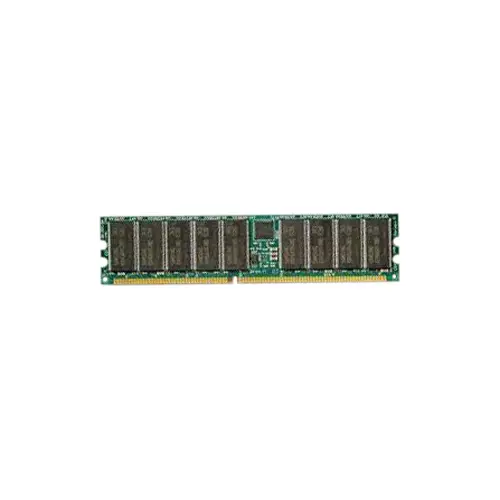
This 16GB DDR3-1333 registered ECC module, with dual-rank x4 organization and CL9 latency, is engineered for server platforms demanding uncompromising data integrity and stability in virtualized environments or memory-intensive databases. Its registered signal buffering and low 1.35V voltage ensure reliable operation under heavy loads, while the ECC protection guards against single-bit errors critical for transactional accuracy.
1. ECC protection corrects single-bit errors in real time, safeguarding transactional data integrity essential for financial and database servers.
2. Registered buffering stabilizes signal integrity across fully populated memory channels, enabling massive capacity scaling without compromising reliability.
3. Dual-rank organization interleaves memory accesses to keep server memory bandwidth saturated, delivering consistent low latency under heavy virtual machine workloads.
4. Generous memory capacity allows dense virtualization, hosting more containers or VMs per node to maximize consolidation ratios and reduce hardware footprint.
5. Low-voltage operation slashes datacenter power draw and cooling demand, significantly lowering total cost of ownership for large-scale deployments.
Based on its RDIMM form factor, 240-pin interface, ECC support, and registered signal type, the MT36KSF2G72PZ-1G4E1LE is unmistakably a server-grade memory module built for enterprise environments. Its four defining characteristics translate directly into uptime, density, and efficiency for your data center.
In a virtualized cluster hosting dozens of VMs, a single undetected bit flip can corrupt guest operating systems or hypervisor data structures, leading to cascading failures. The integrated ECC engine silently corrects single-bit errors and detects multi-bit faults, so your virtualization stack runs with uncompromising data integrity. Meanwhile, the Registered buffer stabilizes the command and address lines, enabling you to populate all 24 DIMM slots per server without signal degradation. This is what allows you to confidently scale to 384 GB or more per node, eliminating the memory bottleneck that starves growing VM fleets. For an in-memory database like Redis or SAP HANA, the dual-rank x4 organization interleaves accesses across internal banks, significantly boosting bandwidth and lowering latency for real-time analytics. Finally, the 1.35V low-voltage operation cuts overall power draw and cooling costs across a fleet of thousands of servers, directly improving your total cost of ownership without sacrificing the 1333 MHz speed. This module is not just a component; it is the assurance that your transactional workloads and business-critical applications stay fast, consistent, and error-free around the clock.
Server Memory Identified: The given module (16GB DDR3-1333 ECC Registered RDIMM, 1.35V) is designed for servers and workstations. Its ECC and registered features ensure reliability under sustained, mission-critical workloads. Below is the capacity planning guidance for three key server scenarios.
General Virtualization
For a mid-range virtualization host, memory is the primary constraint. Install modules in matched sets to populate all memory channels—typically four or eight 16GB RDIMMs for 64–128GB total capacity on a quad-channel platform. This provides ample headroom for 20–30 mixed VMs, and low-voltage 1.35V operation reduces power draw in dense environments. Leave one DIMM slot per channel free to enable future expansion without disrupting existing configuration.
In-Memory Database
In-memory databases such as Redis or SAP HANA demand maximum capacity and fault tolerance. Fully populate every DIMM slot across all memory channels with identical 16GB RDIMMs—a typical dual-socket server might leverage 24 modules to achieve 384GB of RAM. ECC protection guards against bit-flip errors in large data sets, and the dual-rank design of this module helps maintain bandwidth under heavy read/write loads. Always verify that the total capacity exceeds the database working set size by at least 20–30%.
High Performance Computing (HPC)
HPC clusters prioritize memory bandwidth alongside capacity. Install one 16GB RDIMM per channel to fully utilize all memory channels and avoid bandwidth bottlenecks; for a quad-channel Xeon node, this yields 64GB. This balanced configuration sustains high floating-point throughput while keeping dual-rank latency (CL9) acceptable. If the codes require more capacity, add a second identical module per channel, but avoid mixing ranks or speeds to maintain symmetric memory interleaving and predictable performance.
Rigorously tested server memory. Compatible with Dell PowerEdge R720, HP DL380p Gen8, and Lenovo RD630.
Q: Can I mix this MT36KSF2G72PZ-1G4E1LE with other memory modules of different brands or speeds?
A: Mixing brands or speeds on a registered ECC platform is strongly discouraged. Mismatched DIMMs can cause signal integrity issues, system instability, and may disable server RAS features. Identical modules ensure validated performance.
Q: Is this memory compatible with my system?
A: This 240-pin DDR3-1333 PC3-10600 RDIMM works with servers supporting 1.35V registered ECC memory. It typically suits Intel Xeon E5-2600 v1/v2 and AMD Opteron 6300 series platforms. Always check your system's Qualified Vendor List.
Q: What is the recommended DIMM population order for optimal performance?
A: Follow your server board's population guide strictly. For this dual-rank x4 RDIMM, populate identical memory channels first, starting with the farthest slot from the CPU per channel, to maintain balanced interleaving and full ECC protection.
Q: Does this module support overclocking or XMP profiles?
A: No. This is a JEDEC-compliant registered ECC server module operating at standard DDR3-1333 CL9. Overclocking and XMP are not supported on RDIMMs, as server platforms prioritize data integrity and stability over frequency tuning.
Q: What warranty and typical failure rate can I expect?
A: This module includes a one-year warranty. Enterprise-class RDIMMs like this Micron-built part demonstrate extremely low annualized failure rates, typically below 0.4% AFR under specified operating conditions.