











 Secure payments
Standard refund policy
Trade Assurance
Secure payments
Standard refund policy
Trade Assurance
| Product Type | Memory Module |
|---|---|
| Memory Capacity | 16 GB |
| Memory Technology | DDR3 |
| Product Voltage | 1.35V |
| RAM Speed | 1600MHz |
| RAM Standard | DDR3-1600/PC3-12800 |
| Error Identifying | ECC |
| Signal Type | Registered |
| Column Access Strobe (CAS) | CL11 |
| Rank | Dual Rank x4 |
| Quantity of Pins | 240-pin |
| RAM Genre | RDIMM |
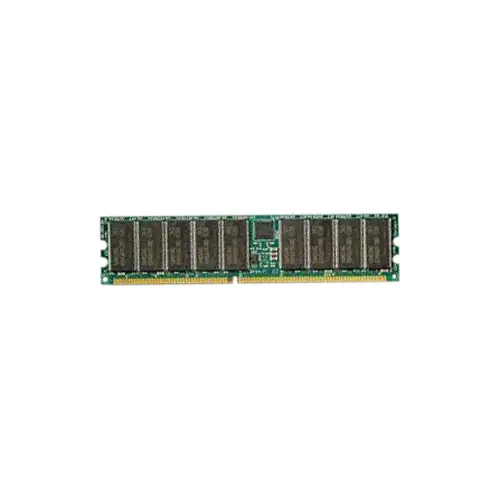
This 16GB DDR3-1600 RDIMM with ECC and registered signaling is engineered for server platforms, excelling in memory-intensive enterprise workloads such as virtualization and in-memory databases where data integrity is non-negotiable. The dual-rank x4 organization delivers balanced load and higher bank-level parallelism, while 1.35V low-voltage operation reduces power draw in dense rack deployments without compromising stability.
1. Substantial module capacity supports dense virtualization and large in-memory database footprints, allowing higher consolidation ratios without sacrificing guest performance.
2. Hardware ECC continuously detects and corrects memory errors, preserving data integrity in transactional and analytics workloads where silent corruption is unacceptable.
3. Registered signal buffering stabilizes the command and address buses under heavy load, enabling fully populated server boards to operate reliably over extended uptime.
4. Low-voltage operation minimizes both power draw and thermal output at the rack level, directly reducing energy costs and cooling overhead in scale-out data centers.
5. Dual Rank x4 interleaving keeps memory channels efficiently utilized, delivering steady bandwidth for concurrent virtual machines and latency-sensitive enterprise services.
The Micron MT36KSF2G72PZ-1G6N1HF is a 16GB DDR3-1600 Registered DIMM purpose-built for server environments, and its four defining characteristics directly address the pain points of IT infrastructure teams. When you are running a virtualization cluster hosting dozens of VMs, the ECC engine is your silent guardian against silent data corruption: it detects and corrects single-bit errors caused by background radiation, preventing a flipped bit from crashing a critical database transaction or silently altering financial records. The registered signal buffer on this RDIMM stabilizes the electrical load on the memory bus, allowing you to populate all channels with confidence, a necessity when scaling to hundreds of gigabytes for a memory-hungry in-memory database like Redis or SAP HANA. Its dual-rank x4 organization means each rank can serve data on alternating cycles, boosting bandwidth in parallel read operations so that your hypervisor experiences lower latency under heavy consolidation. Finally, the 1.35V low-voltage operation reduces power draw per DIMM, which directly cuts cooling costs and raises rack-level energy efficiency in a 24/7 data center. For a database administrator watching query latency during peak trading hours or a systems engineer balancing VM density against power budgets, this memory transforms raw specifications into real operational resilience: less downtime, predictable performance, and a lower total cost of ownership.
General Virtualization
For a modest virtualization host, install a minimum of four 16GB RDIMMs to populate one channel per CPU, delivering 64GB of balanced capacity. Deploy modules in matched sets across channels to maintain NUMA symmetry and avoid performance cliffs as VMs scale. This configuration comfortably supports 15–20 typical virtual machines with room for vMotion overhead.
In-Memory Database
Maximize bandwidth and minimize latency by fully populating all memory channels—typically six or eight modules per socket—using 16GB dual-rank x4 RDIMMs. A six-channel host with 12 DIMMs yields 192GB, ideal for Redis or Memcached datasets that must reside entirely in DRAM. Select low-voltage 1.35V parts to reduce thermal stress during sustained in-memory workloads.
High-Performance Computing
Balance capacity and memory bandwidth by installing one DIMM per channel, leveraging the registered ECC capability to guard against silent data corruption in long-running simulations. For dual-socket nodes, 12 or 16 modules (192–256GB) provide sufficient workspace for dense linear algebra and Monte Carlo jobs. Dual-rank DIMMs at 1600MT/s offer a sweet spot between rank interleaving gains and command rate constraints.
Rigorously tested server memory, compatible with Dell PowerEdge R720/R620, HP DL380p Gen8, and Lenovo ThinkServer RD640.
Q: Can I mix this MT36KSF2G72PZ-1G6N1HF with other memory modules of different brands or speeds?
A: Mixing ECC registered DIMMs of different brands or speeds is not recommended. It can cause signal integrity issues and system instability. Always install identical modules for validated server compatibility.
Q: Is this memory compatible with my Intel-based server platform?
A: This 16GB DDR3L-1600 RDIMM is compatible with Intel Xeon E5-2600 v1/v2 and selected E5-2400 v1/v2 platforms. Please verify your server's HCL or motherboard's qualified vendor list for support.
Q: What is the recommended DIMM population order for optimal performance?
A: Populate identical DIMMs per channel, starting farthest from the CPU. For dual-socket servers, balance memory across both processors. Refer to your system's installation guide for dual-rank x4 optimization.
Q: Does this module support overclocking or XMP profiles?
A: No. This is a server-grade ECC RDIMM operating strictly at JEDEC standard DDR3-1600 (PC3-12800) with CL11. Overclocking and XMP are not supported and would compromise data integrity.
Q: What warranty and typical failure rate can I expect?
A: This Micron module includes a one-year warranty. Enterprise-class DDR3 RDIMMs typically exhibit an annualized failure rate below 0.5% under specified operating conditions, ensuring long-term reliability.