











 Secure payments
Standard refund policy
Trade Assurance
Secure payments
Standard refund policy
Trade Assurance
| Product Type | Memory Module |
|---|---|
| Compliance Standards | RoHS |
| Memory Capacity | 16 GB |
| Memory Technology | DDR3 |
| Product Voltage | 1.5V |
| RAM Speed | 1600MHz |
| RAM Standard | DDR3-1600/PC3-12800 |
| Error Identifying | ECC |
| Signal Type | Registered |
| Column Access Strobe (CAS) | CL11 |
| Rank | Dual Rank x4 |
| Quantity of Pins | 240-pin |
| RAM Genre | RDIMM |
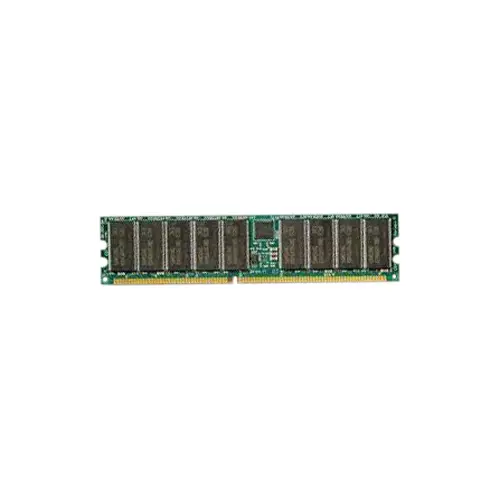
This 16GB DDR3-1600 RDIMM is purpose-built for legacy server platforms, delivering exceptional reliability for memory-intensive virtualization and database workloads. Its registered signal type and ECC error correction ensure stable operation in dual-rank x4 configurations, maintaining data integrity across high-density, multi-DIMM deployments.
1. 16GB capacity per module boosts server memory density, enabling higher virtual machine consolidation without sacrificing guest responsiveness.
2. 1600MHz operating speed supplies the sustained throughput required to saturate multi-core server CPUs, accelerating large in-memory database queries.
3. ECC error correction protects against data corruption by detecting and fixing single-bit faults, a non-negotiable safeguard for critical enterprise workloads.
4. Registered signal buffering stabilizes command and address integrity across fully populated memory channels, preventing signal degradation in dense rack configurations.
5. Dual Rank x4 organization maximizes bank-level parallelism, keeping data pipelines full and latency predictable under the heavy, random access patterns of virtualization hosts.
When you are managing a virtualization cluster or running an in-memory database, the true cost of memory is not the hardware itself, but the downtime caused by silent data corruption. The Micron MT36JSF2G72PZ-1G6D1FE is a 16GB DDR3-1600 Registered RDIMM engineered precisely to eliminate that risk. Its ECC technology actively detects and corrects single-bit errors caused by background radiation, preventing bit flips from silently corrupting your hypervisor state or a critical financial transaction in a Redis or SAP HANA instance. In a dense server populated with multiple DIMMs per channel, the Registered signal buffer stabilizes the command bus, allowing you to populate all 24 slots without compromising signal integrity—a direct answer to the pain of unexpected server reboots under heavy load. The dual-rank x4 configuration further excels here: it delivers higher sustained bandwidth and bank-level parallelism compared to x8 alternatives, so your virtual machines suffer no latency spikes even during simultaneous live migrations. What this means for you is that a 16GB ECC RDIMM operating at a standard 1.5V isn't just a specification—it’s a guarantee of consistent uptime, hardened data fidelity, and the headroom to safely consolidate dozens of mission-critical workloads onto a single platform.
This capacity planning guide applies to 16GB DDR3-1600 Registered ECC RDIMM server memory.
General Virtualization
Populate one DIMM per memory channel to balance cost and performance. In an eight-channel dual-socket server, eight 16GB modules provide 128GB at the full 1600MT/s speed, comfortably supporting dozens of moderate VMs. For dense consolidation, install 16 modules (two per channel, 256GB), though the memory bus may downclock to 1333MHz under the heavier electrical load.
In-Memory Database
Maximize dataset residency by filling all DIMM slots with identical 16GB RDIMMs. A 24-slot system fully loaded with 24 modules delivers 384GB of ECC-protected capacity, drastically reducing storage I/O. Distribute modules symmetrically across both CPU sockets to prevent NUMA bottlenecks, and enable sparing or mirroring only if uptime mandates it, aware that available capacity will decrease.
High-Performance Computing
Optimize for peak bandwidth: install a single DIMM per channel (1DPC) to sustain DDR3-1600 and deliver the highest throughput. Eight modules yield 128GB, adequate for many HPC workloads. If the working set demands more memory, move to 16 modules (2DPC) but expect the speed to fall to 1333MHz, trading bandwidth for additional capacity.
Rigorously tested server memory. Compatible with Dell R720, HP DL380p Gen8, Lenovo x3650 M4, and more.
Q: Can I mix this MT36JSF2G72PZ-1G6D1FE with other memory modules of different brands or speeds?
A: Mixing registered DIMMs is strongly discouraged. Different timings or ranks can degrade signal integrity and cause system instability. For reliable operation, always use identical part numbers within the same server.
Q: Is this memory compatible with my system?
A: This RDIMM fits servers supporting DDR3-1600 ECC Registered memory, such as platforms based on Intel Xeon E5-2600 v1/v2 or AMD Opteron 6300 series. Confirm your board’s Qualified Vendor List.
Q: What is the recommended DIMM population order for optimal performance?
A: Consult your server board’s manual. Generally, populate one identical DIMM per channel first (e.g., slots A1, B1, C1) to maximize bandwidth through balanced memory interleaving across all available channels.
Q: Does this module support overclocking or XMP profiles?
A: No. This is a JEDEC-standard server RDIMM built for stability, not overclocking. It operates exclusively at its rated DDR3-1600 CL11 and does not include any XMP profiles.
Q: What warranty and typical failure rate can I expect?
A: It carries a 1-year warranty. Manufactured to strict standards, this module’s annualized failure rate (AFR) is well below 1% in standard server environments, ensuring long-term dependable operation.