











 Secure payments
Standard refund policy
Trade Assurance
Secure payments
Standard refund policy
Trade Assurance
| Product Type | Memory Module |
|---|---|
| Compliance Standards | RoHS |
| Memory Capacity | 16 GB |
| Memory Technology | DDR3 |
| Product Voltage | 1.5V |
| RAM Speed | 1866MHz |
| RAM Standard | DDR3-1866/PC3-14900 |
| Error Identifying | ECC |
| Signal Type | Registered |
| Column Access Strobe (CAS) | CL13 |
| Rank | Dual Rank x4 |
| Quantity of Pins | 240-pin |
| RAM Genre | RDIMM |
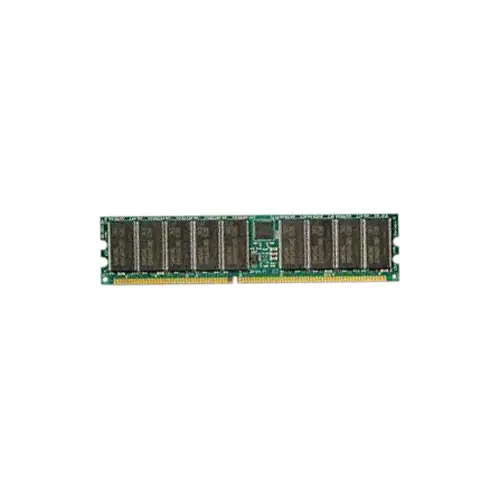
This 16 GB DDR3-1866 Registered ECC RDIMM, engineered with a dual-rank x4 organization and CL13 latency, delivers the data integrity and stable signal buffering required for memory-intensive server workloads such as virtualization and in-memory databases. Its registered architecture and ECC are ideally suited for high-capacity enterprise platforms where reliable multi-DIMM configurations and fault tolerance are critical.
1. ECC protection corrects single-bit errors on the fly, drastically reducing downtime risk in mission-critical data-center environments.
2. The registered signal type buffers command and address lines, enabling large memory populations and rock-solid stability across multi-slot server boards.
3. With a 16 GB capacity per module, a standard dual-socket server can achieve hundreds of gigs of RAM, supporting far denser virtualization and larger in-memory databases.
4. Operating at 1866 MHz, this RDIMM delivers the elevated throughput needed to feed multi-core server CPUs efficiently under sustained I/O and HPC workloads.
5. Dual rank x4 organization interleaves memory banks to drive deeper queue depth, directly translating to lower latency and higher bandwidth saturation for concurrent virtual machine access.
When you deploy a virtualization cluster or an in-memory database, the memory subsystem becomes the foundation of stability and performance. This Micron 16GB DDR3-1866 RDIMM (MT36JSF2G72PZ-1G9E1K) integrates four characteristics that directly address enterprise pain points. First, ECC error correction continuously eliminates single-bit flips caused by cosmic rays or electrical noise – in a hypervisor hosting dozens of VMs, one uncorrected error can silent-corrupt financial transactions or patient records. Second, the registered buffer re-drives command and address signals, letting you populate all channels with high-capacity modules without signal decay; that means reliable 128GB or 256GB configurations for dense consolidation. Third, the dual-rank x4 layout organizes memory banks for interleaved access, significantly boosting effective bandwidth and lowering latency for in-memory databases like SAP HANA where every microsecond determines query speed. Fourth, the native 1866MHz clock and CL13 timing deliver 14.9GB/s peak bandwidth per channel, ensuring virtual machines and caching engines never starve for data. For any 24/7 mission-critical server, this module turns raw specifications into tangible uptime and accelerated response.
General Virtualization
For a typical virtualization host running multiple VMs, memory capacity and reliability are critical. Using 16 GB Registered ECC DDR3-1866 modules, populate at least six to eight identical DIMMs (96–128 GB) across all memory channels to ensure balanced access and maximize throughput. Always install modules in matched sets to leverage channel interleaving, and leave room for future scale by selecting a platform with extra DIMM slots.
In-Memory Database
In-memory databases demand low latency and absolute data integrity, making ECC RDIMMs mandatory. Deploy a fully populated configuration—often 16 x 16 GB (256 GB) or more—to keep entire datasets resident in RAM and reduce storage I/O bottlenecks. Stick to a single rank or dual rank x4 organization per channel to maintain stable signal integrity at 1866 MT/s, and avoid mixing different module densities or ranks in the same channel.
High-Performance Computing
HPC clusters prioritize memory bandwidth for parallel workloads, so install one DIMM per channel at the rated 1866 MHz speed. A common node configuration uses eight 16 GB RDIMMs (128 GB total), delivering high throughput for simulation and modeling codes. For memory-bound applications, choose dual-rank x4 modules to gain a slight bandwidth advantage, and verify that all modules come from the same manufacturing batch to guarantee consistent timing and electrical characteristics.
Rigorously tested server memory, compatible with Dell PowerEdge R720/R620, HP DL380p Gen8, and Lenovo System x3650 M4.
Q: Can I mix this MT36JSF2G72PZ-1G9E1K with other memory modules of different brands or speeds?
A: Mixing different brands or speeds is not recommended for registered ECC memory. The system will default to the lowest common speed and may face stability issues. For mission-critical server environments, identical modules are strongly advised.
Q: Is this memory compatible with my system? I need to know specific Intel or AMD server platform support.
A: This 16GB DDR3-1866 Registered ECC RDIMM is compatible with select Intel Xeon E5/E7 v2 and AMD Opteron 6300/8300 series platforms using the C600-series or equivalent chipsets. Verify your server's Qualified Vendor List (QVL) for exact support.
Q: What is the recommended DIMM population order for optimal performance with this dual-rank registered module?
A: For optimal performance, populate identical DIMMs per memory channel, starting with the slot farthest from the CPU. With dual-rank x4 modules, balancing between channels and adhering to your server board's population guidelines ensures maximum throughput and cooling.
Q: Does this Micron registered module support overclocking or XMP profiles?
A: No. As a server-class Registered ECC RDIMM, this module adheres strictly to JEDEC DDR3-1866 specifications. It does not support overclocking or XMP profiles, as data integrity and reliability take priority over speed tuning.
Q: What warranty and typical failure rate can I expect with this module?
A: This module includes a 1-year warranty. Registered ECC memory typically exhibits an annualized failure rate (AFR) well below 1% under specified conditions, thanks to stringent screening and integrated error correction, ensuring high reliability in server deployments.