











 Secure payments
Standard refund policy
Trade Assurance
Secure payments
Standard refund policy
Trade Assurance
| Product Type | Memory Module |
|---|---|
| Compliance Standards | RoHS |
| Memory Capacity | 16 GB |
| Memory Technology | DDR3 |
| Product Voltage | 1.35V |
| RAM Speed | 1066MHz |
| RAM Standard | DDR3-1066/PC3-8500 |
| Error Identifying | ECC |
| Signal Type | Registered |
| Column Access Strobe (CAS) | CL7 |
| Rank | Quad Rank x8 |
| Quantity of Pins | 240-pin |
| RAM Genre | RDIMM |
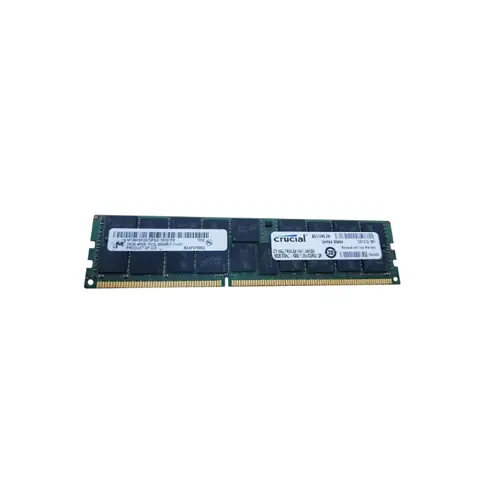
This 16GB DDR3-1066 registered ECC RDIMM is engineered for server platforms requiring uncompromised data integrity, making it ideal for memory-intensive workloads such as virtualization, in-memory databases, and mission-critical enterprise applications. Its quad-rank x8 organization maximizes memory density per channel while the 1.35V low-voltage operation combined with CL7 latency delivers efficient, stable performance and strong signal integrity through registered buffering.
1. The registered interface buffers command and address signals to maintain signal integrity across densely populated server boards, ensuring stable operation when scaling to massive memory configurations.
2. Hardware-level error correction detects and corrects single-bit memory faults in real time, safeguarding transactional and analytical workloads from silent data corruption.
3. Quad rank organization packs more DRAM chips onto the module, maximizing memory capacity per channel for memory-hungry virtualized environments without sacrificing footprint.
4. Low-voltage operation reduces thermal output and power draw in data center racks, lowering cooling costs and improving energy efficiency across large-scale deployments.
5. Generous module capacity allows denser VM placements and larger in-memory databases, directly boosting consolidation ratios and query performance.
This 16GB DDR3-1066 Registered ECC DIMM runs at a frugal 1.35V with Quad Rank x8 density to solve the real pain points of server infrastructure. In a virtualized cluster, an uncorrected memory error can silently corrupt a virtual disk or crash hypervisors, causing downtime. ECC corrects these single-bit errors on the fly, safeguarding transactional integrity and uptime. Registered buffering ensures rock-solid signal integrity when all DIMM slots are full—a must for dual-socket servers hosting dense memory configurations. The Quad Rank architecture packs 16GB into one stick, allowing hosts to scale to 512GB or more without exhausting every slot, vital for memory-hungry VM farms. In an in-memory database like Redis, that high-density stable pool eliminates disk bottlenecks, while error-free operation prevents data loss. The 1.35V low-voltage design slashes power consumption by up to 20%, trimming electricity and cooling costs across entire data center racks.
General Virtualization
Install these 16 GB ECC registered DIMMs across all memory channels to create a fault-tolerant, high-capacity configuration. A dual-socket system with eight modules yields 128 GB, comfortably hosting dozens of VMs. Because these are quad-rank modules, verify the platform’s ability to run two DIMMs per channel without exceeding the rank limit and causing a speed drop.
In-Memory Database
Maximize capacity by fully populating the server with 16 GB low-voltage RDIMMs, building a large, consistent memory store entirely in RAM. ECC protects in-memory tables and indexes from corruption during continuous processing. For optimal access latency, keep one DIMM per channel; if absolute capacity outranks speed, go denser and accept a modest frequency reduction.
High Performance Computing
For throughput-sensitive HPC, install a single 16 GB quad-rank RDIMM per memory channel to sustain the full DDR3-1066 clock without timing relaxations. This 1 DIMM per channel approach yields 128 GB on a typical eight-channel dual-socket server. The 1.35 V registered memory also reduces power consumption in large clusters, fitting sustained parallel workloads.
Thoroughly tested and validated for Dell PowerEdge R720, HP ProLiant DL380p Gen8, and Cisco UCS B200 M3 servers.
Q: Can I mix this MT36KSF2G72PDZ-1G1D1FE with other memory modules of different brands or speeds?
A: Mixing registered ECC modules from different brands or speeds is not recommended. Such combinations can cause signal integrity issues and system instability. Always populate identical kits for validated reliability in server environments.
Q: Is this memory compatible with my server platform?
A: This DDR3-1066 RDIMM with 1.35V is compatible with select Intel Xeon E5-2600 v1/v2 and AMD Opteron 6300 series platforms. Please consult your server motherboard's qualified vendor list to confirm support for quad rank x8 DIMMs.
Q: What is the recommended DIMM population order for optimal performance?
A: Populate identical quad rank RDIMMs per channel, starting with the first slot (often blue). Follow your server board's manual for balanced memory configurations, typically filling all channels symmetrically to enable optimal interleaving and bandwidth.
Q: Does this module support overclocking or XMP profiles?
A: No, this is a JEDEC-compliant server RDIMM. It does not support overclocking or Intel XMP profiles. The module operates only at its rated 1066MHz with CL7 timings to ensure 24/7 mission-critical stability.
Q: What warranty and typical failure rate can I expect?
A: This module includes a one-year warranty. Enterprise-grade RDIMMs like this exhibit very low annualized failure rates, typically under 0.5%, due to rigorous screening and ECC protection, ensuring high reliability in server deployments.