











 Secure payments
Standard refund policy
Trade Assurance
Secure payments
Standard refund policy
Trade Assurance
| Product Type | Memory Module |
|---|---|
| Memory Capacity | 16 GB |
| Memory Technology | DDR3 |
| Product Voltage | 1.35V |
| RAM Speed | 1066MHz |
| RAM Standard | DDR3-1066/PC3-8500 |
| Error Identifying | ECC |
| Signal Type | Registered |
| Column Access Strobe (CAS) | CL7 |
| Rank | Quad Rank x4 |
| Quantity of Pins | 240-pin |
| RAM Genre | RDIMM |
This 16 GB DDR3-1066 registered ECC module, built in a quad-rank x4 configuration with CL7 latency and 1.35 V low‑voltage operation, is purpose‑built for legacy server platforms running memory‑intensive workloads such as virtualization and in‑memory databases where data integrity is paramount. Its registered signal type stabilizes multi‑DIMM channels while the quad‑rank density maximizes capacity per channel, and ECC rigorously corrects single‑bit errors to uphold reliability in mission‑critical enterprise environments.
1. ECC protection proactively detects and corrects single-bit memory errors, eliminating silent data corruption in mission-critical database and financial transaction workloads.
2. Registered signal buffering stabilizes command and address lines across fully populated server boards, enabling seamless scaling to terabytes of RAM without compromising signal integrity.
3. Quad Rank x4 organization packs more DRAM devices per channel, maximizing memory density for large-scale virtualization hosts that demand heavy VM consolidation.
4. Generous per-module capacity allows dense memory configurations in a limited number of slots, directly boosting the number of simultaneous virtual machines or containers per physical node.
5. Low-voltage operation reduces overall datacenter power consumption and thermal stress, lowering cooling costs while maintaining reliable 24/7 enterprise availability.
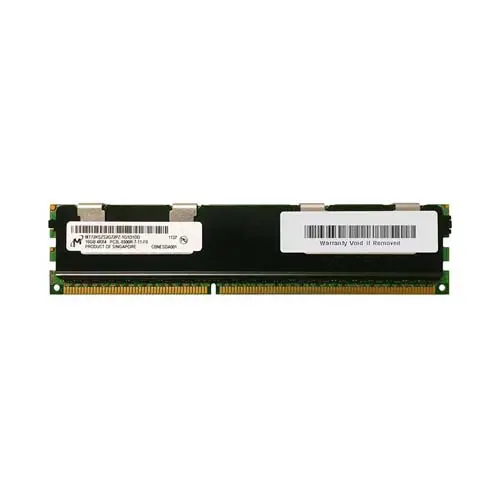
The Micron MT72KSZS2G72PZ-1G1D1DD is unmistakably a server-class DDR3 RDIMM, engineered for enterprise workloads where downtime is not an option. Its four key characteristics translate directly into real-world resilience and efficiency. First, ECC error correction safeguards against silent data corruption: in a dense virtualization cluster running dozens of sensitive VMs, a single cosmic-ray-induced bit flip can poison a database transaction or crash a hypervisor, but ECC detection and correction prevents such cascading failures automatically. Second, the registered buffer ensures signal integrity across fully populated memory channels. When you deploy an in-memory database like Redis or SAP HANA, this module’s buffered architecture stabilizes command and address lines, enabling reliable operation even with its complex quad-rank x4 design—critical for avoiding sporadic faults under sustained heavy load. Third, the 1.35V low-voltage operation directly reduces power consumption and heat in crowded racks, trimming data center operating costs and extending component life. Finally, the quad-rank organization multiplies bank interleaving capability, overlapping memory access across multiple internal rank groups to dramatically improve bandwidth and response times. This means your virtualized infrastructure and memory databases gain consistent, predictable performance during peak demand, not just benchmark numbers.
Server Memory Identified
The provided specifications (ECC, Registered, DDR3L-1066 RDIMM, quad-rank x4) are characteristic of a server-grade memory module, compatible with older generation servers and workstations that require high reliability and large memory capacities.
General Virtualization
For general virtualization, populate at least six identical 16GB modules across all memory channels to maximize interleaving and bandwidth, achieving 96GB total per host. This configuration supports moderate VM density while leveraging the module's quad-rank design for higher capacity, though be mindful that quad-rank DIMMs may limit the maximum speed and quantity per channel on some platforms. Plan for one spare module per server to maintain redundancy in a cluster.
In-Memory Database
In-memory databases demand the highest capacity and reliability, so aim to fill every available DIMM slot with these 16GB RDIMMs to reach the server's maximum supported memory—often 384GB or 512GB on dual-socket systems. The registered ECC feature ensures data integrity during aggressive caching, but verify that the reduced operating voltage (1.35V) does not compromise compatibility with older 1.5V-only memory controllers. Capacity takes precedence over speed; therefore, using all memory channels, even if it forces the memory to run at 1066MHz, is acceptable.
High Performance Computing (HPC)
In HPC environments, memory bandwidth is often critical, so install a balanced set of modules—one per channel per socket—to fully utilize all available memory channels, typically using 8 x 16GB (128GB) per node. For memory-bandwidth-bound workloads, consider a configuration with fewer quad-rank modules per channel (e.g., two per channel) to potentially allow higher operating speeds than 1066MHz if the platform supports it. The ECC capability is essential for long-running computation tasks where silent data corruption must be completely avoided.
Rigorously tested, compatible with Dell R720, HP DL380p G8, IBM x3650 M4. Reliable server memory.
Q: Can I mix this MT72KSZS2G72PZ-1G1D1DD with other memory modules of different brands or speeds?
A: Mixing is not advised. Registered ECC modules require matching rank, speed, and voltage to maintain signal integrity. Mismatched DIMMs can cause instability and data corruption.
Q: Is this memory compatible with my system?
A: This RDIMM is compatible with servers using Intel Xeon E5-2600 v1/v2 or AMD Opteron 6300 platforms that support DDR3-1066 Registered ECC memory. Confirm your board’s QVL.
Q: What is the recommended DIMM population order for optimal performance?
A: Install identical quad-rank DIMMs starting from the first slot of each channel. Always follow your server manual; mixing rank types within a channel degrades bus performance.
Q: Does this module support overclocking or XMP profiles?
A: No. This server-grade DIMM operates at JEDEC-standard timings only. It does not support XMP or overclocking to ensure 24/7 reliability at 1066MHz CL7.
Q: What warranty and typical failure rate can I expect?
A: It carries a 1-year warranty. The typical annualized failure rate is well below 0.5% for this Micron server DRAM, engineered for continuous high-load operation.