











 Secure payments
Standard refund policy
Trade Assurance
Secure payments
Standard refund policy
Trade Assurance
| Product Type | Memory Module |
|---|---|
| Compliance Standards | RoHS |
| Memory Capacity | 16 GB |
| Memory Technology | DDR3 |
| Product Voltage | 1.5V |
| RAM Speed | 1066MHz |
| RAM Standard | DDR3-1066/PC3-8500 |
| Error Identifying | ECC |
| Signal Type | Registered |
| Column Access Strobe (CAS) | CL7 |
| Rank | Quad Rank x4 |
| Quantity of Pins | 240-pin |
| RAM Genre | RDIMM |
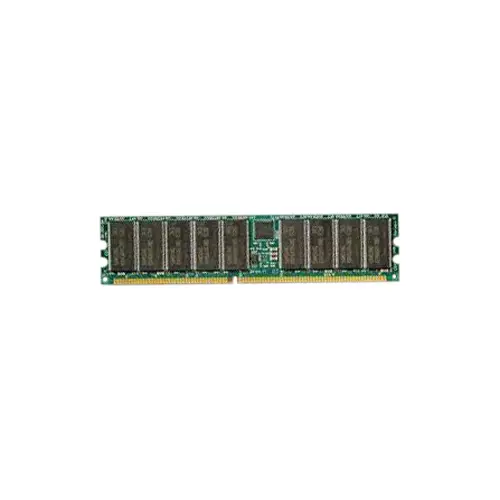
This 16GB DDR3-1066 registered ECC module, organized as a quad-rank x4 RDIMM with a low CAS latency of 7 cycles, is purpose-built for legacy server platforms handling memory-intensive workloads such as virtualization and in-memory databases where data integrity is paramount. The registered signal type stabilizes high-density memory configurations, and the ECC engine corrects single-bit errors on the fly, making it a reliable fit for mission-critical enterprise environments that demand unwavering uptime.
1. Error correction capability scrubs single-bit memory faults in real time, preventing silent data corruption in transactional databases and financial processing.
2. Registered buffering offloads electrical load from the memory controller, enabling fully populated server boards to scale capacity without sacrificing signal integrity.
3. Quad Rank organization packs more DRAM devices per module, maximizing memory density for virtualization hosts that run dozens of concurrent VMs.
4. Higher module capacity provides the headroom for in-memory caching and large dataset analytics, reducing costly disk I/O under heavy query workloads.
5. Tight CAS latency shortens the delay between a read command and data delivery, accelerating response times for latency-sensitive enterprise applications.
For IT infrastructure managers, the Micron MT72JSZS2G72PZ-1G1M1 16GB DDR3-1066 RDIMM resolves the most critical memory challenges in enterprise servers. ECC fault correction operates transparently, instantly healing a single-bit error before it corrupts a virtualized database transaction or a hypervisor page table; without this shield, a silent bit flip could cascade into service outages and data inconsistency across your entire cluster. The Registered, quad-rank x4 architecture is purpose-built for density. By buffering command and address lines, it maintains crisp signal integrity even when you install multiple 16GB modules per channel to reach 512GB or more, enabling ultra-dense VM consolidation for virtual desktop infrastructure and private clouds. The quad-rank layout with x4 DRAM devices provides extensive bank interleaving: the memory controller can issue read requests to one rank while concurrently precharging another, so an in-memory database like SAP HANA can sustain millions of simultaneous key-value operations without latency spikes. Complementing this parallelism, a CAS latency of only 7 cycles at 1066MHz ensures that each access lands swiftly, keeping your live migration and high-frequency trading applications responsive. Ultimately, this memory delivers the data integrity, massive scalability, and deterministic performance that modern always-on services demand, turning memory into a true business enabler.
This 16 GB DDR3-1066 module is a registered ECC RDIMM (quad-rank x4) built for server-class platforms. It maximizes capacity per DIMM but may force lower speeds when fully loaded. The following guidelines help plan configurations for typical server workloads.
General Virtualization
Install six to eight modules (96–128 GB) evenly across all memory channels in a dual-socket host. Symmetric population enables interleaving and stable operation; expect a speed drop to 800 MT/s with quad-rank DIMMs, which is still sufficient for 20+ moderate VMs.
In-Memory Database
Deploy 12–16 modules (192–256 GB) to keep entire datasets in DRAM. Balance modules across controllers and enable RAS features like patrol scrubbing for maximum uptime. This configuration suits memory-resident databases such as SAP HANA or large Redis instances.
High-Performance Computing
For capacity-bound HPC jobs, populate all channels with eight modules (128 GB per node). If memory bandwidth is critical, limit to two DIMMs per channel to sustain 1066 MT/s operation, and verify the motherboard’s quad-rank support at target frequency.
Rigorously tested, this server DDR3 RDIMM is compatible with Dell PowerEdge R710, HP ProLiant DL380 G7, and other servers.
Q: Can I mix this MT72JSZS2G72PZ-1G1M1 with other memory modules of different brands or speeds?
A: Mixing RDIMMs of different brands or speeds is not advisable. The system defaults to the slowest module, potentially causing instability. For reliable server operation, always use identical Micron modules.
Q: Which server platforms support this DDR3-1066 Registered ECC module?
A: This 16GB DDR3-1066 Registered ECC module works with Intel Xeon 5500/5600 and AMD Opteron 6100/6200 servers. Please check your server board's Qualified Vendor List to confirm full compatibility.
Q: What is the recommended DIMM population order for optimal performance?
A: Install quad-rank x4 RDIMMs following your server’s recommended sequence, typically populating the first slot per memory channel. Balancing channels optimizes performance and avoids memory errors. Consult the system manual.
Q: Does this module support overclocking or XMP profiles?
A: No, this server registered ECC module operates strictly at JEDEC DDR3-1066, without XMP or overclocking capability. It is designed for maximum stability in mission-critical environments, not performance tuning.
Q: What warranty and typical failure rate can I expect?
A: It includes a 1-year warranty. Micron server memory typically exhibits an AFR under 0.5% in controlled environments. Ensure proper cooling and follow handling guidelines to maintain long-term reliability.