











 Secure payments
Standard refund policy
Trade Assurance
Secure payments
Standard refund policy
Trade Assurance
| Product Type | Memory Module |
|---|---|
| Memory Capacity | 16 GB |
| Memory Technology | DDR3 |
| Product Voltage | 1.35V |
| RAM Speed | 1600MHz |
| RAM Standard | DDR3-1600/PC3-12800 |
| Error Identifying | ECC |
| Signal Type | Registered |
| Column Access Strobe (CAS) | CL11 |
| Rank | Dual Rank x4 |
| Quantity of Pins | 240-pin |
| RAM Genre | RDIMM |
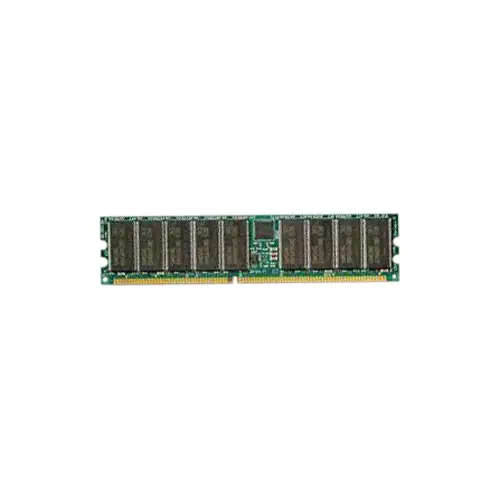
This 16GB DDR3-1600 RDIMM, with its 1.35V low-power operation and ECC registered architecture, is ideally suited for servers running memory-intensive workloads such as virtualization and in-memory databases where data integrity and signal stability are critical. The dual-rank x4 configuration provides balanced load and improved bandwidth efficiency, while the CL11 timing keeps access latency predictably low for sustained enterprise performance.
1. ECC protection silently corrects single-bit errors in real time, safeguarding transactional integrity for databases and financial services where even one bit-flip is unacceptable.
2. Registered buffering strengthens command and address signals across fully loaded memory channels, enabling stable operation with multiple DIMMs per channel in dense virtualization hosts.
3. Dual Rank x4 organization uses rank interleaving to hide precharge latency, sustaining heavily-threaded throughput when many virtual machines compete for memory access.
4. 16 GB capacity per module strikes a density sweet spot, allowing higher VM consolidation ratios on dual-socket servers without exhausting memory slots prematurely.
5. 1.35V low-voltage design reduces overall server power envelope and cooling overhead, extending the life of energy-constrained data center deployments while maintaining 1600 MHz bandwidth.
The Micron MT36KSF2G72PZ-1G6E2H 16GB DDR3L RDIMM addresses four critical server demands: data integrity, signal stability, energy efficiency, and memory parallelism. In virtualized clusters, a single uncorrected bit flip can silently corrupt VMs or transactional logs. ECC on this module continuously corrects such errors with zero performance overhead, protecting your workloads around the clock. When populating dense servers for in-memory databases such as SAP HANA, the registered buffer maintains crisp signals across all DIMM slots, eliminating electrical loading issues that cause unbuffered systems to fail. The 1.35V operating voltage cuts power draw by up to 20% versus standard DDR3, slashing energy bills and easing cooling in scaled-out deployments. Finally, the dual-rank x4 organization uses rank interleaving to boost effective bandwidth, so your Redis instance can sustain millions of operations per second with consistent low latency. This memory directly translates to higher uptime, lower total cost of ownership, and responsive services.
Server Memory Identified
The given specifications—DDR3 Registered ECC RDIMM at 1.35V—are exclusively server-grade. The following guidance addresses typical enterprise load scenarios using these 16GB modules.
General Virtualization
Deploy six to eight identical modules for a balanced 96GB or 128GB pool in a dual-socket system. This setup supports 20–30 moderate VMs, and Registered ECC ensures memory error resilience critical for multi-tenant stability. Populate all memory channels evenly to maximize interleaving and throughput.
In-Memory Database
Aim for the maximum supported capacity using 16GB RDIMMs—typically 256GB to 512GB across all slots. Low-voltage 1.35V modules reduce thermal load in dense configurations, which is essential for sustained high-frequency access patterns. ECC is mandatory here to prevent silent data corruption in financial or real-time analytic databases.
High-Performance Computing (HPC)
Fully populate each memory channel with one DIMM per channel (1DPC) at the module’s native 1600MT/s speed for peak bandwidth. A configuration of 128GB (8x16GB) per node is common for memory-bandwidth-bound simulations. The dual-rank x4 design provides a slight bandwidth advantage in streaming workloads while maintaining manageable latency.
Compatible after rigorous testing: Dell PowerEdge R720, HP DL380p Gen8, Lenovo ThinkServer RD340.
Q: Can I mix this MT36KSF2G72PZ-1G6E2H with other memory modules of different brands or speeds?
A: Mixing RDIMMs of different brands or speeds is not recommended. It may cause signal integrity issues, stability problems, and force all modules to run at the lowest common speed or relaxed timings, jeopardizing server reliability.
Q: Is this memory compatible with my system?
A: This 240-pin DDR3-1600 ECC Registered DIMM is designed for server platforms using Intel Xeon E5/E5 v2 or AMD Opteron 6300/4300 series processors. Verify your server board explicitly supports 1.35V RDIMMs with Dual Rank x4 organization.
Q: What is the recommended DIMM population order for optimal performance?
A: Follow your server motherboard’s manual. Generally, populate identical RDIMMs in matching capacity pairs per memory channel, starting with the DIMM slots farthest from the processor to maintain balanced interleaving and ECC efficiency.
Q: Does this module support overclocking or XMP profiles?
A: No. This is an enterprise-grade ECC Registered DIMM operating at JEDEC standard DDR3-1600 (PC3-12800) with CL11. It does not support XMP or overclocking, prioritizing data integrity and 24/7 stability over adjustable performance.
Q: What warranty and typical failure rate can I expect?
A: This Micron module carries a 1-year warranty. Enterprise RDIMMs like this exhibit extremely low annualized failure rates (typically <0.5%) under proper thermal and electrical conditions, reflecting rigorous testing and robust quality control.