











 Secure payments
Standard refund policy
Trade Assurance
Secure payments
Standard refund policy
Trade Assurance
| Product Type | Memory Module |
|---|---|
| Memory Capacity | 16 GB |
| Memory Technology | DDR3 |
| Product Voltage | 1.35V |
| RAM Speed | 1333MHz |
| RAM Standard | DDR3-1333/PC3-10600 |
| Error Identifying | ECC |
| Signal Type | Registered |
| Column Access Strobe (CAS) | CL9 |
| Rank | Dual Rank x4 |
| Quantity of Pins | 240-pin |
| RAM Genre | RDIMM |
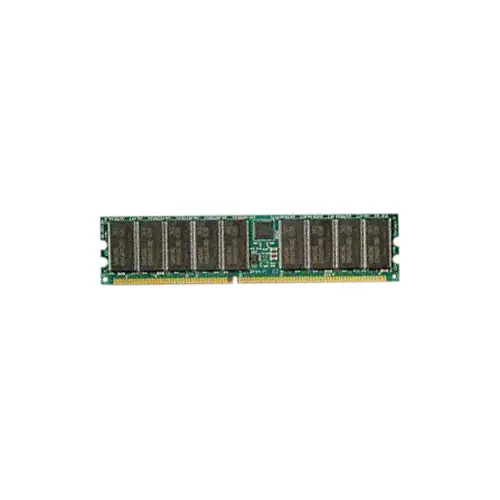
This DDR3-1333 RDIMM with ECC and a registered signal type is purpose-built for server platforms, ensuring data integrity for virtualization and in-memory database workloads. Its dual-rank x4 configuration and CL9 latency optimize memory bandwidth efficiency, while the 1.35V low-voltage operation enhances power savings in dense rack deployments.
1. ECC protection detects and corrects single‑bit memory errors in real time, preserving financial and transactional data integrity across long server uptime cycles.
2. Registered signal buffering decouples the memory controller from the DRAM loads, enabling large‑capacity configurations without compromising command bus stability.
3. Dual Rank x4 organization doubles the number of accessible banks, improving interleaving efficiency and sustaining throughput when multiple virtual machines contend for memory.
4. 16 GB capacity per module provides dense memory footprints that maximize the number of midsize VMs per server node without immediately exhausting available DIMM slots.
5. DDR3 technology in an RDIMM form factor offers a cost‑effective, low‑power refresh cycle path for legacy data centers that still prioritize energy efficiency under 1.35 V operation.
The Micron MT36KSF2G72PZ-1G4P1 is clearly a server-class 16GB DDR3L RDIMM, engineered for mission-critical enterprise workloads where failure is not an option. Its four defining features—integrated ECC, a registered buffer, dual-rank x4 organization, and low 1.35V operation—directly address your deepest infrastructure pain points. In a dense VMware or Hyper-V cluster, a single bit flip in memory caused by cosmic radiation can silently corrupt a virtual machine’s state or crash an entire host. ECC automatically detects and corrects these errors in real time, preserving data integrity and keeping your virtualized services online around the clock. Simultaneously, the registered buffer stabilizes address and command signals across every populated DIMM slot, enabling you to scale to maximum capacity without signal degradation—essential when you need to fill all 24 slots for heavy in-memory databases like SAP HANA or Redis. The dual-rank x4 design deepens bank interleaving, letting the memory controller pipeline more concurrent read and write requests. This translates directly into higher sustained bandwidth and lower latency for your transaction-heavy database, accelerating financial batch processing or real-time analytics by a tangible margin. Finally, the 1.35V power envelope significantly reduces thermal output and energy consumption per module. Across hundreds of nodes in a compute farm, this low voltage slashes cooling costs and electricity bills, directly improving your total cost of ownership while maintaining uncompromised 1333MHz reliability. This module isn’t just memory; it’s the foundation for a stable, dense, and cost-efficient data center.
This 16GB DDR3-1333 Registered ECC RDIMM (1.35V) is tailored for server platforms. Below are capacity planning guidelines for typical workloads.
General Virtualization
Populate 4 × 16GB (64GB) with one DIMM per channel for balanced memory interleaving. Scale to 8 or 16 modules (128GB–256GB) as VM density increases, always matching DIMMs per channel. The 1.35V low-voltage operation cuts power and cooling overhead in clustered hypervisors.
In-Memory Database
Install at least 16 × 16GB modules (256GB) to host hot datasets fully in RAM; expand up to the platform limit using this 16GB granularity. Registered ECC guarantees data integrity, and low voltage mitigates thermal stress in 24/7 deployments. Keep DIMM population uniform across memory controllers for stable latency.
High-Performance Computing
Use one 16GB DIMM per memory channel—typically 8 modules in dual-socket nodes—to achieve maximum bandwidth. The PC3-10600 speed, dual-rank x4 organization, and CAS 9 latency deliver solid HPC throughput. ECC safeguards long-running computations, while 1.35V lowers total cluster energy usage.
Rigorously validated server memory: compatible with Dell PowerEdge R720, HP DL380p Gen8, and IBM System x3650 M4.
Q: Can I mix this MT36KSF2G72PZ-1G4P1 with other memory modules of different brands or speeds?
A: Mixing different brands or speeds is not recommended for this registered ECC RDIMM. It may force all modules to the lowest common speed and can cause signal integrity issues, risking server stability.
Q: Is this memory compatible with my system?
A: It is designed for servers supporting DDR3L-1333 ECC Registered DIMMs (1.35V). Compatible platforms include Intel Xeon E5-2400 v2 series or AMD Opteron 6300 series. Verify your board's qualified vendor list.
Q: What is the recommended DIMM population order for optimal performance?
A: Follow your server manual: typically populate identical dual-rank RDIMMs in matched sets per memory channel. Start with the farthest slot from the CPU in each channel to balance loading and enable interleaving.
Q: Does this module support overclocking or XMP profiles?
A: No. This is an enterprise-grade registered ECC module, strictly following JEDEC DDR3L-1333 CL9 standards. Overclocking and XMP profiles are not supported and would compromise data integrity in server environments.
Q: What warranty and typical failure rate can I expect?
A: This Micron module comes with a 1-year warranty. Enterprise RDIMMs typically exhibit an annualized failure rate below 0.5% under proper thermal conditions, ensuring excellent long-term reliability for mission-critical workloads.