











 Secure payments
Standard refund policy
Trade Assurance
Secure payments
Standard refund policy
Trade Assurance
| Product Type | Memory Module |
|---|---|
| Compliance Standards | RoHS |
| Memory Capacity | 16 GB |
| Memory Technology | DDR3 |
| Product Voltage | 1.5V |
| RAM Speed | 1866MHz |
| RAM Standard | DDR3-1866/PC3-14900 |
| Error Identifying | ECC |
| Signal Type | Registered |
| Column Access Strobe (CAS) | CL13 |
| Rank | Dual Rank x4 |
| Quantity of Pins | 240-pin |
| RAM Genre | RDIMM |
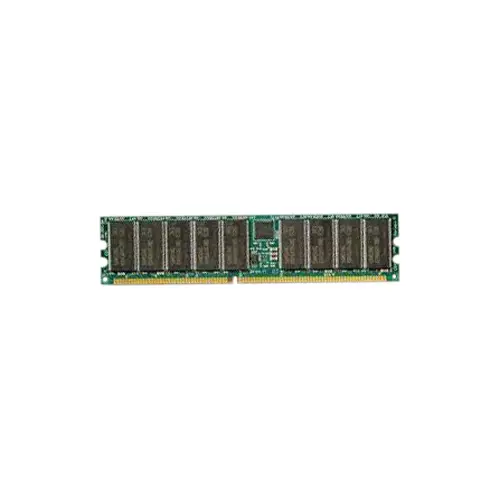
Designed for server-class platforms, this 16GB DDR3-1866 RDIMM with ECC and registered signal buffering ensures data integrity and signal stability in high-density memory configurations, making it ideal for virtualization, memory-resident databases, and mission-critical enterprise workloads. Its dual-rank x4 organization and CL13 latency strike an optimal balance between capacity per channel and responsiveness, maximizing throughput in multi-DIMM deployments.
1. Error-correction code memory proactively detects and corrects single-bit data errors, preserving data integrity essential for financial ledgers and long-duration scientific computations.
2. Registered signal buffering stabilizes electrical loads across densely populated memory channels, enabling large-capacity deployments without compromising system uptime in mission-critical servers.
3. High memory capacity per module supports increased virtual machine density, allowing consolidation of more workloads onto a single physical host before triggering costly scaling.
4. Dual Rank x4 organization exploits interleaving to keep controller pipelines continuously fed, delivering predictable throughput under the heavy parallelism of virtualized databases.
5. Elevated memory clock frequency boosts overall bandwidth, directly shrinking response windows for in-memory analytics and latency-sensitive caching layers.
The MT36JSF2G72PZ-1G9N1 is a 16GB DDR3-1866 Registered DIMM with ECC, engineered specifically for enterprise servers where reliability and performance define your infrastructure. Its four core characteristics directly address real operational risks. ECC memory eliminates silent data corruption; if a cosmic ray flips a bit inside a virtual machine’s kernel, ECC catches and corrects it, preventing a cascading failure across your VMware cluster or a poisoned in-memory database record. The Registered buffer decouples the memory bus from the controller, so you can populate all 24 slots of a dual-socket server without signal integrity loss, stability that is non-negotiable when running tens of VMs that require consistent memory mapping. Dual-rank x4 organization enables rank interleaving, effectively overlapping read and write operations to boost throughput for latency-sensitive applications like Redis caching or real-time analytics. Finally, the 1866MHz speed paired with CL13 delivers the bandwidth to move large datasets swiftly. In practice, these features mean your virtualized environment stays rock-solid during peak loads, and your business-critical data remains accurate minute by minute.
General Virtualization
For moderate consolidation of virtual machines, a balanced starting point is six to eight of these 16 GB RDIMMs (96–128 GB total) evenly distributed across memory channels. The registered ECC design ensures data integrity in multi-tenant environments, while dual-rank modules can maximize capacity without excessive rank-per-channel loading. Scale by adding identical 16 GB sticks in matched groups to maintain symmetric channel population and avoid NUMA imbalance.
In-Memory Database
In-memory databases such as Redis or SAP HANA demand both capacity and fault tolerance, making these registered ECC DIMMs essential. Populate all available memory channels with at least two 16 GB modules per channel to reach a baseline of 128–256 GB, leveraging the 1866 MT/s speed to reduce latency on large datasets. Where the platform supports it, fully populate each channel to hit 512 GB or more while maintaining rank interleaving benefits.
High-Performance Computing (HPC)
HPC workloads favor maximum bandwidth and channel utilization; populate every memory channel with identical 16 GB dual-rank RDIMMs for balanced access. A common configuration is 128–256 GB using one or two DIMMs per channel, tuned to the node’s core count to avoid swapping. The CL13 latency and 1866 MHz frequency offer a good compromise between capacity and throughput for memory‑bound simulations, though higher per‑node capacity may require 32 GB modules if the platform allows mixed capacities.
Rigorously tested server memory. Compatible with Dell PowerEdge R720/R620, HP DL380p Gen8, and IBM x3650 M4.
Q: Can I mix this MT36JSF2G72PZ-1G9N1 with other memory modules of different brands or speeds?
A: Mixing is strongly discouraged. Registered ECC modules require identical part numbers for reliable operation. Mismatched speeds or ranks can cause system instability, POST failures, or silent data corruption in server environments.
Q: Is this memory compatible with my Intel or AMD server platform?
A: This DDR3-1866 ECC Registered RDIMM is designed for dual-socket servers using Intel Xeon E5-2600 v2 or AMD Opteron 6300 series processors. Always verify your motherboard’s QVL to confirm support for 1.5V, 16GB, dual-rank x4 DIMMs.
Q: What is the recommended DIMM population order for optimal performance?
A: Follow your server board’s manual. Typically, populate identical DIMMs per channel starting with the slots farthest from the CPU. Balance ranks across memory channels to maintain full memory bandwidth and enable advanced ECC functions.
Q: Does this module support overclocking or XMP profiles?
A: No. This is a JEDEC-compliant server memory module operating at fixed 1866MHz with CL13 latency. ECC Registered DIMMs prioritize data integrity over speed and do not support XMP or overclocking features.
Q: What warranty and typical failure rate can I expect?
A: This module carries a 1-year warranty. Enterprise-grade RDIMMs like this typically exhibit an annualized failure rate (AFR) well below 0.5% under specified conditions, ensuring high reliability for 24/7 mission-critical workloads.