











 Secure payments
Standard refund policy
Trade Assurance
Secure payments
Standard refund policy
Trade Assurance
| Product Type | Memory Module |
|---|---|
| Compliance Standards | RoHS |
| Memory Capacity | 16 GB |
| Memory Technology | DDR4 |
| Product Voltage | 1.2V |
| RAM Speed | 2133MHz |
| RAM Standard | DDR4-2133/PC4-17000 |
| Error Identifying | ECC |
| Signal Type | Registered |
| Column Access Strobe (CAS) | CL15 |
| Rank | Dual Rank x4 |
| Quantity of Pins | 288-pin |
| RAM Genre | RDIMM |
This Registered DDR4-2133 RDIMM with ECC is purpose-built for server platforms, excelling in memory-intensive workloads like virtualization and in-memory databases where data integrity is non-negotiable. Its dual-rank x4 organization and registered signal architecture deliver superior signal stability and enable higher-capacity configurations, while the integrated ECC engine provides real-time single-bit error correction to safeguard mission-critical uptime.
1. ECC error correction actively detects and corrects single-bit memory faults, crucial for preventing silent data corruption in financial transactions or database operations that demand 24/7 integrity.
2. Registered signal buffering stabilizes the command and address buses when populating all channels in dense server nodes, enabling seamless scaling to 512 GB or higher without signal degradation.
3. Dual rank x4 organization interleaves memory banks to maximize sustained bandwidth under heavy virtualization workloads, reducing contention latency as dozens of VMs compete for shared DRAM resources.
4. 16 GB capacity per module strikes a density sweet spot for hyper-converged infrastructure, allowing a dual-socket server to host more active containers or virtual desktops without oversubscribing storage cache.
5. 2133 MHz base frequency delivers reliable synchronous throughput across massively parallel analytics clusters, where consistent performance under constant load is valued over peak transfer bursts.
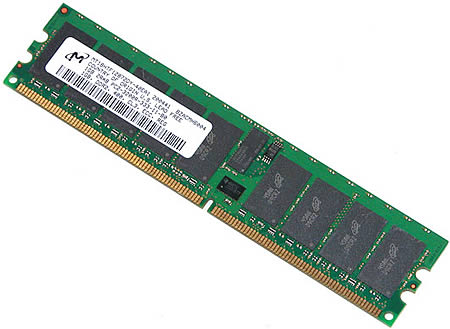
When you are managing a virtualization cluster or an in-memory database, the Micron MTA36ASF2G72PZ-2G18G is not just another DDR4 module — it is the architectural safeguard your data demands. As a 16GB Registered RDIMM with ECC, this memory confronts the invisible threat of bit-flips directly. In a dense VMware or Hyper-V environment hosting dozens of virtual machines, a single uncorrected error can cascade into silent data corruption across entire workloads. The ECC engine detects and corrects these errors in real time, directly protecting transactional integrity and preventing costly downtime.
The Registered bus architecture amplifies that reliability at scale. When your server is fully populated with high-capacity DIMMs to run an in-memory database like SAP HANA or Redis, the electrical load on the memory controller becomes a critical bottleneck. The onboard register buffers the command and address signals, stabilizing communication even under heavy population, so you can confidently deploy large memory footprints without signal degradation. Meanwhile, the dual-rank x4 organization coupled with a 15-cycle CAS latency at 2133MHz balances latency-sensitive routines with sustained bandwidth, optimizing query throughput. This combination keeps your virtualized infrastructure responsive and your database transactions consistent, turning raw specifications into business resilience.
Memory Type Assessment: The specifications—ECC, Registered, RDIMM, 288-pin—clearly identify this as server-grade memory. Capacity planning recommendations follow for typical data center workloads using this 16 GB DDR4-2133 module.
General Virtualization
In virtualized environments, memory is often the primary constraint. A balanced dual-socket server for moderate consolidation should start with eight of these 16 GB modules (128 GB total, evenly across memory channels) to host 20–30 light-to-medium VMs. For higher density, populate all channels with one DIMM per channel to maintain speed while scaling to 256 GB or more, reserving headroom for hypervisor overhead and live migration.
In-Memory Database
In-memory databases such as Redis or SAP HANA demand large, contiguous memory spaces and data integrity. Deploy twelve to sixteen modules (192–256 GB) across both processor sockets to satisfy capacity while leveraging ECC and registered buffering for reliability under heavy write loads. Place modules in a balanced interleaved configuration for maximum throughput and ensure all channels are populated identically to avoid NUMA penalties.
High-Performance Computing (HPC)
HPC clusters rely on memory bandwidth. Configure each node with one DIMM per channel to achieve the highest possible frequency (2133 MHz here) instead of maximum capacity. For dual-socket nodes, a typical memory envelope is 64–128 GB using eight of these modules, prioritizing channel balance and rank interleaving to sustain double-precision floating-point throughput during parallel simulations.
Rigorously tested server RDIMM, validated for Dell PowerEdge R730, R740, HPE DL380 Gen9, Lenovo SR650, and more.
Q: Can I mix this MTA36ASF2G72PZ-2G18G with other memory modules of different brands or speeds?
A: Mixing this RDIMM with other modules is not recommended; mismatched speed, rank, or brand may cause instability, and Registered ECC requires identical population for validated performance and signal integrity.
Q: Is this memory compatible with my server system? (Intel Xeon or AMD EPYC platforms)
A: This DDR4-2133 Registered ECC module is compatible with Intel Xeon E5-2600 v3/v4 and select AMD EPYC platforms. Verify your server's Qualified Vendor List for this specific Micron part number.
Q: What is the recommended DIMM population order for optimal performance on a dual-socket server?
A: Follow your motherboard's memory population guide. Generally, populate identical DIMMs per channel, filling the farthest slots from the CPU first to balance interleaving and ensure ECC reliability.
Q: Does this module support overclocking or XMP profiles?
A: No. As an enterprise Registered DIMM, this module adheres strictly to JEDEC DDR4-2133 standards and does not support overclocking, XMP, or any profile outside default SPD timings for maximum stability.
Q: What warranty and typical failure rate can I expect for this Micron server memory?
A: This module is backed by a one-year warranty. It meets stringent quality standards with an extremely low annualized failure rate typical of Micron’s enterprise-grade, rigorously tested RDIMMs.