











 Secure payments
Standard refund policy
Trade Assurance
Secure payments
Standard refund policy
Trade Assurance
| Product Type | Memory Module |
|---|---|
| Memory Capacity | 16 GB |
| Memory Technology | DDR4 |
| Product Voltage | 1.2 V |
| RAM Speed | 3200 MHz |
| RAM Standard | DDR4-3200/PC4-25600 |
| Error Identifying | ECC |
| Signal Type | Registered |
| Column Access Strobe (CAS) | CL22 |
| Rank | Dual Rank x8 |
| Quantity of Pins | 288-pin |
| RAM Genre | RDIMM |
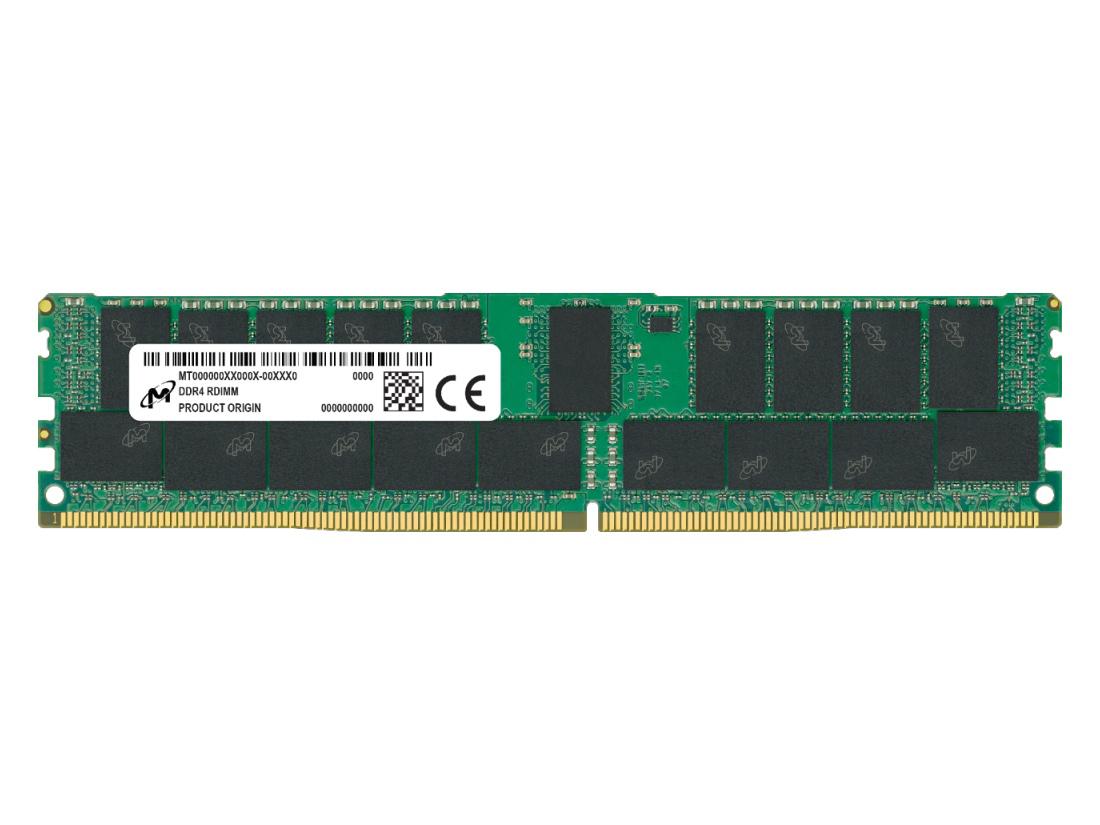
This 16GB DDR4-3200 RDIMM with ECC and registered signaling is engineered for server platforms running virtualization, in-memory databases, and mission-critical workloads where data integrity is paramount. Its dual-rank x8 configuration enhances memory interleaving for improved bandwidth efficiency, while the CL22 latency and 1.2V low-power operation ensure stable, energy-efficient performance in dense rack deployments.
1. End-to-end error correction detects and fixes single-bit memory faults in real time, safeguarding transactional and analytical workloads from silent data corruption that could otherwise ripple into critical business logic errors.
2. The registered clock driver buffers command and address signals, stabilizing the electrical load so hyperscale virtualization hosts can fill every DIMM slot without sacrificing signal integrity or uptime.
3. High-data-rate operation shovels massive bandwidth to the processor, shrinking query windows on in-memory databases and letting big-data analytics pipelines consume and aggregate streams with far less downstream latency.
4. This per-module capacity hits the sweet spot for dense virtualized clusters, packing enough resource headroom to launch more guest instances per socket while leaving room for future scaling without immediate forklift upgrades.
5. Dual rank interleaving hides DRAM precharge gaps by alternating accesses between two internal page sets, keeping the memory channel saturated under the heavy multiplexed workloads typical of multi-tenant cloud nodes.
The Micron MTA18ASF2G72PDZ-3G2J3R is a server-grade DDR4 RDIMM engineered for data centers where data integrity and continuous uptime are non‑negotiable. Its four defining characteristics directly tackle the real pain points of IT infrastructure. First, the registered buffer minimizes electrical loading on the memory bus, allowing you to fully populate every DIMM slot in a virtualization host with stable signal integrity—essential when you need consistent 2TB+ footprints without random reboot risks. Second, integrated ECC constantly detects and corrects single‑bit errors; in a VMware cluster, this prevents a flipped bit from corrupting a database transaction or silently crashing a live migration, protecting your data’s accuracy around the clock. Third, the Dual Rank x8 organization interleaves memory banks to boost sustained bandwidth. For an in‑memory database like Redis or SAP HANA handling millions of queries, this parallel access design directly translates to lower latency and more transactions per second under heavy concurrency. Finally, the 3200 MT/s interface at just 1.2V balances high throughput with outstanding power efficiency, meaning reduced cooling overhead and lower electricity bills in colocation facilities without sacrificing the speed your multi‑core processors demand.
General Virtualization
Start with a balanced configuration of four to eight 16 GB RDIMMs (64–128 GB total) across all memory channels to maximize bandwidth for moderate VM density. Populate identical dual-rank DIMMs symmetrically per CPU socket to sustain consistent low-latency access and avoid NUMA penalties. Scale in 16 GB increments when adding more VMs, keeping channels balanced for predictable performance.
In-Memory Database
Deploy a full population of registered 16 GB modules (e.g., 16×16 GB for 256 GB) to prioritize capacity while maintaining the 3200 MT/s speed with 1.2 V power efficiency. Dual-rank x8 DIMMs deliver the interleaving and reliability critical for large in-memory datasets, and ECC guards against data corruption. Avoid mixing capacities per channel to sustain uniform latency.
High-Performance Computing
Populate all memory channels with identical 16 GB RDIMMs to achieve both maximum bandwidth and capacity—typical sweet spots are 128–256 GB per node. The CL22 Registered DDR4-3200 specification ensures signal integrity in dense multi-DIMM configurations, and dual-rank modules boost throughput via rank interleaving. For memory-bound HPC codes, a fully loaded balanced layout minimizes throttling and keeps data local to each core.
Server memory rigorously tested, compatible with Dell PowerEdge R750, HPE ProLiant DL380 Gen10 Plus, Lenovo ThinkSystem SR650 V2.
Q: Can I mix this MTA18ASF2G72PDZ-3G2J3R with other memory modules of different brands or speeds?
A: Mixing RDIMMs of different brands, speeds, or ranks is not recommended. It can lead to system instability, unbootable states, or disabled ECC functionality. Always populate identical modules validated for your server.
Q: Is this memory compatible with my Intel Xeon or AMD EPYC server platform?
A: This DDR4-3200 ECC Registered DIMM is compatible with platforms supporting 288-pin RDIMMs, such as Intel Xeon Scalable (2nd Gen or newer) and AMD EPYC 7002/7003 series. Verify against your motherboard's QVL for confirmation.
Q: What is the recommended DIMM population order for optimal performance?
A: For dual-rank x8 RDIMMs on a dual-socket server, populate identical modules per channel, starting with blue slots (channel 1) then black slots. This maximizes memory interleaving and bandwidth. Refer to your system manual.
Q: Does this module support overclocking or XMP profiles?
A: No, server-grade RDIMMs like this Micron module strictly adhere to JEDEC DDR4-3200 standards. It does not support overclocking or XMP, ensuring 24/7 operational stability and ECC data integrity.
Q: What warranty and typical failure rate can I expect?
A: This module includes a 1-year warranty. Typical annualized failure rate (AFR) for Micron RDIMMs is below 0.5%, backed by ECC and rigorous testing, ensuring high reliability for enterprise workloads.