











 Secure payments
Standard refund policy
Trade Assurance
Secure payments
Standard refund policy
Trade Assurance
| Product Type | Memory Module |
|---|---|
| Compliance Standards | RoHS |
| Memory Capacity | 16 GB |
| Memory Technology | DDR3 |
| Product Voltage | 1.35V |
| RAM Speed | 1066MHz |
| RAM Standard | DDR3-1066/PC3-8500 |
| Error Identifying | ECC |
| Signal Type | Registered |
| Column Access Strobe (CAS) | CL7 |
| Rank | Quad Rank x4 |
| Quantity of Pins | 240-pin |
| RAM Genre | RDIMM |
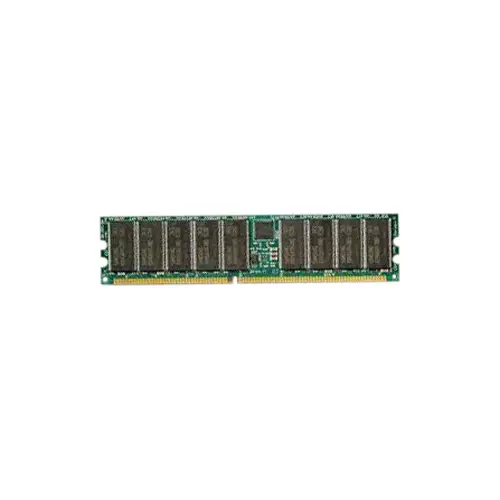
Designed for server environments, this 16GB DDR3-1066 RDIMM leverages quad-rank x4 organization to maximize memory density per channel and registered signaling to maintain signal integrity in multi-DIMM configurations. Its ECC and low 1.35V operation ensure data integrity and reduced power consumption, making it ideally suited for virtualization hosts and memory-intensive in-memory databases.
1. ECC protection silently corrects single-bit errors, preventing silent data corruption in financial transactions and database operations that demand absolute integrity.
2. Registered signal buffering stabilizes high-density memory channels, enabling fully populated server nodes to sustain 24/7 uptime under maximum DIMM count.
3. Quad Rank x4 organization maximizes bank interleaving, accelerating concurrent access patterns for dense virtualization hosts running dozens of VMs.
4. 16 GB capacity per module supplies ample headroom for memory-hungry hypervisors, reducing swapping and preserving QoS in multi-tenant cloud environments.
5. CL7 low latency at 1066 MHz sharpens response times for in-memory caching and OLTP workloads, where every nanosecond of access delay compounds across millions of queries.
The Micron 16GB DDR3L-1066 RDIMM (MT72KSZS2G72PZ-1G1M1FE) is purpose-built for servers where uptime and data integrity are paramount. Its four defining features translate directly into business resilience. ECC error correction eliminates the risk of silent data corruption—a single flipped bit in a financial database or virtual machine checkpoint can cost thousands in downtime. Registered buffering stabilizes high-density configurations, letting you fully populate memory banks to run dozens of VMs on a single host without signal degradation. The quad-rank x4 organization amplifies bandwidth through rank interleaving, ensuring that in-memory caching systems and frequent database lookups remain snappy even under heavy concurrent load. Operating at just 1.35V, this low-voltage module dramatically reduces power draw and waste heat, which in a dense rack directly lowers your monthly energy bill and prolongs server lifespan. For a virtualized cluster or a memory-hungry OLTP database, these capabilities mean you consolidate more workloads with absolute confidence.
General Virtualization
For dense virtualization hosts, populate at least one 16GB RDIMM per memory channel to maximize interleaving and bandwidth. Aim for balanced configurations across all available channels—for a dual-socket system with three channels per CPU, six identical modules deliver 96GB, comfortably supporting dozens of light to medium VMs. Stick to identical part numbers to maintain ECC and registered signaling integrity.
In-Memory Database
In-memory databases demand the largest possible capacity at the lowest latency. Fill every DIMM slot with this 16GB quad-rank RDIMM to reach hundreds of gigabytes, accepting that quad-rank loading may force a slight speed reduction to 800MHz or limit the number of modules per channel. The sheer volume of RAM, combined with ECC protection, outweighs the minor clock step-down for key-value stores and real-time analytics.
High-Performance Computing
HPC workloads often favor bandwidth over latency, but with DDR3-1066 quad-rank modules you trade peak transfer rates for density. Install a full complement of identical 16GB RDIMMs—one per channel—to enable channel interleaving and reach multi-terabyte footprints in large clusters. When absolute bandwidth is critical, consider faster-rated LRDIMMs; otherwise, this registered ECC memory ensures the node stays stable through week-long simulation runs without a single-bit error.
This server memory has been rigorously tested, compatible with Dell PowerEdge R710, HP DL380 G7, and more.
Q: Can I mix this MT72KSZS2G72PZ-1G1M1FE with other memory modules of different brands or speeds?
A: Mixing RDIMMs of different specifications is not advised. It can cause instability, force lower speed, or prevent booting. For server reliability, use identical modules to maintain signal integrity and error correction.
Q: Is this memory compatible with my system?
A: This 16GB DDR3-1066 Registered ECC RDIMM requires a server board supporting 1.35V, Quad Rank x4, and 240-pin DDR3L. Check your Intel Xeon or AMD Opteron platform memory QVL for specific compatibility.
Q: What is the recommended DIMM population order for optimal performance?
A: Follow your server's population guide: populate identical DIMMs per channel, starting farthest from the CPU. For Quad Rank RDIMMs, respect rank limits per channel to avoid performance degradation and ensure balanced memory interleaving.
Q: Does this module support overclocking or XMP profiles?
A: No. As a server-grade Registered ECC module, it operates at fixed JEDEC DDR3-1066 specifications. Overclocking and XMP are not supported; the design prioritizes data integrity and 24/7 operational stability.
Q: What warranty and typical failure rate can I expect?
A: This Micron module includes a 1-year warranty. It exhibits a very low annualized failure rate (AFR) under proper environmental conditions, characteristic of enterprise-class memory designed for continuous, reliable operation.