











 Secure payments
Standard refund policy
Trade Assurance
Secure payments
Standard refund policy
Trade Assurance
| Model | MT18VDDT12872AG-335D1 |
|---|---|
| Product Type | Memory Module |
| Compliance Standards | RoHS |
| Memory Capacity | 1 GB |
| Memory Technology | DDR |
| Product Voltage | 2.5V |
| RAM Speed | 333MHz |
| RAM Standard | DDR-333/PC-2700 |
| Error Identifying | ECC |
| Signal Type | Unbuffered |
| Column Access Strobe (CAS) | CL2.5 |
| Rank | Dual Rank x8 |
| Quantity of Pins | 184-pin |
| RAM Genre | UDIMM |
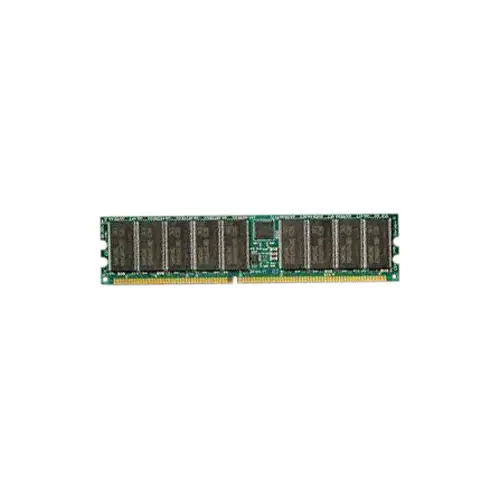
This is a legacy 1 GB DDR-333 unbuffered ECC UDIMM designed for entry-level servers or workstations requiring data integrity in aging platforms. Its dual-rank x8 organization and CL2.5 latency offer a balanced combination of memory bank interleaving and reliable access, making it suited for light virtualized environments, file servers, or mission-critical desktop applications where error correction is paramount.
1. ECC error correction safeguards data integrity by detecting and fixing single-bit errors in real time, crucial for preventing silent corruption in always-on authentication servers and critical database appliances.
2. Unbuffered UDIMM architecture removes the register delay, ensuring ultra-low command-to-DRAM latency that benefits latency-sensitive edge computing nodes and lightweight virtualization hosts.
3. Dual Rank x8 organization enables rank interleaving, which sustains higher effective throughput under concurrent memory accesses typical of multi-tenant web hosting environments.
4. CL2.5 CAS latency delivers a rapid column access response, shrinking transaction processing times and improving the responsiveness of small-scale SQL and directory service instances.
5. One-gigabyte density reliably supports headless legacy server operating systems and dedicated network functions, providing adequate headroom without introducing idle resource waste.
The MT18VDDT12872AG-335D1 is a DDR-333 ECC UDIMM engineered for entry-level servers and professional workstations where data integrity outweighs all other concerns. Although its unbuffered architecture skips the signal-registering chips found in RDIMMs, the onboard ECC circuitry continuously corrects single-bit errors induced by background radiation, silently preventing corruption in financial transaction logs, customer databases, or long-term file archives. In an always-on small business NAS, this means your critical backups escape the creeping degradation that can ruin archive fidelity year after year. The same protection proves vital for a lightweight virtualization host running an in-memory database like Redis: a single bit flip uncaught inside a transaction could cascade into incorrect orders or billing disputes, eroding trust instantly. Beyond error correction, the dual-rank x8 organization interleaves memory banks to lift sustained bandwidth, while the aggressive CL2.5 latency keeps response times crisp under loads of continuous queries. The standard 2.5V operating voltage and 184-pin UDIMM footprint guarantee a straightforward drop-in upgrade for legacy rackmount servers or tower workstations still driving mission-critical tasks. These parameters are not merely electrical specifications; they translate directly into a tangible promise of computational integrity and uninterrupted uptime for the systems that depend on absolute accuracy.
General Virtualization
For a legacy DDR-333 platform with ECC UDIMMs, stability is paramount. Deploy modules in matched pairs to enable dual-channel interleaving, and populate all available slots with identical 1 GB sticks to reach at least 4–8 GB. This provides a moderate number of virtual machines while ECC guards against in-memory errors that could crash multiple guests.
In-Memory Database
In-memory databases demand both capacity and data integrity. Install the maximum supported quantity of these 1 GB ECC modules—typically six to eight DIMMs—to build a 6–8 GB dataset cache. The unbuffered ECC design suits small-scale transactional systems, but the 333 MHz speed and dual-rank organization mean you should keep datasets sized to avoid excessive paging.
High Performance Computing
HPC clusters of this era benefit from balanced memory configurations. Use four or eight identical MT18VDDT12872AG modules in a dual-processor board to achieve symmetric multi-channel access. ECC is essential for long-running simulations, and the CL2.5 latency is acceptable for compute-bound workloads; plan capacity so that working sets fit entirely in RAM to prevent swap bottlenecks.
Rigorously tested server memory, compatible with Dell PowerEdge 2850 and HP ProLiant DL360 G4.
Q: Can I mix this MT18VDDT12872AG-335D1 with other memory modules of different brands or speeds?
A: Mixing is not recommended. Unbuffered ECC DIMMs require identical specifications—speed, rank, and timing—to ensure signal integrity. Disparate modules may cause instability or disable ECC, undermining data protection.
Q: Is this memory compatible with my server or workstation motherboard?
A: Compatibility depends on a chipset supporting DDR-333, 184-pin, and unbuffered ECC. Verify with Intel E7210/E7501 or AMD-8000 series platforms. Consumer boards lacking ECC support will not POST with this UDIMM module.
Q: What is the recommended DIMM population order for optimal performance?
A: Populate identical dual-rank DIMMs in pairs per channel, starting with the slots furthest from the CPU. Follow your system board’s manual for balanced memory interleaving, as unbalanced ECC configurations degrade throughput.
Q: Does this module support overclocking or XMP profiles?
A: No. This is a JEDEC-standard DDR-333 module designed for stability, not overclocking. It lacks XMP profiles and is validated solely at 333MHz with CL2.5 latency to maintain rigorous ECC server-grade reliability.
Q: What warranty and typical failure rate can I expect for this module?
A: It includes a one-year warranty. In controlled environments, ECC UDIMMs demonstrate an AFR below 0.5%. Proper cooling and ESD handling further minimize field defects, ensuring sustained data integrity and long service life.