











 Secure payments
Standard refund policy
Trade Assurance
Secure payments
Standard refund policy
Trade Assurance
| Model | MT18VDDF12872Y-40BF1 |
|---|---|
| Product Type | Memory Module |
| Compliance Standards | RoHS |
| Memory Capacity | 1 GB |
| Memory Technology | DDR |
| Product Voltage | 2.5V |
| RAM Speed | 400MHz |
| RAM Standard | DDR-400/PC-3200 |
| Error Identifying | ECC |
| Signal Type | Registered |
| Column Access Strobe (CAS) | CL3 |
| Rank | Single Rank x4 |
| Quantity of Pins | 184-pin |
| RAM Genre | RDIMM |
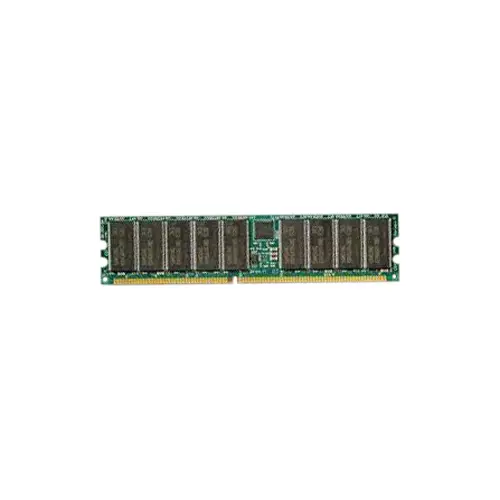
This registered ECC DDR-400 module is engineered for legacy server platforms running virtualization or memory-resident database workloads that demand uncompromising data integrity. Its single-rank x4 configuration and registered signal type ensure robust electrical signaling under multi-DIMM loads, delivering reliable CL3-latency operation with full error correction.
1. On-the-fly error correction shields critical server data from bit corruption, a non-negotiable for 24/7 uptime in transaction processing and virtualization hosts.
2. Registered buffering decouples the memory bus from direct chip loads, allowing dense module populations that scale up memory capacity without signal compromise in enterprise platforms.
3. A purpose-built capacity footprint serves dedicated microservices, appliance controllers, and legacy infrastructure, providing exactly the right amount of reliable memory without wasted power.
4. Peak bandwidth classification supports sustained line-rate data movement for network-attached storage and cache-coherent clustering in steady-state server operations.
5. Single-rank architecture using narrow chip I/O reduces electrical overhead, helping maintain robust error-free operation in high-availability blade and rack deployments.
This server-grade RDIMM is purpose-built for legacy platforms that cannot afford downtime. Its ECC technology actively detects and corrects single-bit memory errors—a critical safeguard in financial transaction systems and memory-resident databases like Redis, where an undetected bit flip can silently corrupt trade records or in-memory caches, leading to cascading application failures. The registered signal buffer is equally vital for dense virtualization clusters. By redriving address and command signals, it allows a single host to run dozens of stable virtual machines across multiple populated channels without signal degradation, directly translating to higher consolidation ratios and uninterrupted multi-tenant workloads. The single-rank x4 organization strikes a deliberate balance: it confines the electrical load to one rank, maintaining clean signal integrity at 400 MHz while delivering consistent bandwidth for latency-sensitive OLAP queries. Finally, the DDR-400 speed at CL3 ensures deterministic, snappy data access when paired with aging servers—extending the useful life of industrial automation controllers or legacy ERP systems where replacing the entire infrastructure is cost-prohibitive. Every parameter from ECC to registered buffering is engineered to keep your data accurate and your services online.
General Virtualization
This 1 GB DDR-400 Registered ECC module is too small for modern virtualization hosts, which typically start at 64 GB or more. In a legacy or lab environment, you may install these modules in multiples to reach a bare minimum of 8–16 GB, but you must populate channels symmetrically to preserve ECC and interleaving benefits. For any production hypervisor, replace with higher-capacity RDIMMs and plan for at least 25–50% headroom above total VM working-set memory.
In-Memory Database
In-memory databases require capacity orders of magnitude beyond what this DIMM provides. A single 1 GB stick will not even hold a small dataset index, so it would only serve as a spare for very old, memory-light management controllers. Deployments like Redis or SAP HANA need large, registered ECC memory banks (hundreds of gigabytes) with consistent rank and rank interleaving rules to maintain low latency under full ECC coverage.
High-Performance Computing (HPC)
DDR-400 is a serious performance bottleneck by modern HPC standards, where bandwidth-hungry workloads depend on multiple memory channels per socket. Although ECC is mandatory for result integrity, a single-rank 1 GB RDIMM delivers insufficient capacity and bandwidth. For a legacy cluster node, you could fill all channels with identical modules to maximize interleaving, but cluster-wide scaling demands uniform, higher-capacity DIMMs to avoid swap and OOM kills on large MPI ranks.
Rigorously tested, this server memory fits Dell PowerEdge 1850, 2850, HP ProLiant DL360 G4, and more.
Q: Can I mix this MT18VDDF12872Y-40BF1 with other memory modules of different brands or speeds?
A: Mixing with different brands or speeds is not advised in registered ECC servers. It risks instability, conflicts between registered/unbuffered types, or performance loss. For maximum reliability, deploy identical modules.
Q: Is this memory compatible with my Intel or AMD server platform?
A: This is a DDR-400 registered ECC DIMM (184-pin). It suits servers using Intel E7500/E7520 or AMD 8000 series chipsets supporting Registered DDR. Please verify your board's memory support list for single-rank x4 RDIMMs.
Q: What is the recommended DIMM population order for optimal performance?
A: For dual-channel server boards, populate identical modules in pairs per channel, usually starting from the slots furthest from the CPU. Refer to your motherboard manual for the correct bank/slot sequence when installing single-rank x4 RDIMMs.
Q: Does this module support overclocking or XMP profiles?
A: No, this is a JEDEC-standard DDR-400 registered server module without XMP or overclocking support. Operating it beyond rated specs may degrade stability and compromise error correction, voiding warranty.
Q: What warranty and typical failure rate can I expect?
A: This module comes with a one-year warranty. Registered ECC DDR modules are exceptionally reliable, exhibiting a typical Annualized Failure Rate (AFR) below 0.5% in standard server environments with proper cooling.