











 Secure payments
Standard refund policy
Trade Assurance
Secure payments
Standard refund policy
Trade Assurance
| Product Type | Memory Module |
|---|---|
| Compliance Standards | RoHS |
| Memory Capacity | 1 GB |
| Memory Technology | DDR2 |
| Product Voltage | 1.8V |
| RAM Speed | 400MHz |
| RAM Standard | DDR2-400/PC2-3200 |
| Error Identifying | ECC |
| Signal Type | Registered |
| Column Access Strobe (CAS) | CL3 |
| Rank | Single Rank x4 |
| Quantity of Pins | 240-pin |
| RAM Genre | RDIMM |
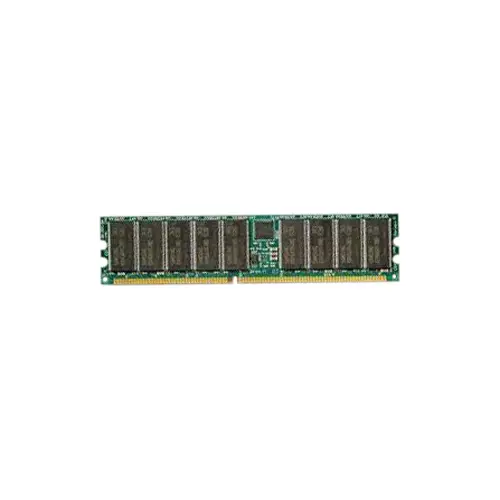
This Registered ECC DDR2-400 RDIMM delivers the data integrity and signal stability required for legacy server platforms running memory-critical workloads like virtualization or in-memory databases. Its Single Rank x4 organization and low CL3 latency optimize command scheduling efficiency, ensuring reliable throughput in high-density, fault-tolerant environments.
1. ECC detection and correction shields every data block from single-bit memory errors, preserving transactional integrity in always-on enterprise servers.
2. Registered signal buffering stabilizes high-capacity memory configurations, allowing platforms to populate all DIMM slots without compromising signal quality.
3. Single Rank x4 organization minimizes electrical loading on the memory bus, enabling reliable operation when multiple modules are installed in dense rack servers.
4. CL3 column access latency accelerates cache-line fills, reducing database query response times for latency-sensitive financial and virtualization workloads.
5. PC2-3200 throughput delivers a steady 3.2GB/s per channel, efficiently handling concurrent connections in legacy web hosting and file-serving environments.
The MT18HTF12872Y-40EA2 is a server-grade DDR2-400 Registered ECC DIMM designed for enterprise workloads where stability and uptime are non-negotiable. Four key characteristics translate directly into real-world resilience. ECC memory prevents single-bit errors from cosmic particles—in virtualized farms, a single undetected bit flip can corrupt a hypervisor and crash dozens of guest machines, an unacceptable risk. The registered signal buffer cleanly drives high-density memory configurations, letting you fully load 16 or more DIMMs per server without signal degradation, which is crucial for large-memory in-memory databases like Redis where every gigabyte counts. Its single-rank x4 organization delivers higher command and data bus efficiency, boosting throughput when multiple VMs compete for memory bandwidth under heavy database transactions. Finally, the 1.8V operating voltage cuts power consumption and heat output inside dense rack enclosures, reducing cooling overhead and prolonging hardware life. For virtualized clusters and real-time data platforms, this module delivers the rock-solid data integrity, scalable capacity, and energy efficiency your infrastructure demands.
This is a legacy server-grade memory module (1GB DDR2-400 ECC Registered RDIMM) suitable only for older server platforms. Below is capacity planning guidance for three typical workloads.
General Virtualization
Hypervisors such as VMware ESXi or Hyper-V on servers of this era rely on total installed capacity to run multiple VMs. With 1GB RDIMMs, populate every available DIMM slot across all memory channels to maximize capacity—ideally 16 or more modules for 16–32GB total. Enable memory interleaving in the BIOS, but expect performance limitations due to low bandwidth. Reserve at least 512MB for the hypervisor and allocate remaining memory carefully to avoid overcommitment.
In-Memory Database
In-memory databases (e.g., Redis, SAP HANA) require large, contiguous memory pools. A fully populated configuration using these 1GB modules yields, at best, 32GB with 32 slots—far below modern requirements. This module is practical only for tiny test datasets or light caching layers. For production, consolidate workloads onto a newer server with higher-capacity DIMMs; these modules may serve as emergency spares for legacy maintenance.
High Performance Computing (HPC)
HPC applications stress memory bandwidth per core. Populate all memory channels symmetrically (e.g., 4 or 8 identical modules per channel) to preserve balanced interleaving and avoid NUMA penalties. However, the 400MT/s speed and small 1GB capacity severely throttle floating-point throughput. Use these modules only for lightweight management nodes, login nodes, or as replacements in aging clusters where compute tasks are I/O-bound rather than memory-bandwidth-bound.
Validated server memory: rigorously tested, compatible with Dell PowerEdge 2950/1950, HP ProLiant DL380 G5, and IBM System x3650.
Q: Can I mix this MT18HTF12872Y-40EA2 with other memory modules of different brands or speeds?
A: We strongly advise using only identical part-number modules. Mixing different brands, speeds, or RDIMM configurations can cause timing conflicts and instability, especially in server environments. Matching all modules ensures reliable operation.
Q: Is this memory compatible with my system?
A: This DDR2-400 Registered ECC RDIMM is compatible with legacy server platforms supporting PC2-3200 and 240-pin slots, such as those based on Intel 5000 series chipsets or AMD Socket F. Please verify your motherboard’s qualified vendor list.
Q: What is the recommended DIMM population order for optimal performance?
A: Follow your server motherboard manual. Typically, populate the farthest slot from the CPU in each channel first, then fill channels symmetrically to enable memory interleaving and maximize bandwidth. Matched pairs are required.
Q: Does this module support overclocking or XMP profiles?
A: No. This server memory complies with JEDEC standards, with no XMP or overclocking support. It is designed for stability and data integrity, running at the fixed DDR2-400 speed and CL3 timing. Overclocking would jeopardize ECC reliability.
Q: What warranty and typical failure rate can I expect?
A: This module comes with a one-year warranty. As an enterprise-grade RDIMM, it is engineered for a low annualized failure rate (AFR), typically far below commercial-grade components, ensuring long-term reliability in mission-critical systems.