











 Secure payments
Standard refund policy
Trade Assurance
Secure payments
Standard refund policy
Trade Assurance
| Product Type | Memory Module |
|---|---|
| Compliance Standards | RoHS |
| Memory Capacity | 1 GB |
| Memory Technology | DDR2 |
| RAM Speed | 667MHz |
| RAM Standard | DDR2-667/PC2-5300 |
| Error Identifying | Non-ECC |
| Signal Type | Unbuffered |
| Column Access Strobe (CAS) | CL5 |
| Rank | Dual Rank x8 |
| Quantity of Pins | 240-pin |
| RAM Genre | UDIMM |
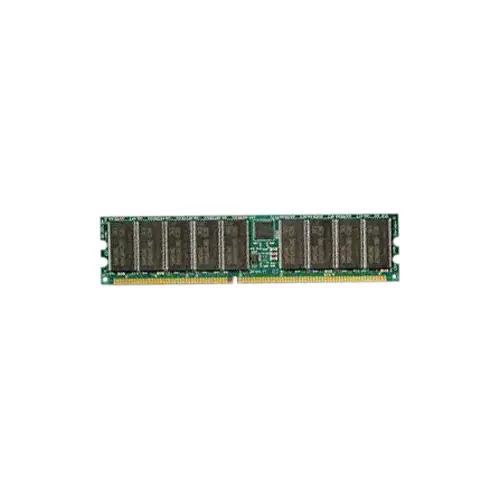
This is a desktop memory module, specifically an unbuffered Non-ECC DDR2 UDIMM, ideal for breathing new life into aging desktops used for office productivity or light content creation. Its Dual Rank x8 configuration boosts signal stability on older chipsets, while the CL5 CAS latency at 667 MHz ensures responsive task switching in everyday workloads.
1. Unbuffered UDIMM design strips away register chips, cutting access latency for snappier mouse-to-screen response and giving desktop enthusiasts more predictable overclocking headroom.
2. Dual Rank x8 organization keeps both rank banks interleaved, sustaining high command throughput that prevents stutter during heavy multitasking and content creation.
3. CL5 column access strobe tightens data retrieval timing, translating directly into higher minimum frame rates and smoother gameplay in competitive titles.
4. 1 GB capacity provides enough working space to keep legacy productivity suites in memory, avoiding disk thrashing and keeping everyday office responsiveness fluid.
5. PC2-5300 bandwidth feeds texture-heavy game engines without starvation, ensuring quick level loads and comfortable operation across multiple desktop browser tabs.
This is a desktop memory module, purpose-built to eliminate the bottlenecks that frustrate gamers, video editors, and power users. The unbuffered, non-ECC architecture removes the validation overhead found in server memory, allowing the memory controller to talk directly to the DRAM chips with minimal latency. For anyone deep in a AAA title, that translates to tighter frame times and quicker reaction shots — every nanosecond counts when rendering complex in-game physics. With a DDR2-667 speed and a tight CL5 latency, the module responds instantly to data requests, preventing micro-stutters during texture streaming or large video renders. The dual-rank x8 organization interleaves access across two internal sets of chips, extracting more bandwidth from each clock cycle, which becomes tangible when your timeline scrubbing stays smooth even under multiple high-bitrate layers. At 1 GB on a 240-pin UDIMM form factor, it slips into existing desktop boards for a straightforward upgrade that can turn a sluggish, unresponsive system into a competent multitasker. For the video editor who relies on real-time previews or the gamer who refuses to let a stutter ruin a match, this memory means fewer wait-cursors and more productive, uninterrupted sessions.
Gaming Build
For modern gaming, dual-channel configurations are essential to avoid bottlenecks. Pair matched 16GB (2x8GB) or 32GB (2x16GB) DDR4/DDR5 kits for optimal frame rates; avoid single-stick setups that cut bandwidth in half. Given this legacy 1GB DDR2 module, it cannot meet current game requirements and should not be considered for any contemporary gaming rig.
Content Creation
Video editing and 3D rendering workloads demand large, fast memory pools—64GB is the recommended baseline for 4K timelines or complex scenes. Populate all four DIMM slots with identical high-capacity modules to maximize bandwidth, but a 1GB DDR2-667 stick is entirely unsuitable: modern platforms require high-speed DDR4 or DDR5, not decade-old low-density UDIMMs.
General Productivity
For office multitasking, email, and web browsing, 8GB or 16GB of budget-friendly DDR4 offers the best cost-per-performance. Dual-channel kits remain preferable, but a single 8GB stick is a viable starting point. The 1GB DDR2-667 module described is obsolete for any modern productivity build and should only be used for restoring vintage systems.
Rigorously tested, this desktop DDR2 UDIMM ensures compatibility with systems like Dell OptiPlex 745/755, HP Compaq dc7700, and Lenovo ThinkCentre M55.
Q: Can I mix this MT16HTF12864AY-667A3 with other memory modules of different brands or speeds?
A: Mixing is not recommended. Even with identical specs, variations in ICs and PCB design may cause instability. For guaranteed compatibility, use identical modules throughout.
Q: Is this memory compatible with my desktop system?
A: It is a 240-pin DDR2-667 UDIMM for desktops. Verify your motherboard supports DDR2 and chipsets such as Intel 965/975 or AMD 690G, and accepts 1 GB dual-rank modules.
Q: What is the recommended DIMM population order for optimal performance?
A: Install this dual-rank module as a matched pair in same-color slots for dual-channel mode. For a single module, use the primary slot specified in your motherboard manual.
Q: Does this module support overclocking or XMP profiles?
A: No. This JEDEC-compliant DDR2-667 CL5 module lacks XMP support and is not validated for overclocking. Operation beyond rated specs is not covered under warranty.
Q: What warranty and typical failure rate can I expect?
A: A 1-year limited warranty is provided. Under standard operating conditions, the estimated annualized failure rate remains below 0.5%, ensuring reliable long-term use.