











 Secure payments
Standard refund policy
Trade Assurance
Secure payments
Standard refund policy
Trade Assurance
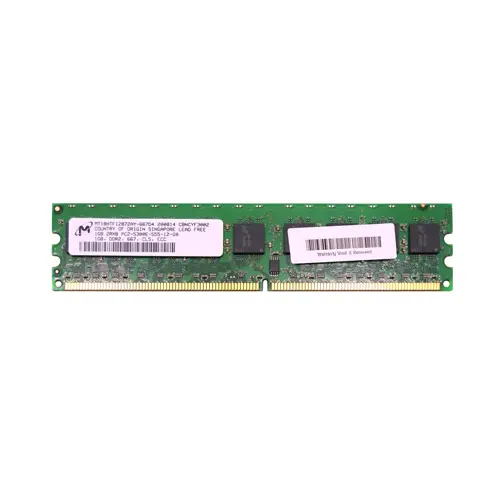
| Model | MT18HTF12872AY-667D4 |
|---|---|
| Product Type | Memory Module |
| Compliance Standards | RoHS |
| Memory Capacity | 1 GB |
| Memory Technology | DDR2 |
| Product Voltage | 1.8V |
| RAM Speed | 667MHz |
| RAM Standard | DDR2-667/PC2-5300 |
| Error Identifying | ECC |
| Signal Type | Unbuffered |
| Column Access Strobe (CAS) | CL5 |
| Rank | Dual Rank x8 |
| Quantity of Pins | 240-pin |
| RAM Genre | UDIMM |
This DDR2-667 ECC unbuffered DIMM targets legacy entry-level servers and workstations, delivering data integrity for reliability-sensitive tasks such as light virtualization or file serving. Its dual-rank x8 organization boosts memory bandwidth efficiency, while the ECC capability and unbuffered signaling ensure stable, error-corrected operation at 1.8V with CL5 latency.
1. ECC protection silently corrects single-bit memory errors in flight, preserving transaction accuracy for point-of-sale terminals and always-on microservers where data fidelity is non-negotiable.
2. Unbuffered UDIMM architecture trims command latency, giving small-office database servers faster query retrieval times under moderate concurrent connections.
3. Dual Rank x8 organization keeps memory banks interleaved, sustaining consistent throughput during multi-client file transfers in a NAS appliance.
4. CL5 column access strobe shortens the delay before read bursts begin, tightening application response for legacy inventory management systems that demand snappy user interactions.
5. 1GB capacity targets embedded server uses such as firewall appliances or VoIP gateways, where rock-solid uptime and low thermal footprint outweigh large footprint demands.
The MT18HTF12872AY-667D4 is an ECC Unbuffered DDR2 module purpose-built for entry-level servers and critical workstations where data integrity cannot be compromised. Its ECC capability continuously detects and corrects single-bit memory errors—silent corruption that, in a small business file server or a virtualized test environment, could otherwise cascade into backup failures or VM crashes. This means your weekend batch jobs complete without unexplained glitches, and your customer records remain consistent. The unbuffered design, while not registered, keeps latency low and ensures seamless compatibility with affordable server chipsets, making it ideal for cost-conscious IT teams upgrading legacy hypervisors without motherboard headaches. Dual-rank organization packs two independent ranks of DRAM on the module, enabling the memory controller to interleave commands; for a lightweight database engine like Redis, this parallelism translates to more queries served per second and snappier response under concurrent connections. The DDR2-667 speed with CL5 timings delivers determined bandwidth, so when multiple virtual machines compete for resources, the memory subsystem stays responsive rather than becoming a bottleneck. Ultimately, this module closes the gap between basic desktop reliability and true server-grade assurance, giving you measurable uptime and consistent performance in file serving, virtualization, and data-sensitive applications.
Server Memory — This is a DDR2-667 ECC Unbuffered DIMM designed for single-socket servers and workstations that require data integrity without the cost of registered memory. Capacity planning must account for the modest 1 GB density and aging platform limits.
General Virtualization
Populate all available DIMM slots with identical modules to maximize total memory. A dual-socket system with 8 slots can reach 8 GB, which is the bare minimum for light virtualization. For running multiple VMs, install two matched modules per channel to enable dual-channel interleaving and slightly boost throughput.
In-Memory Database
In-memory databases demand capacity and error protection. Use the largest supported configuration—typically 16 GB across 16 slots if the board allows—and never mix ECC with non-ECC DIMMs. Group modules in symmetric pairs per channel to maintain consistent latency and avoid performance cliffs under sustained write loads.
High-Performance Computing
HPC workloads balance bandwidth and capacity. Fill each memory channel with identical dual-rank DIMMs to achieve peak bandwidth from the DDR2-667 interface. Because single-node memory is limited, cluster design should distribute datasets and favor replicated small-block computation, ensuring ECC guards against silent data corruption during long-running jobs.
Server memory rigorously tested, compatible with Dell PowerEdge 840, T105, HP ML115 G5, DL120 G5.
Q: Can I mix this MT18HTF12872AY-667D4 with other DDR2 modules of different brands or speeds?
A: Mixing modules is not advised. Variances in brand, speed, or chip organization can undermine ECC functionality and cause system instability. For optimal reliability, use identical MT18HTF12872AY-667D4 modules across all populated slots.
Q: Is this memory compatible with my Intel or AMD server platform?
A: It is compatible with servers using Intel 5000X/5100 chipsets and select AMD Opteron platforms that accept DDR2-667 ECC UDIMMs. Verify your motherboard’s QVL for ECC support.
Q: What is the recommended DIMM population order for optimal performance on a dual‑processor server?
A: Populate matched pairs per CPU memory bank starting from slots farthest from the chipset. Refer to your system manual for balanced interleaving; typically, install in DIMM_A1 and DIMM_B1 first.
Q: Does this module support overclocking or XMP profiles?
A: No. As an ECC server UDIMM, it complies with JEDEC DDR2-667 only. It does not support overclocking or XMP; reliability and data integrity are prioritized over performance tuning.
Q: What warranty and typical failure rate can I expect for this MT18HTF12872AY-667D4?
A: This module is covered by a one-year limited warranty. The typical annualized failure rate (AFR) for this Micron part is below 0.5% under standard server operation, ensuring high reliability.