











 Secure payments
Standard refund policy
Trade Assurance
Secure payments
Standard refund policy
Trade Assurance
| Product Type | Memory Module |
|---|---|
| Memory Capacity | 1 GB |
| Memory Technology | DDR2 |
| Product Voltage | 1.8V |
| RAM Speed | 667MHz |
| RAM Standard | DDR2-667/PC2-5300 |
| Error Identifying | ECC |
| Signal Type | Fully Buffered |
| Column Access Strobe (CAS) | CL5 |
| Rank | Dual Rank x8 |
| Quantity of Pins | 240-pin |
| RAM Genre | FB-DIMM |
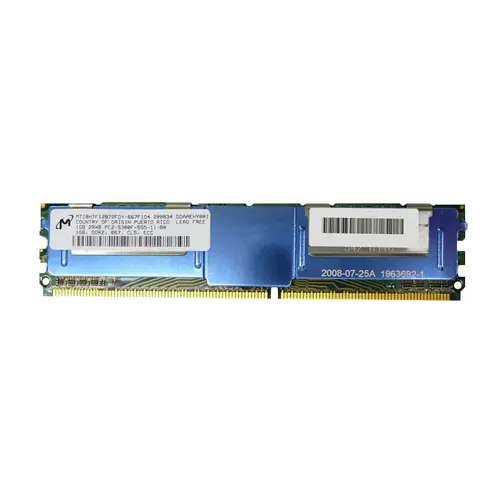
This 1GB FB-DIMM with ECC and Fully Buffered signaling is engineered for legacy server platforms where data integrity and signal stability are critical, making it suitable for light virtualization or memory-database caching roles on aging dual-socket systems. Its Dual Rank x8 organization and CL5 latency provide a balanced access profile, while the fully buffered architecture ensures robust signal quality across multiple DIMMs per channel.
1. ECC protection detects and corrects single-bit memory errors on-the-fly, safeguarding transactional integrity in mission-critical database and financial servers where even silent data corruption is unacceptable.
2. Fully Buffered architecture serializes address and data signals, enabling a high-capacity memory channel with improved signal integrity that sustains throughput under heavily populated server racks.
3. Dual Rank x8 organization interleaves memory accesses across two internal rank groups, boosting command bus utilization and reducing idle cycles for virtualized environments hosting multiple concurrent VMs.
4. The 1 GB module capacity serves as a granular building block for right-sizing enterprise workloads, allowing precise memory allocation per virtual machine without overprovisioning costly resources.
5. Operating at 667 MHz, the module delivers a peak bandwidth of approximately 5.3 GB/s, which balances power-efficient compute node performance for routine web serving and light containerized applications.
The MT18HTF12872FDY-667F1D4 is a server-grade fully buffered DIMM, purpose-built for legacy enterprise platforms that still demand unwavering reliability. Its four defining characteristics translate directly into operational confidence for IT managers.
First, ECC error correction is non-negotiable in memory-resident database servers such as ageing ERP systems running on DDR2-era hardware. A single undetected bit flip in financial transaction tables can cascade into silent data corruption; ECC detects and corrects single-bit errors in real time, preserving data integrity without taking the node offline. Second, the fully buffered architecture decouples the memory bus from the DRAM devices via an advanced buffer chip. This allows dense population of all 240-pin slots on a 4-way virtualization host without signal degradation, so you can safely allocate more memory to guest virtual machines running legacy line-of-business applications. Third, the dual-rank x8 organization enables rank interleaving, boosting effective bandwidth during simultaneous read/write bursts. In a VMWare ESX cluster consolidating multiple file servers, this translates to lower latency under heavy context-switching loads. Finally, the JEDEC-standard DDR2-667 speed and 1.8V operating voltage ensure consistent, predictable thermal profiles inside 1U rackmount servers, where cooling headroom is minimal and every watt of reduced power draw helps maintain long-term stability in a 24/7 data center environment.
Capacity Planning Guide for FB-DIMM DDR2-667 ECC Server Memory
Your module (1GB, DDR2-667, ECC, Fully Buffered) is legacy server-class memory. FB-DIMMs were common in older enterprise servers and workstations requiring high capacity and reliability. Given its age and density, plan carefully for specific workloads.
General Virtualization
A single 1GB FB-DIMM is insufficient for modern hypervisors. For very light, legacy virtualized environments, install the maximum number of modules your board supports, ideally populating all channels with identical Dual Rank x8 DIMMs to leverage the FB-DIMM’s serial throughput. Even then, allocate strictly to retired guest OS instances needing minimal RAM.
In-Memory Database
In-memory databases demand large capacities and absolute data integrity. While ECC is critical, 1GB sticks severely limit dataset size. Fill every DIMM slot to aggregate capacity, but recognize that real-time analytics on terabytes is impossible. Use only for tiny indexing caches where ECC-protected correctness outweighs performance.
High Performance Computing (HPC)
HPC clusters using DDR2-era nodes benefit from the FB-DIMM’s buffered architecture for memory bandwidth at scale. Install matched quad or octal sets in each node for balanced memory interleaving. However, the 667MHz speed and CL5 latency create a bottleneck for modern compute-bound tasks; restrict usage to throughput-oriented, embarrassingly parallel codes with low memory pressure.
This fully buffered server memory is rigorously tested for guaranteed compatibility with Dell PowerEdge 2950/2900, HP ProLiant DL380 G5, and IBM System x3650.
Q: Can I mix this MT18HTF12872FDY-667F1D4 with other memory modules of different brands or speeds?
A: Mixing FB-DIMMs of different brands or speeds is not recommended. It can cause system instability and performance degradation. Use identical modules for guaranteed compatibility.
Q: Is this memory compatible with my server system?
A: This is a 1GB DDR2-667 Fully Buffered DIMM with ECC. It is compatible with Intel 5000/5100/5400 series chipsets and select AMD servers requiring 240-pin FB-DIMMs. Verify your server's memory QVL.
Q: What is the recommended DIMM population order for optimal performance?
A: Populate channels in matched pairs, following the server board's slot numbering sequence. For dual-rank FB-DIMMs, install identical modules per channel to maintain balanced interleaving and reliability.
Q: Does this module support overclocking or XMP profiles?
A: No. Enterprise-grade FB-DIMMs operate at fixed JEDEC standards for stability and data integrity. Overclocking and XMP are not supported and would compromise ECC reliability.
Q: What warranty and typical failure rate can I expect?
A: This module includes a 1-year warranty. Actual failure rates are extremely low, in line with enterprise server memory standards, ensuring high reliability for 24/7 operation.