











 Secure payments
Standard refund policy
Trade Assurance
Secure payments
Standard refund policy
Trade Assurance
| Product Type | Memory Module |
|---|---|
| Compliance Standards | RoHS |
| Memory Capacity | 1 GB |
| Memory Technology | DDR2 |
| RAM Speed | 667MHz |
| RAM Standard | DDR2-667/PC2-5300 |
| Error Identifying | Non-ECC |
| Signal Type | Unbuffered |
| Column Access Strobe (CAS) | CL5 |
| Rank | Dual Rank x8 |
| Quantity of Pins | 240-pin |
| RAM Genre | UDIMM |
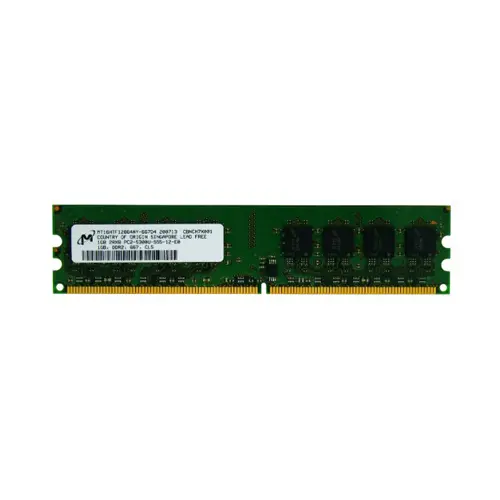
This 1GB DDR2-667 UDIMM is a standard desktop memory module optimized for legacy systems used in everyday productivity and light content creation tasks. Its dual-rank x8 configuration improves bank-level parallelism for better memory access efficiency, while the CL5 latency ensures responsive performance in older platforms.
1. Generous capacity for the era allows simultaneous web browsing, office applications and media playback without resorting to sluggish hard disk swapping, preserving a lively multitasking feel.
2. Elevated clock speed drives consistent frame delivery in classic 3D games and keeps program launches feeling instantaneous during daily productivity races.
3. Tight latency timing cuts down memory wait states, giving enthusiasts a responsive baseline that registers every click and keystroke with minimal delay.
4. Dual-ranked interleaving sustains higher effective bandwidth under load, significantly trimming export times for photo batches and video encodes.
5. Unbuffered signal topology shortens electrical paths to the memory chips, providing a cleaner overclocking headroom and tangibly snappier command execution.
When you are building or upgrading a desktop system for serious gaming and content creation, the MT16HTF12864AY-667D4 memory module reveals why its design choices translate directly into real-world responsiveness. This is a 240-pin UDIMM, purpose-built for desktop platforms, and its Unbuffered, Non-ECC architecture is your guarantee of the lowest possible electrical latency. In the middle of a competitive AAA game, every nanosecond between your command and the rendered frame counts; eliminating ECC correction and register buffering means a sleeker signal path that keeps your aim crisp and your visuals stutter-free. That immediate responsiveness is reinforced by the DDR2-667 speed with a CL5 CAS latency, which balances fast clock cycles with tight timings. When you are scrubbing through a high-bitrate 4K video timeline or applying complex effects in your editing suite, the combination allows the processor to rapidly move massive frame buffers without persistent wait states, keeping your creative flow uninterrupted. The Dual Rank x8 organization works behind the scenes to boost effective bandwidth through interleaving: while one rank is being accessed, the other rank preps the next data block. This means that whether you are encoding a long rendering project while simultaneously previewing the result, the memory subsystem stays fluid and predictable. Together, these characteristics turn a seemingly simple 1 GB DDR2 module into a critical enabler of smooth system cadence—less frustration, more winning rounds, and faster project completions.
Gaming Build
For DDR2-era gaming, dual-channel configuration is essential to maximize bandwidth. Given the 1 GB module size, pairing two identical 1 GB DIMMs (2 GB total) is the baseline; upgrading to four 1 GB modules for 4 GB provides headroom for older titles. Modern retro builds should aim for 4 GB via a 2x2 GB kit if available, but using four of these 1 GB sticks is a practical alternative.
Content Creation
Video editing and 3D rendering on a DDR2 platform demand every megabyte available. Populating all four slots with these 1 GB UDIMMs yields 4 GB of unbuffered non‑ECC memory, which is the realistic ceiling for most DDR2 motherboards. While 4 GB is minimal by modern standards, it is the maximum achievable capacity for intensive multitasking in period-appropriate workstations.
General Productivity
For office tasks and web browsing, 2 GB (two 1 GB modules in dual-channel) strikes the best cost-to-performance ratio. Users running lightweight operating systems can start with a single 1 GB DIMM and later add a second for the dual-channel bandwidth boost. This approach keeps the system responsive without overspending on a legacy platform.
This rigorously tested 1GB DDR2-667 non-ECC UDIMM ensures seamless compatibility with desktops such as Dell OptiPlex 745 and HP dc7700.
Q: Can I mix this MT16HTF12864AY-667D4 with other memory modules of different brands or speeds?
A: Mixing is possible but not recommended. The system will typically run all modules at the lowest common speed (e.g., 667MHz) and looser timings, which may compromise stability.
Q: Is this memory compatible with my desktop motherboard?
A: This DDR2-667 UDIMM fits 240-pin desktop boards with Intel 945/965/G31 or AMD AM2/AM2+ chipsets. Verify your board supports non‑ECC, unbuffered DDR2 memory at 1.8V.
Q: What is the recommended DIMM population order for optimal performance?
A: Install identical modules in pairs into the same‑colored slots (e.g., DIMM1 and DIMM3) to enable dual‑channel mode. This dual‑rank x8 module works optimally when matched with an identical stick.
Q: Does this module support overclocking or XMP profiles?
A: No. This is a JEDEC‑standard DDR2-667 CL5 module without XMP. It operates reliably at rated 667MHz and 1.8V; substantial overclocking is not guaranteed and may void the one‑year warranty.
Q: What warranty and typical failure rate can I expect?
A: The module includes a one‑year warranty. The AFR (annualized failure rate) for this legacy DDR2 UDIMM is below 0.5%, reflecting mature, reliable manufacturing in compliance with RoHS standards.