











 Secure payments
Standard refund policy
Trade Assurance
Secure payments
Standard refund policy
Trade Assurance
| Product Type | Memory Module |
|---|---|
| Memory Capacity | 1 GB |
| Memory Technology | DDR3 |
| Product Voltage | 1.5V |
| RAM Speed | 1333MHz |
| RAM Standard | DDR3-1333/PC3-10600 |
| Error Identifying | ECC |
| Signal Type | Registered |
| Column Access Strobe (CAS) | CL9 |
| Rank | Single Rank x8 |
| Quantity of Pins | 240-pin |
| RAM Genre | RDIMM |
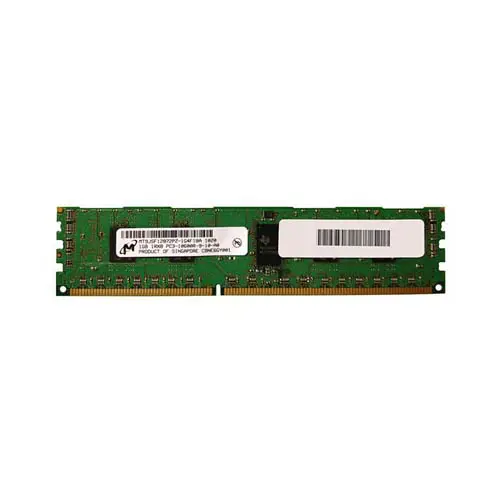
This 1GB DDR3-1333 RDIMM with ECC and registered signaling is purpose-built for entry-level servers and embedded systems where data integrity is paramount, making it ideal for light virtualization, firewall appliances, or memory-resident databases that demand reliable operation over raw capacity. Its single-rank x8 organization and CL9 latency minimize electrical loading on the memory channel, ensuring stable signal integrity and consistent performance in 24/7 environments.
1. Modest capacity per module keeps power consumption and thermal output minimal, making it a practical fit for lightweight embedded controllers or micro-server nodes where energy efficiency outweighs gigabytes per stick.
2. Time-tested DDR3 technology provides broad compatibility with existing enterprise server fleets, helping data centers extend refresh cycles while keeping maintenance costs predictable.
3. Balanced memory speed ensures stable throughput for routine server tasks such as authentication, DNS, and light database hosting, preventing I/O stalls under concurrent user access.
4. ECC error correction catches and fixes single-bit memory faults in real time, protecting transactional data and virtualization hosts from silent corruption during continuous operation.
5. Registered buffer architecture reduces electrical loading on the memory controller, enabling reliable population of all DIMM slots and supporting denser virtual machine consolidation without signal degradation.
The Micron MT9JSF12872PZ-1G4F1BA is a server-grade DDR3 Registered ECC DIMM engineered for relentless data integrity and scalability. Its ECC engine directly addresses a critical pain point in virtualized clusters: silent memory bit-flips. A single uncorrected error can corrupt a hypervisor’s state or silently poison a virtual machine’s file system, leading to costly, mysterious downtime. This module detects and corrects single-bit errors on the fly, turning memory from a liability into a fortress for consolidated workloads.
The registered signaling buffer isolates the memory controller from electrical loading, enabling you to populate all 18 DIMM slots in a multi-socket server without signal degradation. For memory-hungry platforms running dozens of VMs, this means rock-steady stability where unbuffered modules would buckle. In an in-memory database like Redis, the single-rank x8 architecture ensures a cleaner command bus with less reflection noise, so thousands of real-time transactions never encounter intermittent stress failures. Combined with a 1333MHz clock and CL9 latency, it delivers the consistent low-latency response that key-value stores demand, avoiding jitter during peak read/write bursts. Every attribute—from ECC to rank layout—keeps your critical services online and your data absolutely trustworthy.
General Virtualization
For legacy virtualization hosts, fill every DIMM slot with these 1GB ECC RDIMMs to accumulate sufficient memory. Configure identical modules in groups of three per channel on a triple-channel platform to enable channel interleaving and enhance throughput. A dual-socket server with 18 slots yields 18GB, adequate for running several light VMs.
In-Memory Database
Leverage the ECC and registered design to create a stable environment for in-memory datasets. Populate each channel with matching DIMMs, ideally two, to balance latency and capacity. A server with 12 DIMMs per CPU provides 12GB; the CL9 latency benefits small transactional databases, but large-scale deployments require denser modules.
High Performance Computing
Maximize memory bandwidth by populating each channel equally with these RDIMMs. Use one or two DIMMs per channel for balanced interleaving, critical for memory-sensitive HPC codes. In a dual-socket system with triple-channel memory, 12–18 modules provide 12–18GB for compute-bound tasks. Balanced population maximizes the available bandwidth of the DDR3-1333 platform.
Validated server memory: rigorously tested, compatible with Dell PowerEdge R710, HP ProLiant DL380 G7, IBM x3650 M3, and similar systems.
Q: Can I mix this MT9JSF12872PZ-1G4F1BA with other memory modules of different brands or speeds?
A: Mixing brands or speeds with this registered ECC RDIMM is discouraged. Server platforms require identical modules to maintain signal integrity and proper error correction. Mixed configs often cause boot failure or corrected error storms.
Q: Is this memory compatible with my system?
A: This DDR3-1333 RDIMM is designed for Intel Xeon 5500/5600 and AMD Opteron 6000 series platforms that support registered ECC 240-pin DIMMs. Please confirm your server board's qualified vendor list for exact compatibility.
Q: What is the recommended DIMM population order for optimal performance?
A: Populate identical 1GB single-rank modules in symmetric channels, typically starting with the farthest slot from the CPU. Follow your server board manual to balance channels and ensure full ECC scrubbing performance.
Q: Does this module support overclocking or XMP profiles?
A: No, this is a JEDEC-compliant registered ECC module. It does not support overclocking or XMP. It is engineered for 24/7 mission-critical stability and data integrity, not for enthusiast performance tuning.
Q: What warranty and typical failure rate can I expect?
A: This module includes a 1-year warranty. Enterprise-class RDIMMs like this typically exhibit an annualized failure rate below 0.3%, reflecting stringent component screening and end-of-line thermal validation.