











 Secure payments
Standard refund policy
Trade Assurance
Secure payments
Standard refund policy
Trade Assurance
| Product Type | Memory Module |
|---|---|
| Compliance Standards | RoHS |
| Memory Capacity | 1 GB |
| Memory Technology | DDR |
| RAM Speed | 333MHz |
| RAM Standard | DDR-333/PC-2700 |
| Error Identifying | Non-ECC |
| Signal Type | Unbuffered |
| Column Access Strobe (CAS) | CL2.5 |
| Rank | Dual Rank x8 |
| Quantity of Pins | 184-pin |
| RAM Genre | UDIMM |
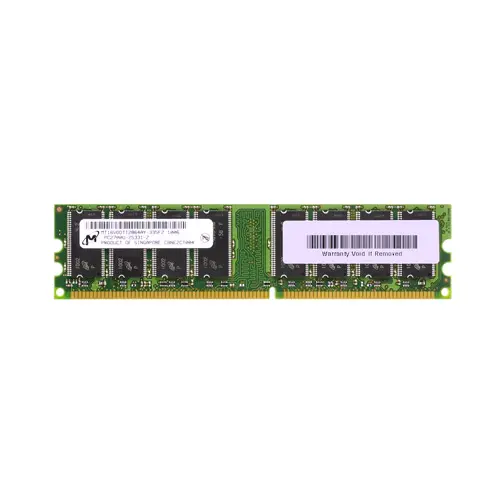
This DDR-333 (PC-2700) unbuffered, non-ECC UDIMM is purpose-built for legacy desktop platforms, delivering reliable performance for vintage gaming, retro content creation, or industrial control workloads. Its dual-rank x8 organization and CL2.5 low-latency column access strobe significantly improve memory bank interleaving and command response, ensuring stable, responsive operation in older systems that require direct, unbuffered signaling.
1. Its one-gigabyte density comfortably caches a full suite of background utilities and a memory-hungry browser, preventing swap thrashing and keeping everyday multitasking fluid on a family or home-office desktop.
2. The 2.7 GB/s peak throughput pushes texture streaming and map loading past the stutter zone, delivering consistent frame pacing in classic and e‑sports titles without choking the North Bridge.
3. A column access strobe of just two-and-a-half cycles cuts the wait for critical data, tightening the feel of every click and keystroke during fast-paced gaming and content editing sessions.
4. Dual Rank organization interleaves bank accesses to sustain bandwidth under load, directly lifting minimum frame rates and smoothing out desktop compositing when multiple windows overlap.
5. Unbuffered signaling removes register latency from the command path, giving overclockers the clean timings they need to push the memory controller further and shave microseconds off system responsiveness.
The MT16VDDT12864AY-335F2 is a 1 GB DDR-333 UDIMM built for desktop platforms, and its four defining characteristics — Non-ECC operation, Unbuffered signal path, Dual Rank x8 configuration, and CL2.5 latency — are decisive in real-world performance. In AAA gaming, the CL2.5 CAS latency tightens the gap between data request and delivery, reducing frame-time spikes that cause micro-stutter during fast-paced firefights. The dual-rank design enables rank interleaving, effectively doubling the likelihood that a pending read is ready on the next clock cycle; this matters when high-resolution textures stream continuously, keeping immersion seamless. Unbuffered architecture eliminates the register delay found in server modules, preserving the snappy responsiveness that content creators rely on when scrubbing through 4K video timelines in DaVinci Resolve or layering effects in After Effects. The absence of ECC overhead further trims latency and cost, aligning perfectly with the desktop user’s priority: raw speed and smooth multitasking over mission-critical data integrity. Whether you are upgrading an aging workstation for freelance design or fine-tuning a retro gaming rig, this PC-2700 module balances low-latency bandwidth with practical affordability, ensuring that memory bottlenecks never sabotage your creative flow or competitive edge.
Gaming Build
Given the 1 GB DDR-333 UDIMMs, a dual-channel configuration is possible by installing two matched modules for a total of 2 GB. This setup doubles the memory bandwidth to 2.7 GB/s, which can slightly improve frame-time consistency in period-appropriate titles from the early 2000s. However, it falls far short of modern 16 GB or 32 GB requirements and is only viable for retro gaming rigs using compatible DDR1 motherboards.
Content Creation
For content creation workloads like video editing or 3D rendering on legacy platforms, maximizing capacity is essential. Populate all available DIMM slots with these 1 GB modules—four modules for 4 GB total—although the practical ceiling is limited by the chipset. Even at maximum density, the memory pool remains insufficient for high-resolution assets, so this configuration is best suited to lightweight SD video work or vintage software with modest RAM demands.
General Productivity
A cost-effective productivity setup should start with a single 1 GB module for basic operating system tasks and office applications, with the option to add a second module for dual-channel benefits and 2 GB total. This balances responsiveness and expense for old machines running lightweight Linux distributions or Windows XP. Avoid investing in more modules than the system’s memory slots can physically accept, as the 1 GB capacity per stick already represents the peak density for this DDR-333 generation.
This 1GB DDR PC2700 UDIMM is rigorously tested for desktops: Dell Dimension 4600, OptiPlex GX270, HP Compaq D530.
Q: Can I mix this MT16VDDT12864AY-335F2 with other memory modules of different brands or speeds?
A: Mixing brands or speeds is not recommended. The system will default to the slowest module’s timings, potentially causing instability. For optimal reliability, use identical modules in matched pairs consistently.
Q: Is this memory compatible with my desktop motherboard?
A: This module is compatible with motherboards supporting 184-pin DDR-333/PC-2700 unbuffered non-ECC memory. Verify your chipset (e.g., Intel 845/865 series) and ensure it accepts 1GB dual-rank x8 UDIMMs.
Q: What is the recommended DIMM population order for optimal performance?
A: For single-channel boards, any slot is acceptable. For dual-channel platforms, install two identical modules in the same color-coded slots. This dual-rank module can be used alone or in matched pairs for best throughput.
Q: Does this module support overclocking or XMP profiles?
A: No, this JEDEC-standard DDR-333 module does not support XMP or overclocking. It operates exclusively at its rated PC-2700 specification with CL2.5 latency to ensure maximum system stability.
Q: What warranty and typical failure rate can I expect?
A: This module includes a one-year warranty. Typical annualized failure rate (AFR) is below 0.5% under normal operating conditions, consistent with industry expectations for high-quality DRAM deployed in standard environments.