











 Secure payments
Standard refund policy
Trade Assurance
Secure payments
Standard refund policy
Trade Assurance
| Model | MT18HTF12872DY-40EA1 |
|---|---|
| Product Type | Memory Module |
| Compliance Standards | RoHS |
| Memory Capacity | 1 GB |
| Memory Technology | DDR2 |
| Product Voltage | 1.8V |
| RAM Speed | 400MHz |
| RAM Standard | DDR2-400/PC2-3200 |
| Error Identifying | ECC |
| Signal Type | Registered |
| Column Access Strobe (CAS) | CL3 |
| Rank | Dual Rank x8 |
| Quantity of Pins | 240-pin |
| RAM Genre | RDIMM |
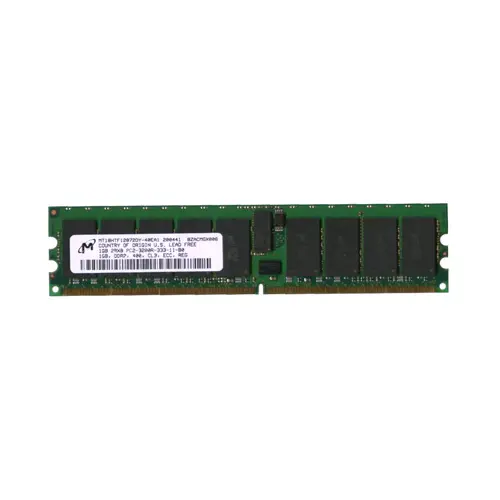
This is a legacy server-grade 1GB DDR2-400 Registered ECC memory module (PC2-3200 RDIMM) tailored for older enterprise platforms running virtualization or memory-intensive database workloads. Its dual-rank x8 configuration and registered signal type help maintain signal integrity under high-density configurations, while ECC and low CL3 latency ensure data accuracy and responsive memory access for mission-critical stability.
1. ECC memory protection silently corrects single-bit errors, preventing data corruption in mission-critical server applications that demand continuous uptime.
2. Registered signaling buffers command and address lines, allowing servers to populate numerous DIMMs per channel without compromising signal integrity, which is vital for high-capacity virtualization farms.
3. Dual-rank organization interleaves memory accesses across multiple internal banks, increasing sustained bandwidth for concurrent virtual machine execution and heavy database operations.
4. Low column access latency minimizes the delay from read request to data fetch, reducing CPU stall cycles in latency-sensitive enterprise workloads like in-memory caching.
5. Moderate clock frequency paired with efficient data staging delivers reliable baseline throughput, supporting stable performance for legacy infrastructure refreshes and embedded server appliances.
The MT18HTF12872DY-40EA1 is a server-class registered DIMM, purpose-built for environments where downtime is unacceptable and data accuracy is nonnegotiable. Its ECC technology actively detects and corrects single-bit memory errors caused by background radiation or electrical noise—a silent threat that, in a virtualization cluster hosting dozens of virtual machines, could otherwise corrupt hypervisor state or silently flip a critical calculation in a financial database. The registered signal buffer is equally vital: it redrives address and command lines, stabilizing signal integrity when multiple DIMMs populate a server board. In a dense memory configuration for an in-memory database like Redis or SAP HANA, this means you can scale capacity reliably without sacrificing boot-time stability or risking intermittent glitches under heavy load. Additionally, the dual-rank x8 organization leverages rank interleaving, allowing the memory controller to pipeline accesses between two internal ranks on the same module. This directly improves bandwidth utilization during concurrent query execution, where a single rank would force idle wait states. With a CAS latency of just 3 cycles at 400MHz, the module serves cached data with minimal delay—an advantage that translates into faster transaction commit times and smoother real-time analytics, keeping your services responsive when every millisecond counts.
General Virtualization
This 1GB DDR2-400 Registered ECC RDIMM is designed for legacy server platforms. For lightweight virtualization on older hypervisors, populate all memory channels symmetrically to preserve memory interleaving and ECC integrity. A typical host with 4 or 8 such modules (4–8 GB) can support a small number of low-resource VMs, but capacity is extremely limited by modern standards — plan to maximize DIMM slots.
In-Memory Database
In-memory databases demand large, fast memory pools, making 1GB modules impractical for production datasets. If repurposing this memory, install the maximum supported number of identical RDIMMs (e.g., 8 or 16) to create a modest cache tier or a test bed. Be aware that DDR2-400 bandwidth and 1GB granularity severely constrain dataset size and query performance; consider this only for education or proof-of-concept setups.
High-Performance Computing (HPC)
HPC clusters rely on balanced memory bandwidth and capacity per node. This Registered DIMM can serve in a legacy compute node if populated evenly across memory channels for optimal throughput. For memory-bound simulations, deploy dual-rank modules to leverage rank interleaving, and fill all available channels with matched RDIMMs to extract maximum memory parallelism from the DDR2 memory controller.
Rigorously tested, compatible with Dell PowerEdge 2800, HP DL380 G4, IBM x346, and similar servers.
Q: Can I mix this MT18HTF12872DY-40EA1 with other memory modules of different brands or speeds?
A: Mixing is not recommended. Registered ECC modules must be identical in speed, rank, and organization to prevent signal integrity issues and ensure server stability. Always use matched kits.
Q: Is this memory compatible with my system?
A: This 1GB DDR2-400 Registered ECC RDIMM is compatible with servers using Intel 5000/5100 series chipsets or AMD Opteron platforms that support 240-pin Registered memory. Verify your board’s qualified vendor list.
Q: What is the recommended DIMM population order for optimal performance?
A: Follow your server board manual. Typically, populate the slots furthest from the CPU first, filling identical channels per bank. Balanced interleaving across memory controllers maximizes throughput.
Q: Does this module support overclocking or XMP profiles?
A: No. This is a JEDEC-compliant Registered ECC module built for reliability, not overclocking. It operates at fixed 400MHz with CL3 timings to maintain data integrity in 24/7 server environments.
Q: What warranty and typical failure rate can I expect?
A: This module carries a one-year warranty. Built with enterprise-grade components and rigorous testing, it delivers very low AFR, typically under 0.5%, backed by robust in-system error correction.