











 Secure payments
Standard refund policy
Trade Assurance
Secure payments
Standard refund policy
Trade Assurance
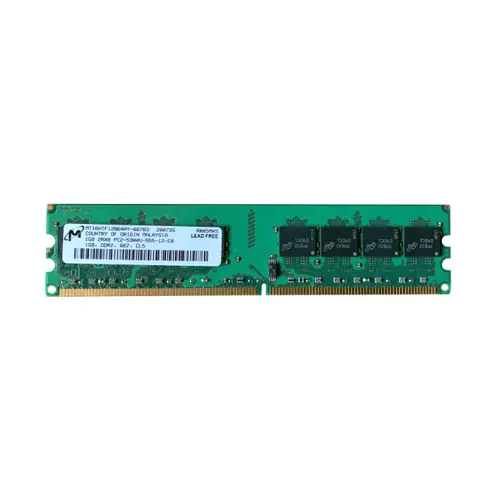
| Product Type | Memory Module |
|---|---|
| Compliance Standards | RoHS |
| Memory Capacity | 1 GB |
| Memory Technology | DDR2 |
| RAM Speed | 667MHz |
| RAM Standard | DDR2-667/PC2-5300 |
| Error Identifying | Non-ECC |
| Signal Type | Unbuffered |
| Column Access Strobe (CAS) | CL5 |
| Rank | Dual Rank x8 |
| Quantity of Pins | 240-pin |
| RAM Genre | UDIMM |
This unbuffered, non-ECC DDR2-667 UDIMM is a desktop-class module ideally suited for mainstream productivity and light content creation on older systems, where its dual-rank x8 organization improves bank-level parallelism for smoother multitasking. The CL5 latency and unbuffered signaling deliver deterministic command response and stable operation at 667 MHz, making it a reliable upgrade for extending the life of legacy desktop platforms.
1. A full gigabyte of memory comfortably handles everyday desktop tasks and classic gaming without swap thrashing, keeping the system responsive under light multitasking loads.
2. The elevated clock speed drives rapid frame buffer updates, helping to maintain smooth visuals and consistent frame pacing in legacy gaming titles.
3. Tight CAS latency reduces the time the processor waits for data, sharpening system responsiveness during intensive multitasking and fast-paced action sequences.
4. Dual-rank organization leverages bank interleaving to keep data pipelines full, which is essential for accelerating content creation workflows like photo editing and media conversion.
5. Unbuffered signaling bypasses register delays, giving overclockers a cleaner and more immediate memory path for chasing higher system performance and lower latency.
Designed as a desktop UDIMM, this module’s four defining characteristics directly tackle real-world performance pain points for gamers and creative professionals. The non‑ECC, unbuffered architecture strips away the error‑checking overhead found in server memory, allowing the memory controller to issue commands with minimal latency. When you are mid‑raid in a triple‑A title or scrubbing through a 1080p video timeline, that reduced delay means fewer micro‑stutters and faster response to every click. Running at 667MHz with a tight CL5 CAS latency, the module delivers a responsive sweet spot: the clock speed keeps frame rates consistent, while the low column access time ensures the CPU rarely waits for critical data, which is essential during CPU‑intensive rendering passes. The dual‑rank x8 organization takes this further by interleaving accesses across two internal ranks, effectively widening the data pipeline under heavy multitasking. For anyone breathing life into an older desktop, the standard 240‑pin UDIMM form factor guarantees instant, drop‑in compatibility with a vast range of motherboards. Together, these attributes transform an aging system into a capable workhorse—whether you are exporting a project deadline or chasing a leaderboard rank, you experience tangible smoothness where it matters most.
Memory Type Determination:
Non-ECC, unbuffered, 240‑pin UDIMM with DDR2‑667/PC2‑5300 specifications clearly identifies this as desktop memory.
Capacity Planning Guide
Gaming Build
For a dual‑channel configuration on a legacy DDR2 platform, start with two matched 1 GB modules (2 GB total). For the best possible gaming experience within the platform’s limits, populate all four DIMM slots with identical 1 GB modules to achieve 4 GB of dual‑channel memory. Note that modern 16 GB/32 GB kits are unsupported; a platform upgrade is required for contemporary gaming.
Content Creation
Video editing and 3D rendering demand maximum capacity, but a 64 GB target is impossible with DDR2. Install four 1 GB modules to reach the realistic 4 GB ceiling, configuring them as two dual‑channel pairs to maximize bandwidth. Given the severe capacity restriction, this platform is only viable for light legacy projects; migrating to a DDR4/DDR5 system is strongly recommended for professional workloads.
General Productivity
A cost‑effective office and multitasking setup uses two 1 GB modules in dual‑channel mode (2 GB total), providing smooth performance for web browsing, documents, and light spreadsheets. If the budget is extremely tight, even a single 1 GB module works, but adding a second identical UDIMM yields noticeable responsiveness gains without significant expense.
This rigorously tested desktop memory is compatible with systems such as Dell OptiPlex 755, HP dc7800, and Lenovo ThinkCentre M57.
Q: Can I mix this MT16HTF12864AY-667B3 with other memory modules of different brands or speeds?
A: Mixing is possible, but all modules will operate at the slowest common speed and latency. For stable desktop performance, we recommend identical DDR2-667 UDIMMs with matching CAS latency and dual-rank organization.
Q: Is this memory compatible with my system?
A: This DDR2-667 UDIMM is compatible with desktop motherboards supporting 240-pin DDR2 at PC2-5300. Please verify your chipset’s memory support (e.g., Intel 965/G31 series) and ensure 1 GB per slot capacity is accepted.
Q: What is the recommended DIMM population order for optimal performance?
A: Install matched pairs in the same-colored slots to enable dual-channel interleaving. On most desktop boards, populate slots DIMM1 and DIMM3 first, or follow your motherboard manual for the preferred dual-channel configuration.
Q: Does this module support overclocking or XMP profiles?
A: No. This JEDEC-standard DDR2-667 module does not support XMP, which was introduced with DDR3. It is designed for reliable plug-and-play operation at 667 MT/s with CL5 latency and does not feature overclocking profiles.
Q: What warranty and typical failure rate can I expect?
A: This memory is backed by a 1-year warranty. As a RoHS-compliant, non-ECC UDIMM built to Micron specifications, it has a very low annual failure rate under normal desktop operating conditions.