











 Secure payments
Standard refund policy
Trade Assurance
Secure payments
Standard refund policy
Trade Assurance
| Product Type | Memory Module |
|---|---|
| Memory Capacity | 1 GB |
| Memory Technology | DDR3 |
| RAM Standard | DDR3-1333/PC3-10600 |
| Error Identifying | ECC |
| Signal Type | Registered |
| RAM Genre | DIMM |
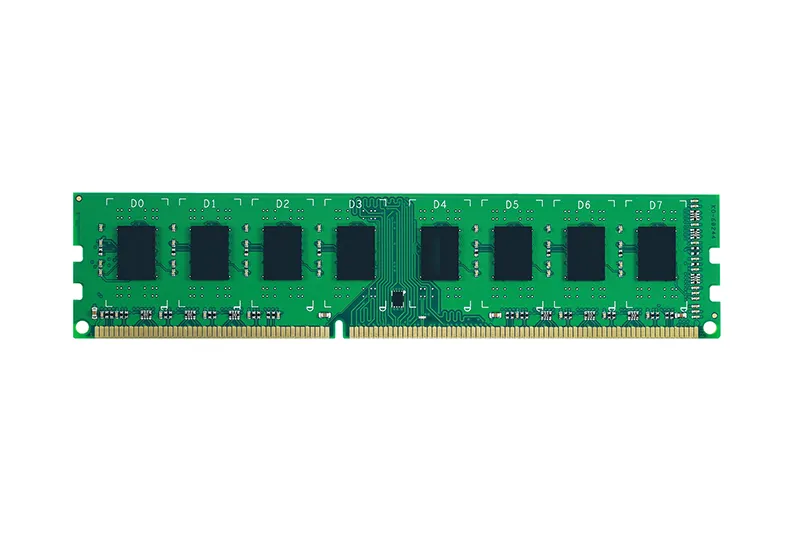
This is a server-grade DDR3 Registered DIMM with ECC, purpose-built for platforms requiring uncompromising data integrity in virtualized environments and memory-intensive database workloads. Its registered signal type stabilizes high-density configurations by reducing electrical load on the memory controller, while ECC protection actively corrects single-bit errors to prevent silent data corruption in mission-critical operations.
1. Modest density module suits dedicated microservices or embedded server nodes where per-slot capacity is secondary to cost and long-term reliability.
2. DDR3 technology provides a proven, power-efficient base for legacy enterprise servers, ensuring stable operation across extended deployment lifecycles.
3. The mainstream speed grade delivers steady bandwidth perfectly matched to predictable workloads like file serving or light database hosting.
4. ECC correction continuously scrubs single-bit errors, preserving data accuracy for financial transaction logs and virtualization metadata integrity.
5. Registered signal buffering decouples electrical loading, allowing multiple DIMMs to coexist in a channel without degrading command stability in density-packed racks.
The MTS9JSF12872PY is unmistakably a server memory module, evidenced by its ECC, Registered signal type, and standard DIMM form factor. In mission‑critical environments, these four characteristics translate directly into uptime and accuracy. First, Error Correcting Code (ECC) is non‑negotiable. Within a virtualization cluster, a single undetected bit-flip in the hypervisor’s memory can cascade into silent data corruption across multiple guest machines or force an entire host offline. ECC detects and corrects single-bit errors at the hardware level, effectively immunizing your virtual infrastructure against cosmic ray-induced failures. Second, the Registered architecture buffers the command and address signals, dramatically reducing electrical load on the memory controller. This means that even when populating all DIMM slots in a rack server, signal integrity remains rock‑solid, preventing the boot failures and random crashes that plague unbuffered designs under heavy configurations. Third, the DDR3-1333 speed delivers a consistent 10.6 GB/s bandwidth, which for an in‑memory database like Redis is critical. Every microsecond of latency matters when serving session caches or leaderboard queries to millions of users; stable, error‑free throughput ensures real‑time responsiveness without data inconsistencies. Finally, the standard DIMM format guarantees compatibility across a wide range of server boards, simplifying upgrades in legacy virtualization nodes or purpose‑built database appliances. For you, deploying this module means guarding your transaction logs and container states with an unyielding shield against memory errors, turning what is often the weakest reliability link into the strongest foundation of your service stack.
General Virtualization
This 1 GB DDR3-1333 ECC Registered DIMM is unsuitable as a primary capacity module for modern virtualization hosts, but it can serve in small management or utility roles. In a lab or light hypervisor environment, install a pair of these modules (2 GB total) for basic integrity, though typical workloads now demand 8 GB sticks or higher. Reserve this module for firmware updates or low‑memory embedded controllers where registered ECC is still required.
In‑Memory Database
In‑memory databases require large, fast memory pools, so a single 1 GB stick is far below practical minimums. You would need an impractically high number of these modules to reach even 16 GB, which drives up power and latency. The only viable use is in a development or education testbed: deploy two modules in a dual‑channel setup purely to validate ECC and registered DIMM handling, not for performance evaluation.
High‑Performance Computing
HPC clusters rely on density and bandwidth; this 1 GB module is legacy hardware for most compute nodes. It could provide ECC‑protected boot memory for head nodes or service processors in a blade enclosure. If you have existing nodes that accept DDR3 Registered DIMMs, use them strictly in pairs to maintain channel balance and error correction, but plan a complete memory refresh for any serious workload.
DDR3 Registered ECC server memory, rigorously tested. Compatible: Dell R710, R720, HP DL380 G8, IBM x3650 M3, etc.
Q: Can I mix this MTS9JSF12872PY with other memory modules of different brands or speeds?
A: Mixing different brands or speeds with registered ECC memory is not recommended, as it may cause stability issues or unbootable systems. To ensure reliable server operation, use identical modules with the same rank, latency, and part number.
Q: Is this memory compatible with my system?
A: This DDR3-1333 ECC Registered DIMM is designed for server platforms such as Intel Xeon 5500/5600 series or AMD Opteron 4100/6100 series. Please verify your motherboard's qualified vendor list and ensure it supports 1.5V registered memory.
Q: What is the recommended DIMM population order for optimal performance?
A: Populate DIMMs per the server board manual, typically filling identical slots per memory channel grouping (e.g., blue slots first) to enable multi-channel interleaving. For triple-channel systems, install in sets of three matching modules.
Q: Does this module support overclocking or XMP profiles?
A: No. As an enterprise-grade ECC Registered DIMM, it adheres strictly to JEDEC DDR3-1333 specifications. Overclocking and XMP are disabled to guarantee data integrity and 24/7 operational stability in server environments.
Q: What warranty and typical failure rate can I expect?
A: This module is covered by a one-year warranty. Enterprise memory undergoes rigorous screening and burn-in testing, delivering an annualized failure rate (AFR) typically below 0.5%, ensuring exceptional long-term reliability.