











 Secure payments
Standard refund policy
Trade Assurance
Secure payments
Standard refund policy
Trade Assurance
| Product Type | Memory Module |
|---|---|
| Memory Capacity | 2 GB |
| Memory Technology | DDR3 |
| Product Voltage | 1.5V |
| RAM Speed | 1333MHz |
| RAM Standard | DDR3-1333/PC3-10600 |
| Error Identifying | ECC |
| Signal Type | Registered |
| Column Access Strobe (CAS) | CL9 |
| Rank | Dual Rank x8 |
| Quantity of Pins | 240-pin |
| RAM Genre | RDIMM |
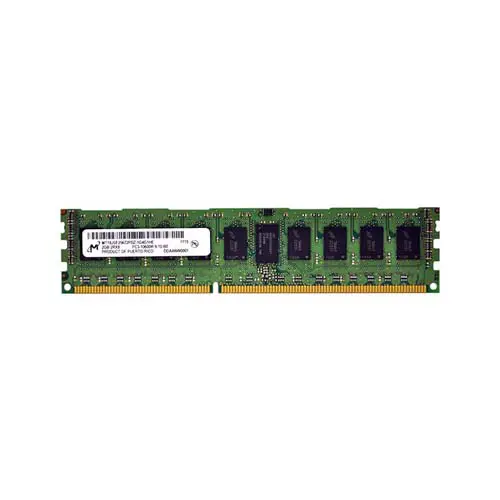
This 2GB DDR3-1333 Registered ECC DIMM in a Dual Rank x8 configuration is designed for legacy server platforms, ensuring data integrity for lightweight virtualization and memory-resident database applications. The registered signal type stabilizes command and address buses under multi-module loads, while ECC and a CL9 latency provide the reliability essential for 24/7 operation in entry-level enterprise environments.
1. ECC protection detects and corrects single-bit errors in real time, preserving data integrity during continuous operation of financial databases and mission-critical enterprise applications.
2. Registered signal buffering stabilizes command and address lines, enabling high-density server configurations where memory scalability and signal integrity directly impact virtualization host reliability.
3. Dual Rank x8 organization interleaves access across two internal rank groups, sustaining memory bandwidth saturation that keeps latency-sensitive virtual machines responsive under consolidation.
4. 1333MHz clock speed delivers sufficient throughput per channel for legacy enterprise workloads, balancing power efficiency with the bandwidth demands of concurrent database queries and hosted services.
5. CL9 column access latency offers predictable read-timing characteristics that reduce memory controller stalls, ensuring steady response times in transaction-heavy server environments.
When you are managing a virtualization cluster or an in-memory database, the choice of server memory defines your uptime and transactional consistency. The Micron MT18JSF25672PDZ-1G4G1HE is a DDR3-1333 RDIMM engineered precisely for these workloads, and its four core characteristics turn technical specifications into operational guarantees.
The registered signal type places a buffer between the memory controller and the DRAM chips, directly addressing the pain point of scaling to multiple DIMMs per channel. In a dense virtualization host packed with dozens of modules, this buffering stabilizes the electrical load on the memory bus, preventing signal degradation that would otherwise trigger random crashes during peak VM migrations. Meanwhile, the ECC engine continuously scrubs single-bit errors caused by background radiation — an inevitability in data centers. For a Redis or SAP HANA instance holding mission-critical working sets, an uncorrected bit flip is not a performance hiccup; it is silent data corruption. ECC transforms that risk into a logged, corrected event.
The dual-rank x8 organization further enhances what this means for you. Dual rank allows the memory controller to interleave accesses across two internal ranks, overlapping precharge and activation cycles. In database query processing, where repeated random-access patterns choke throughput, this interleaving yields measurably lower idle latency and higher sustained bandwidth than a single-rank module can deliver. Even CL9 latency at 1333 MT/s is tuned for steady-state reliability, not overclocking extremes. At 1.5V standard voltage, the module balances thermal headroom for 24/7 operation without throttling — essential when every rack watt counts. In the end, you are not just buying a 2GB DDR3 stick; you are investing in a foundational building block that keeps a virtualized environment predictable and in-memory datasets accurate, minute after minute.
General Virtualization
Populate at least six identical 2 GB modules per CPU (12 GB total) to enable triple‑channel interleaving. This configuration supports a handful of light virtual machines while hardware ECC corrects transient errors. If DIMM slots permit, scale symmetrically to twelve modules (24 GB) to host additional guests without sacrificing balanced memory throughput.
In‑Memory Database
Maximize capacity by filling every available DIMM slot; a dual‑socket server with 18 slots per CPU reaches roughly 72 GB using these modules. This fits small Redis instances or development‑grade databases, but it is insufficient for production in‑memory workloads. Plan a timely upgrade to 8 GB or 16 GB RDIMMs to reduce module count, power draw, and failure points.
High‑Performance Computing (HPC)
For peak bandwidth, install a single 2 GB DIMM per memory channel (6 GB per CPU), though many HPC jobs will quickly exhaust this capacity. A more practical balanced setup uses two modules per channel (12 GB per CPU) to double memory headroom while retaining most of the bandwidth. Always populate channels symmetrically; ECC and registered buffering protect data integrity during long compute runs.
Rigorously tested server memory, compatible with Dell PowerEdge R710, R720, HP DL380 G7, DL380p Gen8, and more.
Q: Can I mix this MT18JSF25672PDZ-1G4G1HE with other memory modules of different brands or speeds?
A: Mixing is not recommended in server environments. Registered ECC modules demand identical timings, ranks, and voltage for stability. Mixing brands or speeds may cause POST failures or silent data corruption.
Q: Is this memory compatible with my system?
A: This 2GB DDR3-1333 Registered ECC RDIMM is compatible with Intel 5500/5520 and AMD G34/C32 platforms. Verify your board supports 1.5V RDIMMs and ECC, and check the memory QVL for validation.
Q: What is the recommended DIMM population order for optimal performance?
A: Populate identical dual-rank RDIMMs per channel starting with the farthest slots. For dual-socket servers, balance DIMMs across all memory channels to maximize interleaving and bandwidth. Consult your system’s population guide.
Q: Does this module support overclocking or XMP profiles?
A: No. This is a JEDEC-compliant server RDIMM running standard DDR3-1333 CL9 at 1.5V. It does not support XMP, overclocking, or voltage adjustments. Strict reliability requires exactly those nominal specifications.
Q: What warranty and typical failure rate can I expect?
A: It carries a one-year warranty. Enterprise-grade Registered ECC memory typically exhibits an annualized failure rate below 0.5% under specified thermal and voltage conditions, ensuring strong long-term data integrity.