











 Secure payments
Standard refund policy
Trade Assurance
Secure payments
Standard refund policy
Trade Assurance
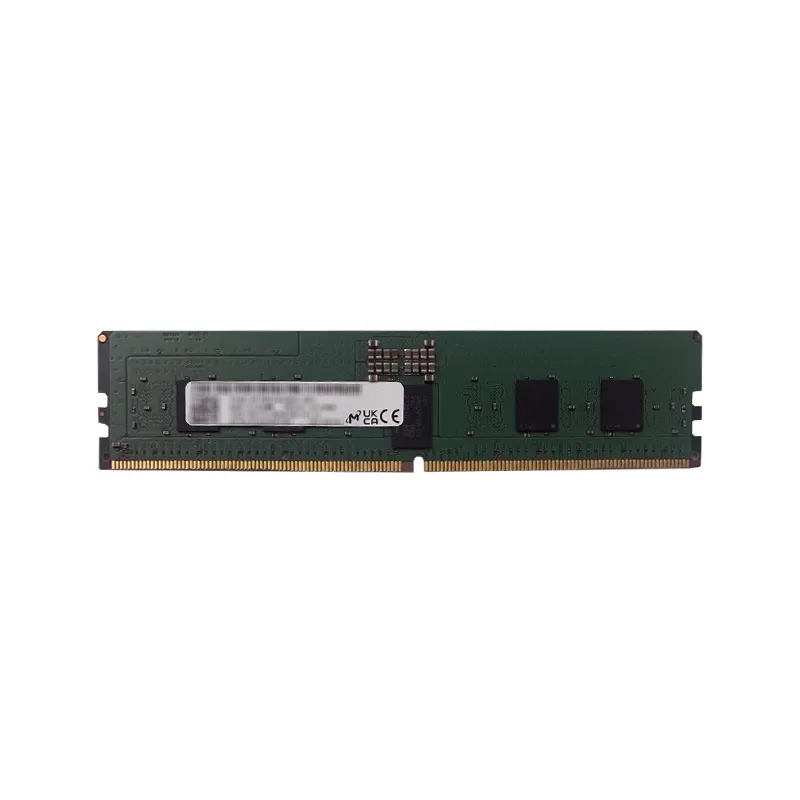
| Product Type | Memory Module |
|---|---|
| Memory Capacity | 24 GB |
| Memory Technology | DDR5 |
| Product Voltage | 1.1 V |
| RAM Speed | 4800 MHz |
| RAM Standard | DDR5-4800/PC5-38400 |
| Error Identifying | ECC |
| Signal Type | Registered |
| Column Access Strobe (CAS) | CL40 |
| Rank | Single Rank x8 |
| Quantity of Pins | 288-pin |
| RAM Genre | RDIMM |
This RDIMM with ECC and registered signal type is engineered for server environments, ensuring critical data integrity under heavy virtualization and in-memory database workloads. Its single-rank x8 configuration at DDR5-4800 delivers balanced throughput and reduced electrical loading, which enhances signal stability and allows for higher density per channel in rack-optimized platforms.
1. A 24 GB module density allows precise memory allocation per virtual machine, enabling higher consolidation ratios without wasting capacity on over-provisioned nodes.
2. DDR5 technology elevates memory bandwidth ceiling with bank-refresh parallelism, sustaining low tail latency for in-memory databases under bursty access patterns.
3. End-to-end ECC silently corrects single-bit errors and detects multi-bit corruptions, a non-negotiable safeguard for data integrity in long-running analytical workloads.
4. Registered buffering relocates signal termination on the module, preserving clean command/address paths essential for stable operation across fully populated multi-DIMM channels.
5. Operating at just 1.1 volts shrinks the power envelope per DIMM, cumulatively reducing energy and cooling demands in densely packed rack-scale deployments.
As a server memory specialist, I want to emphasize how the MTC10F108YS1RC48B DDR5 RDIMM directly solves real-world enterprise pain points. In virtualization clusters and in-memory databases, four integrated characteristics define its value. ECC is your silent guardian in financial trading or electronic health record systems where a single bit flip can corrupt a transaction or crash a Redis node; it detects and corrects errors in real time, preserving data integrity without downtime. The registered buffer acts as a signal amplifier, letting you populate all memory channels with 24 GB modules while maintaining rock-solid stability—vital when a hypervisor must host hundreds of VMs without electrical loading issues. The single-rank x8 configuration at 24 GB gives you both generous capacity and lower access latency compared to dual-rank alternatives, so your SAP HANA instance processes real-time analytics faster without the performance penalty of interleaving delays. Finally, the 1.1 V power envelope combined with 4800 MT/s bandwidth means higher compute density in every 1U rack, driving down cooling costs while consistently feeding hungry CPU cores. From multi-tenant cloud hosts to latency-sensitive financial algorithms, this memory transforms a potential bottleneck into a reliable, efficient engine that protects data, scales effortlessly, and accelerates the insights you depend on.
General Virtualization
For dense virtualization hosts, populate at least six of these 24 GB RDIMMs across a dual-socket platform to deliver 144 GB of ECC-protected capacity while keeping DIMM slots available for growth. Configure memory channels symmetrically—one DIMM per channel—to maintain balanced NUMA access and maximize throughput for mixed VM workloads.
In-Memory Database
In-memory databases demand both capacity and data integrity; deploy twelve modules (288 GB) in a two-DIMM-per-channel configuration to satisfy large working sets without immediately falling back to storage. The registered ECC design at 4800 MT/s guards against bit errors during sustained in-memory processing, ensuring predictable query latency under load.
High-Performance Computing
For bandwidth-sensitive HPC jobs, install eight modules (192 GB) with one DIMM per channel across eight memory channels to saturate the memory bus and minimize access contention. The single-rank x8 organization helps achieve lower latency at 4800 MT/s, while ECC reliability is critical for long-running simulations where silent data corruption cannot be tolerated.
Rigorously tested for servers: Dell PowerEdge R760, HPE ProLiant DL380 Gen11, Lenovo ThinkSystem SR650 V3.
Q: Can I mix this MTC10F108YS1RC48B with other memory modules of different brands or speeds?
A: Mixing this RDIMM with modules of different brands or speeds is not recommended. It may cause signal integrity issues and system instability on server platforms, potentially voiding support agreements.
Q: Is this memory compatible with my system?
A: This DDR5-4800 Registered ECC module is compatible with server boards supporting Intel Xeon Scalable (Sapphire Rapids) or AMD EPYC 9004 series processors. Verify your motherboard's QVL for RDIMMs.
Q: What is the recommended DIMM population order for optimal performance?
A: Follow your server motherboard's population guide precisely. Typically, populate identical modules in groups of eight per CPU to balance memory channels, starting with the primary slot set for each channel.
Q: Does this module support overclocking or XMP profiles?
A: No. As an enterprise RDIMM, it operates strictly at JEDEC standard DDR5-4800 CL40. Overclocking and XMP are disabled to ensure 24/7 data integrity and reliability in mission-critical environments.
Q: What warranty and typical failure rate can I expect?
A: This module includes a 1-year warranty. Built with strict quality control, its typical annualized failure rate (AFR) is well below industry average, ensuring high long-term operational reliability.