











 Secure payments
Standard refund policy
Trade Assurance
Secure payments
Standard refund policy
Trade Assurance
| Model | MT9VDDT3272AG-265G4 |
|---|---|
| Product Type | Memory Module |
| Compliance Standards | RoHS |
| Memory Capacity | 256 MB |
| Memory Technology | DDR |
| Product Voltage | 2.5V |
| RAM Speed | 266MHz |
| RAM Standard | DDR-266/PC-2100 |
| Error Identifying | ECC |
| Signal Type | Unbuffered |
| Column Access Strobe (CAS) | CL2.5 |
| Rank | Single Rank x8 |
| Quantity of Pins | 184-pin |
| RAM Genre | UDIMM |
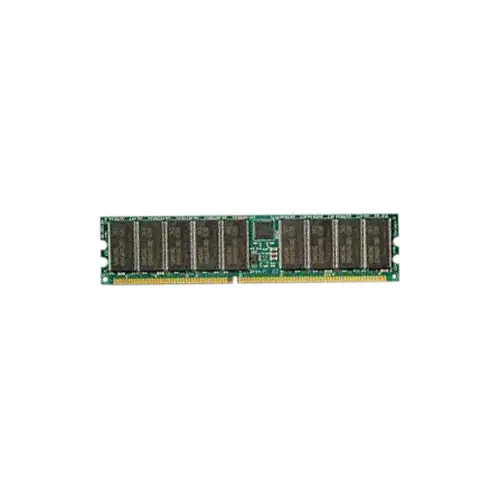
Based on its 184-pin UDIMM form factor with ECC and 2.5V DDR-266 specification, this module is unregistered server memory suited for entry-level servers or legacy mission-critical workstations. Its single‑rank x8 organization and CL2.5 low‑latency timing ensure stable signal integrity and efficient error correction, making it ideal for light virtualization and memory‑sensitive embedded applications where data integrity is paramount.
1. ECC error correction proactively detects and fixes single-bit memory faults, preserving data integrity for always-on server workloads where silent corruption cannot be tolerated.
2. Unbuffered signal architecture trims memory access latency, boosting the responsiveness of lightweight database transactions and control-plane operations.
3. A targeted 256 MB capacity right-sizes embedded server appliances and network gear, delivering stable firmware execution without costly overprovisioning.
4. CL2.5 CAS latency drives down read/write turnaround times, giving latency-sensitive virtualized tasks a deterministic performance edge under load.
5. Single Rank x8 organization lowers bus electrical loading, strengthening signal integrity and ensuring reliable operation across aging server baseboards.
Designed for legacy server and workstation platforms that still rely on DDR-266, the MT9VDDT3272AG-265G4 is an unbuffered ECC UDIMM whose four defining characteristics directly address the real-world demands of always-on, data-sensitive environments. ECC is the most critical of these: in a small business file server storing financial records or a medical imaging archive, a single-bit error in memory can silently corrupt a patient’s scan or a tax calculation. This module detects and corrects such errors, turning invisible data rot into a non-issue for your long-term storage integrity.
The unbuffered design and single-rank x8 organization work together to guarantee broad compatibility and stable signal quality in older motherboards often found in point-of-sale terminals or industrial control PCs. You avoid the training failures and boot issues that plague higher-density registered modules on these humble chipsets, keeping your 24/7 kiosk or factory line controller running without memory-related service calls. The low CAS latency of CL2.5 then ensures that every read command returns data with minimal delay, which is vital for a legacy DNS server or a lightweight database handling hundreds of queries per minute. In these scenarios, a slower CL3 part would stack microseconds of latency into palpable sluggishness, whereas CL2.5 helps the processor stay fed, preserving the responsive feel your users expect from an appliance-grade machine that simply cannot be allowed to stutter.
General Virtualization
This module is a legacy server DDR ECC UDIMM, unsuitable for modern hypervisors that demand 64 GB or more per host. For period-correct virtualization labs using lightweight hypervisors of its era, populate all available DIMM slots with identical 256 MB modules to maximize memory channels and enable ECC protection, ensuring stability for a small number of light guest machines.
In-Memory Database
Real-time in-memory platforms like Redis or Memcached require gigabytes of low-latency RAM; a single 256 MB stick offers no practical capacity. For experimental or educational uses on vintage hardware, deploy the maximum number of modules your server board supports, interleaving across channels to marginally improve throughput, and strictly rely on ECC to guard against silent data corruption during dataset operations.
High-Performance Computing
Contemporary HPC clusters operate with hundreds of gigabytes per node, making this 256 MB module obsolete. In a retro-cluster restoration, adopt a fully balanced symmetrical population across all sockets and memory channels to achieve the highest aggregate bandwidth, and verify the ECC scrubbing feature is active in the BIOS to sustain calculation integrity over long-running parallel jobs.
Rigorously tested, compatible with Dell PowerEdge 400SC/600SC, Precision 340/350, and other DDR-266 ECC Unbuffered systems.
Q: Can I mix this MT9VDDT3272AG-265G4 with other memory modules of different brands or speeds?
A: Mixing is not advised for servers. Variations in timings or ECC controller tolerance may lead to instability or uncorrectable errors. Use identical modules to guarantee reliable operation and data integrity.
Q: Is this memory compatible with my server platform?
A: It fits servers accepting 184-pin DDR-266/PC-2100 ECC unbuffered DIMMs. Typical platforms include Intel E750x/E7210 chipsets or older AMD Opteron boards with registered BIOS support for this specification.
Q: What is the recommended DIMM population order for optimal performance?
A: Always populate the first DIMM slot of each ECC memory channel, usually the slot closest to the processor. Follow your server manual to enable balanced interleaving and full ECC protection without sacrificing throughput.
Q: Does this module support overclocking or XMP profiles?
A: No. It is a JEDEC-compliant DDR-266 server module. Overclocking and XMP are disabled to preserve ECC integrity and ensure continuous, error-free operation in mission-critical environments.
Q: What warranty and typical failure rate can I expect?
A: This module comes with a 1-year warranty. The design yields an extremely low annualized failure rate, typically below 0.5% under normal server conditions, as a result of stringent component screening.