











 Secure payments
Standard refund policy
Trade Assurance
Secure payments
Standard refund policy
Trade Assurance
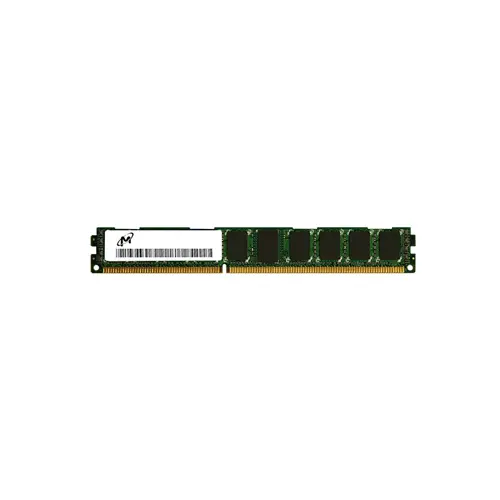
| Model | MT18KDF25672PZ-1G4F1 |
|---|---|
| Product Type | Memory Module |
| Compliance Standards | RoHS |
| Memory Capacity | 2 GB |
| Memory Technology | DDR3 |
| Product Voltage | 1.35V |
| RAM Speed | 1333MHz |
| RAM Standard | DDR3-1333/PC3-10600 |
| Error Identifying | ECC |
| Signal Type | Registered |
| Column Access Strobe (CAS) | CL9 |
| Rank | Dual Rank x8 |
| Quantity of Pins | 240-pin |
| RAM Genre | RDIMM |
This 2GB DDR3-1333 registered ECC module is engineered for server platforms requiring data integrity in virtualized environments and memory-intensive databases, where its registered signal type enhances signal stability across multiple DIMMs. The dual-rank x8 organization with CL9 latency balances access parallelism and efficient command scheduling, while ECC protection safeguards against single-bit errors in critical 24/7 operations.
1. ECC memory detects and corrects single-bit errors in real time, preserving data integrity for transactional databases and critical enterprise applications.
2. Registered buffering stabilizes the control signals across densely populated server boards, enabling seamless scaling to higher RAM capacities without sacrificing uptime.
3. Dual-rank x8 organization interleaves memory accesses across two internal ranks, keeping throughput consistent under heavy virtualization workloads where multiple VMs compete for I/O.
4. The 1333 MHz clock and PC3-10600 bandwidth provide a smooth 10.6 GB/s pipeline, ensuring concurrent virtual machines experience minimal memory latency during peak loads.
5. Low 1.35-volt operation cuts power draw and thermal output, allowing hyperscale data centers to increase rack density while reducing monthly cooling expenditure.
The Micron MT18KDF25672PZ-1G4F1 is a server-grade RDIMM built for reliability-driven enterprise workloads, where downtime is not an option. Its ECC technology actively detects and corrects single-bit memory errors—a critical safeguard when you are running a dense virtualization cluster. In that environment, a flipped bit in a hypervisor’s memory space can silently corrupt multiple guest machines, leading to cascading failures and hours of forensic debugging. With this module, that risk is neutralized at the hardware level. The registered signal buffer stabilizes the command and address lines, allowing you to populate all memory channels in a 2U rack server without signal degradation, so your VMware or Proxmox hosts scale reliably as VM density grows.
For in-memory databases like Redis or SAP HANA, the dual-rank x8 organization improves row-hammer resilience and interleaving efficiency, delivering consistent 1333MHz bandwidth under sustained query loads. Meanwhile, the 1.35V low-voltage operation directly translates to lower power draw per DIMM. In a fully loaded 24-slot server, that voltage reduction cuts cooling demands measurably, extending hardware lifespan and shrinking your data center’s OpEx. Even at a focused 2GB capacity, this module remains the exact fit for dedicated management controllers, network appliance firewalls, or light-weight Kubernetes worker nodes where ECC protection and signal integrity are non-negotiable—proving that precision engineering matters far more than capacity alone when your infrastructure cannot afford silent data corruption.
This 2GB DDR3L-1333 registered ECC RDIMM targets server environments.
General Virtualization
A virtualization host commonly needs 64GB. Using these 2GB RDIMMs, install 32 pieces, filling all eight memory channels with four DIMMs each. This balanced population ensures maximum bandwidth and allows memory sparing or mirroring for high availability. The 1.35V supply reduces energy use.
In-Memory Database
For in-memory databases, capacity is critical; populate every available slot, such as 24 modules delivering 48GB. The registered ECC corrects errors, and the dual-rank organization boosts concurrent access. Always use identical 2GB sticks for reliable timing. This modular approach scales with slot count.
High-Performance Computing
High-performance computing needs uniform bandwidth. Install the same number of these dual-rank RDIMMs per channel: e.g., 4 modules per channel in a quad-channel node gives 32GB. The 1333MHz CL9 and registered signals ensure sustained low latency. Consistent DIMM population across all nodes prevents NUMA bottlenecks.
This server memory is rigorously tested and compatible with Dell PowerEdge R720, HP DL380p Gen8, Lenovo ThinkServer RD430, and more.
Q: Can I mix this MT18KDF25672PZ-1G4F1 with other memory modules of different brands or speeds?
A: Mixing RDIMMs from different brands or speeds is not recommended in server environments. All modules should match in speed, rank, and timings to ensure signal integrity and avoid memory errors or unexpected system instability.
Q: Is this memory compatible with my server system?
A: This MT18KDF25672PZ-1G4F1 is a DDR3-1333 ECC Registered DIMM. It requires a server board with a compatible Intel or AMD platform supporting registered memory, such as Intel Xeon 5500/5600 series or AMD Opteron 6100 series chipsets.
Q: What is the recommended DIMM population order for optimal performance using this module?
A: For optimal performance, populate identical RDIMMs per memory channel, starting with the furthest slot from the CPU. Follow your server's specific population guide to maintain balanced channels and maximize memory bandwidth.
Q: Does this MT18KDF25672PZ-1G4F1 module support overclocking or XMP profiles?
A: No, this is a server-grade ECC registered DIMM. It adheres strictly to JEDEC DDR3-1333 specifications for mission-critical stability and does not support overclocking or Intel XMP profiles.
Q: What warranty and typical failure rate can I expect for this memory module?
A: This module includes a one-year warranty. As an ECC RDIMM built for 24/7 server operation, the AFR is typically well below 0.5% under specified conditions, ensuring high reliability for enterprise workloads.