











 Secure payments
Standard refund policy
Trade Assurance
Secure payments
Standard refund policy
Trade Assurance
| Product Type | Memory Module |
|---|---|
| Compliance Standards | RoHS |
| Memory Capacity | 2 GB |
| Memory Technology | DDR2 |
| Product Voltage | 1.8V |
| RAM Speed | 400MHz |
| RAM Standard | DDR2-400/PC2-3200 |
| Error Identifying | ECC |
| Signal Type | Registered |
| Column Access Strobe (CAS) | CL3 |
| Rank | Dual Rank x4 |
| Quantity of Pins | 240-pin |
| RAM Genre | RDIMM |
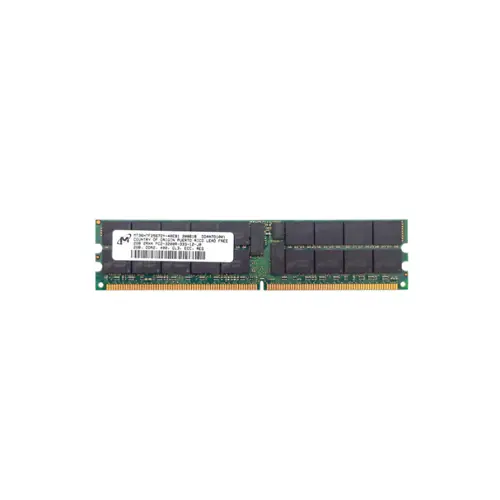
Designed for legacy server platforms, this 2GB DDR2-400 Registered ECC RDIMM (PC2-3200) is ideal for memory-intensive virtualized environments and small-scale database applications where data integrity is critical. Its 1.8V dual-rank x4 configuration with CL3 latency and registered signaling delivers stable operation at tight timings, while ECC reliably corrects single-bit errors to prevent downtime.
1. ECC protection detects and corrects single-bit memory errors in real time, preventing silent data corruption in mission-critical enterprise databases.
2. Registered signal buffering stabilizes high-capacity memory arrays by reducing electrical load on the memory controller, essential for large-scale virtualization hosts with numerous DIMMs per channel.
3. Dual Rank x4 organization interleaves accesses across internal banks, maximizing sustained bandwidth and lowering latency for transactional workloads under heavy concurrent user loads.
4. A CAS latency of just three cycles delivers fast column access, improving the responsiveness of caching layers and reducing read delays in latency-sensitive financial applications.
5. Operating at 400 MHz, the module provides a reliable 3.2 GB/s per channel of throughput, sufficient to maintain steady data streams for network-attached storage and legacy web-serving platforms.
The MT36HTF25672Y-40EB1 is a 2GB DDR2-400 registered ECC RDIMM purpose-built for legacy servers, and its four defining attributes directly prevent downtime in mission-critical scenarios. ECC continuously corrects single-bit errors caused by background radiation; in a virtualized cluster, this stops a flipped bit from corrupting the hypervisor and crashing every VM on the host. In an in-memory database like Redis, the same ECC protection ensures unerring transactional accuracy. Registered buffering re-drives command and address signals, letting you populate every DIMM slot without signal degradation—essential for maximizing RAM capacity for dense VM consolidation or large database tables. The dual-rank x4 design unlocks rank interleaving, overlapping memory accesses to boost bandwidth precisely when multiple VMs or heavy queries hammer the memory bus. Finally, the 400MHz clock paired with CL3 latency delivers deterministic, low-latency responses that prevent transaction timeouts. This module transforms an aging server into a reliable business asset.
General Virtualization
Install at least four identical 2 GB modules (8 GB total) across paired memory channels to enable symmetric interleaving; if the server has more slots, populate eight modules to comfortably run several lightweight VMs without swapping. Distribute DIMMs evenly between processor sockets to prevent NUMA penalties and keep remote memory access latency low.
In-Memory Database
Fill every available DIMM slot with matching 2 GB RDIMMs to reach the platform’s maximum capacity—essential for hosting entire datasets in RAM. The registered ECC and dual-rank x4 design maintain signal integrity and guard against corruption in dense configurations, which is critical for transactional in-memory tables.
High-Performance Computing (HPC)
Mount identical modules in all memory channels per CPU (for example, four or eight balanced DIMMs) to maximize collective bandwidth via channel interleaving on the DDR2-400 interface. Though total capacity is modest by modern standards, a fully populated registered configuration provides the deterministic access times and throughput that parallel HPC codes demand.
Server-grade, rigorously tested. Compatible with HP ProLiant DL380 G4, Dell PowerEdge 2850, IBM xSeries 346.
Q: Can I mix this MT36HTF25672Y-40EB1 with other memory modules of different brands or speeds?
A: Mixing is not recommended. Mismatched speeds or chip organization can cause signal integrity issues on registered DDR2 platforms. Always use identical modules for validated system stability and reliable ECC operation.
Q: Is this memory compatible with my system?
A: It fits servers requiring DDR2-400 Registered ECC RDIMMs with 1.8V. Verify your Intel or AMD platform supports PC2-3200, 240-pin RDIMMs, and dual-rank x4 organization. Check the system's qualified vendor list.
Q: What is the recommended DIMM population order for optimal performance?
A: Populate slots per your server manual, typically filling identical banks first. For dual-rank RDIMMs, install across memory channels to balance interleaving. Common rule: start with farthest slot from CPU per channel.
Q: Does this module support overclocking or XMP profiles?
A: No. This is a server-class Registered ECC DDR2 module operating at JEDEC-standard CL3 latency. It does not support overclocking or XMP, which are contrary to the stability required by mission-critical systems.
Q: What warranty and typical failure rate can I expect?
A: This module carries a one-year warranty. As a legacy DDR2 RDIMM, it has intrinsically low failure rates when operated within spec. Enterprise-grade testing ensures long-term reliability in compliant servers.