











 Secure payments
Standard refund policy
Trade Assurance
Secure payments
Standard refund policy
Trade Assurance
| Product Type | Memory Module |
|---|---|
| Compliance Standards | RoHS |
| Memory Capacity | 2 GB |
| Memory Technology | DDR2 |
| Product Voltage | 1.8V |
| RAM Speed | 400MHz |
| RAM Standard | DDR2-400/PC2-3200 |
| Error Identifying | ECC |
| Signal Type | Registered |
| Column Access Strobe (CAS) | CL3 |
| Rank | Single Rank x4 |
| Quantity of Pins | 240-pin |
| RAM Genre | RDIMM |
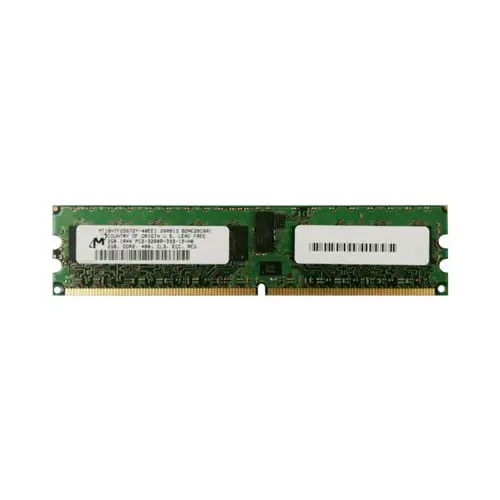
This RDIMM is engineered for legacy server platforms where data integrity is paramount, and its ECC with registered signaling ensures stable operation in memory-intensive workloads like virtualization and small-scale databases. The single-rank x4 configuration combined with a low CAS latency of CL3 optimizes command scheduling efficiency and minimizes access delays on older DDR2-400 memory controllers.
1. ECC error correction silently resolves single-bit memory faults, preventing silent data corruption that could compromise long-running analytical workloads or financial transaction integrity.
2. Registered buffering restores clean command and address signaling across fully loaded memory channels, essential for consistent operation in dense multi-socket server configurations.
3. Module capacity provides an efficient footprint for entry-level virtualization, allowing hypervisors to host multiple lightweight instances without triggering performance-sapping swap activity.
4. Single-rank x4 organization balances electrical loading with wide channel utilization, improving fault granularity and sustained throughput for in-memory caching and database operations.
5. The DDR2-400 speed grade delivers predictable, low-latency data movement, ensuring stable responsiveness for synchronous replication and legacy line-of-business application servers.
Based on the RDIMM form factor, registered signal type, and ECC support, this module is engineered for server environments where data integrity and uptime are non-negotiable. The first critical feature is ECC error correction, which detects and corrects single-bit memory errors caused by background radiation. In a financial transactions database, a single uncorrected bit flip can silently corrupt a ledger entry, leading to cascading compliance failures. Second, its registered buffer redistributes the electrical load from the memory controller, enabling a virtualization cluster to populate all DIMM slots without signal degradation; this directly translates to hosting more virtual machines per physical host without random reboots. Third, the single-rank x4 organization strikes an optimal balance between bandwidth and latency, reducing contention when multiple VMs hammer the memory bus simultaneously. Fourth, the DDR2-400 speed grade with CL3 latency delivers deterministic response times for in-memory caching engines like Redis, where microsecond delays in key lookups erode user-facing performance. Together, these characteristics harden your infrastructure against silent data corruption, capacity bottlenecks, and unpredictable latency.
General Virtualization
This DDR2-400 Registered ECC module provides 2GB capacity, suitable for light, legacy virtualization hosts. Given the low density, populate all available memory slots (e.g., 8 modules for 16GB) to run a handful of low-resource virtual machines. Prioritize mirrored channel configurations to maintain ECC error correction, but plan a platform refresh for modern hypervisors that demand far higher memory throughput and capacity.
In-Memory Database
In-memory databases require both high capacity and data integrity; this single-rank x4 RDIMM delivers reliable ECC at a low entry cost. Because 2GB per stick demands numerous DIMMs to reach a useful dataset size, install six or more modules to achieve 12GB–16GB for small caching layers. Configure all channels evenly and enable memory scrubbing, though production workloads will quickly outgrow this DDR2-era density.
High-Performance Computing
HPC clusters can repurpose these modules for lightweight compute nodes where memory capacity per core is modest. Using a fully populated 8-DIMM configuration (16GB) with registered ECC ensures stable, error-free operation for batch processing. Balance the modules across memory branches and banks to optimize bandwidth, but recognize that the 400MHz speed and CL3 latency will bottleneck floating-point or data-intensive simulations, making them suited only for educational or archival HPC tasks.
Rigorously tested server memory, compatible with Dell PowerEdge 2950, HP ProLiant DL360 G5, IBM System x3650.
Q: Can I mix this MT18HTF25672Y-40EE1 with other memory modules of different brands or speeds?
A: Mixing different brands or speeds is not recommended. This RDIMM relies on strict signal integrity; mismatched modules may cause POST failures, system instability, or ECC errors in server environments.
Q: Is this memory compatible with my Intel or AMD server platform?
A: It is designed for DDR2-based server platforms supporting Registered ECC memory. Verify your board supports PC2-3200 RDIMMs with 1.8 V and 240-pin sockets. Consult your server’s qualified vendor list.
Q: What is the recommended DIMM population order for optimal performance?
A: Populate identical RDIMMs per channel, starting with the farthest slots from the CPU. Always follow your server board manual to maintain balanced memory interleaving and ECC functionality.
Q: Does this module support overclocking or XMP profiles?
A: No. As a server-grade Registered ECC DDR2 module, it adheres strictly to JEDEC specifications. Overclocking or XMP is not supported and would compromise data integrity and reliability.
Q: What warranty and typical failure rate can I expect?
A: This module includes a one-year warranty. With high-quality compliance to RoHS and stringent testing, the typical annualized failure rate (AFR) is well below 0.5% under normal operating conditions.