











 Secure payments
Standard refund policy
Trade Assurance
Secure payments
Standard refund policy
Trade Assurance
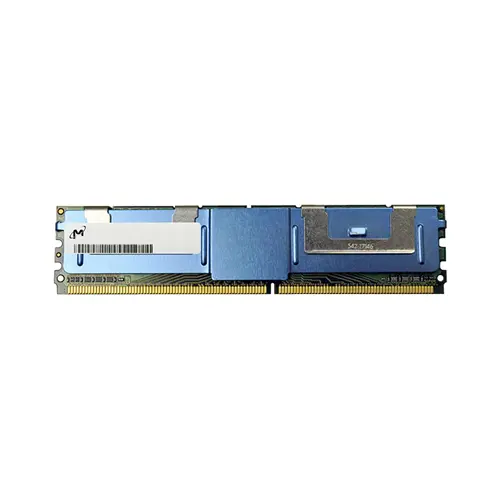
| Model | MT36HTF25672FY-667B3E3 |
|---|---|
| Product Type | Memory Module |
| Memory Capacity | 2 GB |
| Memory Technology | DDR2 |
| Product Voltage | 1.8V |
| RAM Speed | 667MHz |
| RAM Standard | DDR2-667/PC2-5300 |
| Error Identifying | ECC |
| Signal Type | Fully Buffered |
| Column Access Strobe (CAS) | CL5 |
| Rank | Dual Rank x4 |
| Quantity of Pins | 240-pin |
| RAM Genre | FB-DIMM |
This FB-DIMM module is engineered for legacy server platforms, making it ideal for memory-intensive enterprise workloads like virtualization and in-memory databases where data integrity is critical. Its fully buffered architecture ensures stable, high-capacity signaling, while dual-rank x4 organization and ECC deliver robust error correction and efficient interleaving for enhanced data reliability under sustained operation.
1. The fully buffered architecture decouples the memory data path from the host controller, enabling large per-channel capacities that are critical for scaling virtual machine density in enterprise hypervisors.
2. Integrated error correction silently detects and corrects single-bit faults in real time, safeguarding transactional integrity for databases and financial-processing workloads.
3. Dual Rank x4 organization overlaps row activations across banks, keeping data buses fully utilized and minimizing access latency under heavy consolidation traffic.
4. A per-module capacity aligned with dense 240-pin server board layouts allows administrators to maximize total installed memory without sacrificing rank interleaving performance.
5. The validated transfer bandwidth maintains consistent throughput for streaming workloads, eliminating stutter in multi-user content delivery and middle-tier caching services.
Designed specifically for enterprise servers, the Micron MT36HTF25672FY-667B3E3 FB-DIMM addresses the unforgiving demands of data center environments where downtime is simply not an option. Its Fully Buffered architecture tackles one of the most critical pain points in high-density server deployments: signal degradation. In a virtualized cluster running dozens of guest machines on a single rack, populating all memory slots often leads to electrical loading that corrupts commands. The advanced buffer on this module serializes data traffic, maintaining crisp signal integrity so you can scale memory capacity without sacrificing stability, thereby maximizing VM density and ROI.
When deployed inside an in-memory database like Redis powering a real-time financial trading platform, this memory’s ECC engine becomes your frontline defense against silent data corruption. A single bit flip caused by background radiation can instantly turn a valid transaction into a multimillion-dollar error. The dual-rank x4 organization further ensures that error correction works in parallel with sustained bandwidth, keeping response times consistently low under heavy query loads. At a modest 1.8V, it also helps curb the cumulative thermal footprint inside dense blade chassis. This is not just memory; it is an insurance policy for data integrity and continuous service availability, letting you run mission-critical workloads with absolute confidence.
This is a server-class memory module, identified by its FB-DIMM form factor, ECC support, and fully buffered architecture. Below are capacity planning guidelines for typical server workloads using these 2GB DDR2-667 modules.
General Virtualization
Virtualized hosts demand ample capacity to run multiple VMs. Populate all memory channels symmetrically with identically sized modules to maintain balanced interleaving. For light consolidation, install eight modules (16GB total) across both branches; scale to 16 identical modules (32GB) when hosting more machines, ensuring sufficient headroom for hypervisor overhead and balloon drivers.
In-Memory Database
In-memory databases thrive on capacity and fault tolerance. Maximize total RAM by filling every available DIMM slot with these 2GB modules, ideally achieving 32GB or more on dual-socket platforms. Use the memory sparing mode if supported, pairing modules in mirrored ranks to leverage ECC scrubbing and preserve data integrity for mission-critical caches and datasets.
High-Performance Computing (HPC)
HPC workloads prioritize sustained memory bandwidth. Install at least four modules per processor to enable quad-channel interleaving, and match the population across both memory risers for fully buffered daisy-chaining stability. For bandwidth-sensitive simulations, deploy a uniform 8-DIMM configuration (16GB) and set the BIOS to aggressive open-page policies, avoiding any mixing of different ranks or speeds.
Rigorously tested FB-DIMM server memory: compatible with Dell PowerEdge 2950/1950, HP DL380 G5, IBM x3650.
Q: Can I mix this MT36HTF25672FY-667B3E3 with other memory modules of different brands or speeds?
A: Mixing FB-DIMMs with different brands, speeds, or ranks is not recommended. It may cause instability or no POST. Install identical modules with the same speed, rank, and ECC feature for guaranteed compatibility.
Q: Is this memory compatible with my system?
A: This FB-DIMM is designed for servers using Intel 5000 series chipsets (e.g., 5000P/5000V) and compatible Xeon processors. Verify your server board supports DDR2-667 Fully Buffered ECC memory before purchasing.
Q: What is the recommended DIMM population order for optimal performance?
A: Install in identical pairs, populating matched-color slots first. Follow your server’s manual: typically, fill Channel 0 and Channel 1 slots in tandem to enable dual-channel mode and proper FB-DIMM AMB handshaking.
Q: Does this module support overclocking or XMP profiles?
A: No. This is a JEDEC-standard server FB-DIMM running at 667MHz with no XMP or overclocking support. It operates fixed at CL5 and 1.8V to ensure enterprise-class stability and data integrity.
Q: What warranty and typical failure rate can I expect?
A: This module includes a one-year warranty. As an enterprise-grade FB-DIMM with ECC and advanced AMB, it exhibits a very low annualized failure rate (typically under 0.5%) under normal server operating conditions.