











 Secure payments
Standard refund policy
Trade Assurance
Secure payments
Standard refund policy
Trade Assurance
| Product Type | Memory Module |
|---|---|
| Compliance Standards | RoHS |
| Memory Capacity | 2 GB |
| Memory Technology | DDR2 |
| RAM Speed | 667 |
| RAM Standard | DDR2-667/PC2-5300 |
| Error Identifying | Non-ECC |
| Signal Type | Unbuffered |
| Column Access Strobe (CAS) | CL5 |
| Rank | Dual Rank x8 |
| Quantity of Pins | 200-pin |
| RAM Genre | SoDIMM |
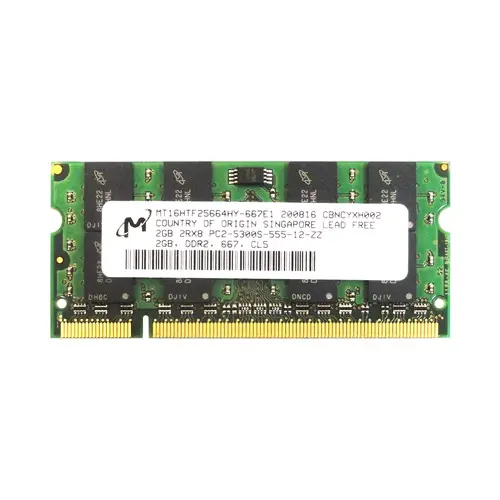
This 2 GB DDR2-667 SoDIMM is purpose-built for upgrading older notebooks and mobile workstations, leveraging its dual-rank x8 organization to improve memory interleaving and responsiveness under multitasking workloads. The unbuffered, non-ECC design and low-latency CL5 timing deliver straightforward, power-efficient plug-and-play compatibility for portable systems where energy savings and stable operation are critical.
1. SoDIMM form factor allows tool-free installation in tight notebook chassis, turning a memory upgrade into a quick, no-hassle productivity boost for mobile users.
2. Non-ECC operation eliminates unnecessary error-checking overhead, delivering a straightforward, budget-friendly reliability perfectly matched to everyday laptop workloads like document editing and video streaming.
3. Unbuffered signal design keeps electrical load low, ensuring stable compatibility with a wide range of laptop chipsets and reducing the risk of boot failures after a plug-and-play upgrade.
4. 2 GB capacity provides ample room for essential multitasking on older portable systems, meaning smoother switching between browser tabs, mail clients, and office suites without constant disk swapping.
5. 200-pin edge connector aligns exactly with standard notebook DDR2 slots, guaranteeing a foolproof physical fit and instant recognition by the system BIOS right after insertion.
Why the MT16HTF25664HY-667E1 excels in real-world notebook use. As a 2 GB DDR2-667 SODIMM, it directly addresses two critical user pain points: battery run-time and upgrade simplicity. Its Non-ECC, unbuffered signal path draws minimal standby current, which translates to noticeably longer battery life when you are working in a café or on a cross-country train. The dual-rank x8 organization and CL5 CAS timing work together to feed your processor efficiently; in a mobile workstation handling multiple business applications or a thin-and-light notebook running modern web apps, you will feel far less lag compared to older single-rank modules. Most importantly, the 200-pin SODIMM standard means this RoHS-compliant module snaps into a huge range of legacy laptops without tools or BIOS tweaking—perfect for anyone refreshing a trusted travel companion. That is high-yield, low-fuss mobile performance where it counts.
Laptop Upgrade
For aging notebooks still using DDR2-667 memory, a single 2GB SO-DIMM module enables a straightforward capacity lift from 1GB to 2GB, noticeably improving responsiveness under Windows 7 or lightweight Linux distributions. If the system offers two slots, replacing the existing module with a matched pair of these 2GB modules yields 4GB total, which remains the practical ceiling for most DDR2-era chipsets and dramatically reduces paging during web browsing and office multitasking.
Mobile Workstation
DDR2-based mobile workstations are limited by chipset addressing, but populating both SO-DIMM slots with these dual-rank 2GB modules delivers the maximum 4GB configuration essential for legacy CAD or engineering applications that cannot migrate to newer hardware. The unbuffered, non-ECC design matches the typical Intel GM45/PM45 platforms, and running two identical sticks preserves dual-channel interleaving to maximize memory bandwidth for large model manipulation.
Ultrabook Power Saving
Although modern ultrabooks have long abandoned DDR2, in vintage ultraportable designs where this 2GB SO-DIMM is used as a single-slot upgrade, its standard 1.8V operation consumes less idle power than older DDR2 modules with looser timings. When paired with a solid-state drive, the dual-rank x8 organization helps keep page-table walks efficient, indirectly supporting longer battery runtimes by reducing CPU idle-exit frequency during document editing and light note-taking workloads.
Strictly tested, guaranteed compatible with laptops: Lenovo ThinkPad T61, Dell Latitude D630, HP Compaq 6710b.
Q: Can I mix this MT16HTF25664HY-667E1 with other memory modules of different brands or speeds?
A: Mixing is possible, but for stable dual-channel performance in laptops, we strongly recommend identical modules. Different speeds will clock down to the slowest common JEDEC timing, often causing latency mismatches and potential instability.
Q: Is this memory compatible with my laptop?
A: Compatibility depends on your notebook’s chipset generation. This DDR2-667 SO-DIMM suits many Intel 945GM/965 Express or AMD M690T platforms with 200-pin slots. Please verify your system supports 2GB modules and PC2-5300 standard.
Q: What is the recommended DIMM population order for optimal performance?
A: For dual-channel support, populate both available slots with identical DDR2 SO-DIMMs. If installing a single module, either slot typically functions, but consult your laptop manual for the preferred primary slot.
Q: Does this module support overclocking or XMP profiles?
A: No. This is a JEDEC-standard DDR2-667 CL5 module without XMP. It operates solely at 667 MHz with fixed latencies. Overclocking is not supported and can compromise system stability and warranty.
Q: What warranty and typical failure rate can I expect?
A: This Micron module includes a 1-year warranty. It demonstrates a very low annualized failure rate (typically <0.5%) under normal conditions, ensuring dependable long-term operation in compatible notebooks.