











 Secure payments
Standard refund policy
Trade Assurance
Secure payments
Standard refund policy
Trade Assurance
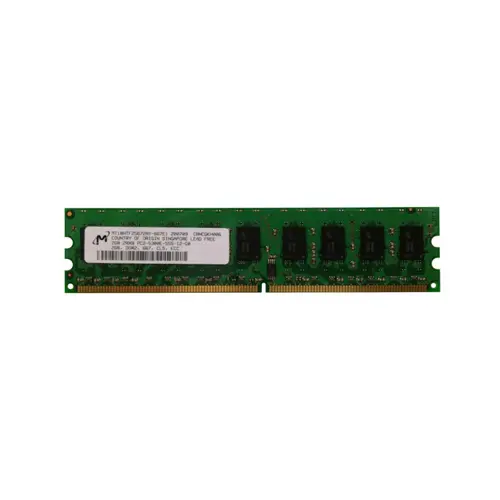
| Model | MT18HTF25672AY-667E1 |
|---|---|
| Product Type | Memory Module |
| Compliance Standards | RoHS |
| Memory Capacity | 2 GB |
| Memory Technology | DDR2 |
| Product Voltage | 1.8V |
| RAM Speed | 667MHz |
| RAM Standard | DDR2-667/PC2-5300 |
| Error Identifying | ECC |
| Signal Type | Unbuffered |
| Column Access Strobe (CAS) | CL5 |
| Rank | Dual Rank x8 |
| Quantity of Pins | 240-pin |
| RAM Genre | UDIMM |
This DDR2-667 ECC Unbuffered DIMM is purpose-built for entry-level servers, NAS systems, and small business applications where data integrity and stability are non-negotiable. Its ECC capability corrects single-bit memory errors on the fly to prevent silent data corruption, while the dual-rank x8 organization improves command interleaving for consistently low latency in light virtualization and file-serving workloads.
1. ECC error correction safeguards data integrity in always-on file servers, silently fixing single-bit flips to prevent storage corruption during critical record-keeping operations.
2. Unbuffered signal topology trims command-to-response latency, giving cost-conscious tower servers the snappy I/O reaction time needed for responsive client-side database lookups.
3. Dual Rank x8 organization interleaves memory banks to keep the channel busy, boosting throughput consistency when a single-socket server juggles concurrent VPN tunnels and departmental file sharing.
4. The 2 GB capacity provides comfortable memory headroom for headless Linux appliance servers, allowing background cron jobs and lightweight web caches to run without swapping into sluggishness.
5. PC2-5300 bandwidth supplies steady 5.3 GB/s transfers, allowing a small office domain controller to handle authentication spikes and group policy pushes without introducing perceptible login delays.
The MT18HTF25672AY-667E1 is a server-grade unbuffered ECC DDR2 module built for legacy platforms that cannot tolerate data corruption or downtime. In a virtualized cluster running multiple VMs on an older hypervisor, memory integrity is non-negotiable. The ECC engine continuously detects and corrects single-bit errors caused by background radiation or electrical noise, preventing silent data corruption that would otherwise crash guest operating systems. Meanwhile, the module’s dual-rank x8 organization interleaves memory banks across two ranks, giving the hypervisor enough command pipelining bandwidth to keep concurrent virtual machines responsive instead of stacking up memory wait cycles.
In an in-memory database or caching tier, where a flipped bit in a Redis key can silently poison financial calculations or session data, ECC turns an invisible hardware fault into a logged correction event instead of a business-impacting incident. The unbuffered architecture eliminates the extra clock cycle of registered modules, so that CL5 latency and 667 MHz speed actually translate into tight lookup times—critical when the application demands millions of operations per second. These four attributes—error detection, dual-rank bandwidth, unbuffered responsiveness, and proven DDR2-667 stability—together mean fewer unexplained outages, consistent query latencies, and a longer useful life for the infrastructure still running your critical workloads.
Memory Type Assessment
Based on the specifications — DDR2-667, ECC, Unbuffered, 240-pin UDIMM with 2 GB capacity — this module is a server memory module. It is designed for entry‑level servers and workstations that require data integrity without registered buffering.
General Virtualization
Populate all available DIMM slots with identical 2 GB modules to maximize memory channels and interleaving. A 4‑module configuration (8 GB total) in a dual‑channel setup provides sufficient headroom for light virtualized workloads, ensuring ECC protection for stable hypervisor operation.
In‑Memory Database
Deploy the maximum supported capacity using matched pairs of 2 GB ECC UDIMMs — typically four modules for 8 GB. While modest by modern standards, this config enables small in‑memory datasets while guaranteeing single‑bit error correction, which is critical for transactional consistency.
High‑Performance Computing
Install modules in a balanced dual‑channel arrangement (at least two identical DIMMs) to double the memory bandwidth. For parallel MPI jobs, use four 2 GB sticks to achieve 8 GB and maintain symmetric memory access across both channels, reducing node‑level bottlenecks. Always verify identical part numbers for uniform timing.
Rigorously tested server memory compatible with Dell PowerEdge 840, 860, HP ProLiant ML110 G4, and IBM x3105.
Q: Can I mix this MT18HTF25672AY-667E1 with other memory modules of different brands or speeds?
A: Mixing is not advised. ECC UDIMMs require matched characteristics for stable operation. Disparate brands or speeds may force the system to run at the lowest common speed, disable ECC, or cause unbootable states.
Q: Is this memory compatible with my system?
A: It fits server boards supporting DDR2 ECC Unbuffered DIMMs, such as those based on Intel X38/X48 chipsets or AMD Socket AM2/AM3 with ECC support. Verify your board manual for 240-pin ECC UDIMM compatibility.
Q: What is the recommended DIMM population order for optimal performance?
A: Populate identical modules per channel, starting with the slot farthest from the CPU. For dual-channel platforms, install in pairs (e.g., DIMM_A1 and DIMM_B1 first) to enable memory interleaving and ensure ECC functionality.
Q: Does this module support overclocking or XMP profiles?
A: No. As a server-grade ECC UDIMM certified for DDR2-667 at CL5, it prioritizes data integrity and 24/7 stability. It lacks XMP profiles and overclocking is strongly discouraged to avoid jeopardizing error correction.
Q: What warranty and typical failure rate can I expect?
A: This module includes a 1-year warranty. Its annualized failure rate (AFR) is extremely low, typically under 0.2%, reflecting rigorous testing and qualification for continuous operation in enterprise environments.