











 Secure payments
Standard refund policy
Trade Assurance
Secure payments
Standard refund policy
Trade Assurance
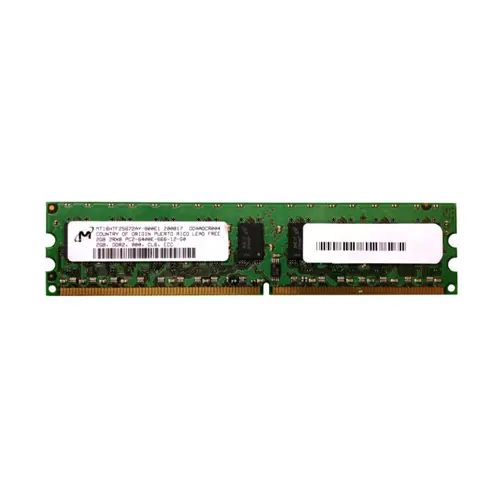
| Model | MT18HTF25672AY-800E1 |
|---|---|
| Product Type | Memory Module |
| Compliance Standards | RoHS |
| Memory Capacity | 2 GB |
| Memory Technology | DDR2 |
| Product Voltage | 1.8V |
| RAM Speed | 800MHz |
| RAM Standard | DDR2-800/PC2-6400 |
| Error Identifying | ECC |
| Signal Type | Unbuffered |
| Column Access Strobe (CAS) | CL6 |
| Rank | Dual Rank x8 |
| Quantity of Pins | 240-pin |
| RAM Genre | UDIMM |
This unbuffered ECC DDR2-800 UDIMM is engineered for entry-level servers and professional workstations where data integrity is critical, leveraging error-correcting code to detect and correct single-bit memory errors in always-on environments. Its dual-rank x8 organization and CL6 latency optimize memory bandwidth and interleaving for consistent performance under moderate multi-tasking and light virtualization workloads.
1. ECC protection silently corrects single-bit memory errors, safeguarding long-running server workloads against silent data corruption and unplanned downtime.
2. Dual Rank x8 organization interleaves memory banks to sustain higher effective bandwidth, keeping transaction-heavy database and virtualization tasks responsive.
3. Unbuffered UDIMM design trims controller latency and power, making it a cost-effective choice for entry-level server deployments where every watt and nanosecond counts.
4. 800MHz clock speed drives PC2-6400 throughput, ensuring smooth handling of concurrent user requests on web and light application servers.
5. 2GB density provides just enough headroom for dedicated appliances, DNS caches, or lean virtualized network functions without overprovisioning cost.
Understanding the MT18HTF25672AY-800E1 begins with recognizing its identity: this is a server-grade UDIMM built for reliability-driven workloads. Its four defining characteristics translate directly into tangible uptime and performance in environments where memory errors are not an option.
The primary safeguard is ECC, or error-correcting code memory. In a virtualization cluster running multiple guest machines on a single host, a single-bit flip in non-ECC memory can silently corrupt a database transaction or crash a hypervisor. This module’s built-in error detection and correction prevents such soft errors from propagating into application failure, which means your financial records or customer data remain consistent without unexplained downtime. Paired with this is its dual-rank organization, which interleaves memory accesses across two internal ranks of x8 chips. For an in-memory database like Redis serving thousands of queries per second, dual rank reduces access latency under heavy load by overlapping command sequences, effectively delivering higher sustained throughput than a single-rank module of the same speed grade.
Beyond error immunity and bandwidth, the unbuffered design (UDIMM) with a 1.8V operating voltage and a tight CAS latency of CL6 at 800MHz keeps electrical loading minimal and predictable. In a dense 1U or 2U server, where thermal headroom is scarce, the low voltage reduces power draw and cooling demands without sacrificing responsiveness. That CL6 latency ensures the memory controller spends fewer clock cycles waiting for data, which is critical when every millisecond counts in OLTP transactions. Together, these attributes mean you are not just installing memory—you are hardening your infrastructure against silent corruption, maximizing database throughput, and controlling energy costs, all from a single standard 240-pin module that fits seamlessly into older server platforms still powering essential services.
General Virtualization
For light workloads on legacy hypervisors, this 2GB ECC UDIMM can serve basic domain controllers or small utility VMs. Install modules in pairs to maintain dual-channel operation and maximize throughput on older dual-socket platforms. Given the low density, populate all available DIMM slots—typically up to 8 or 16 GB total—to host a handful of idle or low-memory guests without swapping.
In-Memory Database
In-memory databases demand substantial capacity, making a single 2GB stick insufficient for production datasets. To prototype Redis or Memcached on retro hardware, install six to eight identical modules (12–16 GB) and enable memory interleaving. Use ECC to protect critical in-memory structures, but plan a near-term migration; sustained OLTP workloads will exhaust this footprint rapidly.
High-Performance Computing
HPC nodes historically relied on DDR2 ECC UDIMMs for compute-bound MPI jobs. Populate all channels evenly—four or eight modules for symmetric rank interleaving—to deliver the lowest latency. For modern codes, 2GB per core is a bottleneck, so restrict these nodes to single-threaded embarrassingly parallel tasks. Dual-rank x8 modules offer marginally better command scheduling, but total capacity remains the primary constraint.
Stringently tested for server compatibility: Dell PowerEdge 840, HP ProLiant ML110 G5, IBM System x3200.
Q: Can I mix this MT18HTF25672AY-800E1 with other memory modules of different brands or speeds?
A: Mixing is not recommended for server environments. For ECC UDIMMs, identical part numbers and ranked organizations are required to maintain data integrity and avoid POST or stability issues.
Q: Is this memory compatible with my system?
A: It is compatible with server or workstation boards supporting DDR2-800 ECC Unbuffered memory. Verify your Intel or AMD platform accepts 240-pin UDIMMs with ECC functionality.
Q: What is the recommended DIMM population order for optimal performance?
A: Install in matched pairs per channel, typically populating slots of the same color first. Consult your server board manual for dual-channel configuration to enable 128-bit ECC access.
Q: Does this module support overclocking or XMP profiles?
A: No. This server-grade module adheres to JEDEC DDR2-800 timing (CL6) at 1.8V. It does not feature XMP profiles and is not designed for overclocking.
Q: What warranty and typical failure rate can I expect?
A: This module includes a 1-year warranty. As an enterprise-grade ECC UDIMM, it delivers high reliability with an AFR well below industry consumer levels when operated within specifications.