











 Secure payments
Standard refund policy
Trade Assurance
Secure payments
Standard refund policy
Trade Assurance
| Product Type | Memory Module |
|---|---|
| Compliance Standards | RoHS |
| Memory Capacity | 2 GB |
| Memory Technology | DDR2 |
| RAM Speed | 800 |
| RAM Standard | DDR2-800/PC2-6400 |
| Error Identifying | Non-ECC |
| Signal Type | Unbuffered |
| Column Access Strobe (CAS) | CL6 |
| Rank | Dual Rank x8 |
| Quantity of Pins | 200-pin |
| RAM Genre | SoDIMM |
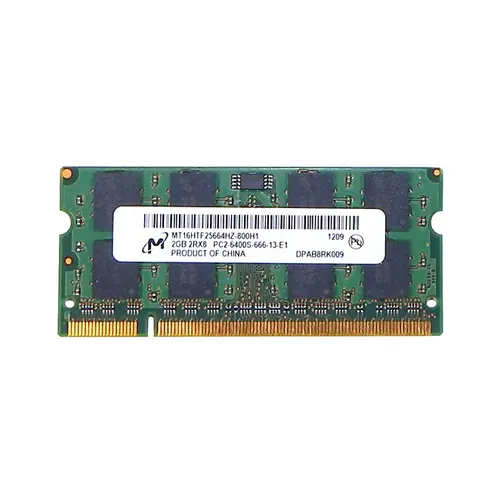
This 2GB DDR2-800 SoDIMM is a non-ECC, unbuffered notebook memory module designed for upgrading legacy laptops and compact mobile workstations where power efficiency and compatibility are critical. Its dual-rank x8 organization and CL6 latency deliver stable, responsive performance in thermally constrained environments, ensuring reliable plug-and-play operation without the need for manual tuning.
1. The SoDIMM form factor ensures a drop-in upgrade for compact laptop chassis, minimizing downtime and avoiding the need for specialized tools during a quick memory refresh.
2. Non-ECC operation eliminates the overhead of error correction circuitry, directly lowering idle power draw and extending battery runtime during everyday productivity tasks.
3. Unbuffered signal architecture strips away register latency, accelerating data access for the processor and delivering visibly faster application launches on mobile workloads.
4. The 2 GB capacity provides sufficient headroom for a modern operating system with essential office applications, preventing page-file thrashing that would otherwise slow the system to a crawl.
5. DDR2 technology operates at a balanced voltage point, producing less heat inside the confined thermal envelope of a notebook while still supporting the bandwidth needed for smooth multitasking.
For notebook users, the MT16HTF25664HZ-800H1 SODIMM delivers exactly what mobile computing demands: energy-conscious operation and effortless compatibility. Its DDR2-800 specification and unbuffered, non-ECC design are deliberately tuned for the thermal and power constraints of laptops. At 2GB, this dual-rank x8 module strikes an ideal balance between capacity and low electrical load, helping extend battery runtime in real-world mobile workflows. Consider a field engineer running diagnostic software on an aging ThinkPad T61: the module’s standard 1.8V operation and CL6 latency prevent excessive heat buildup inside tight chassis, keeping the system stable during hours of vibration-prone use on a factory floor. For a student reviving a thin-and-light ultraportable, the 200-pin SODIMM form factor guarantees a drop-in fit without clearance issues. Dual-rank interleaving further optimizes integrated graphics performance for smooth multitasking between research documents, browser tabs, and video lectures. This isn’t just a memory upgrade—it’s a practical solution that prolongs usable battery life, avoids thermal throttling, and instantly restores responsiveness in mission-critical mobile environments where carrying a charger isn’t always an option.
Laptop Upgrade
For users stuck with a single 1 GB or 512 MB SoDIMM, installing this 2 GB DDR2‑800 module brings an immediate multitasking improvement. If your notebook has a free slot, adding a second identical 2 GB stick enables symmetric dual‑channel mode, effectively doubling memory bandwidth and smoothing everyday web browsing and document workflows on older Windows 7 or lightweight Linux systems. This 4 GB total is the practical sweet spot before the platform’s chipset limit.
Mobile Workstation
Populate both SoDIMM slots with these 2 GB modules to reach the maximum 4 GB capacity that most DDR2‑era mobile workstations support. The dual‑rank x8 organization improves bank interleaving, helping professional tools like CAD viewers, legacy Adobe Creative Suite, or statistical packages hold larger working sets and reduce disk thrashing. Combined with an SSD, this configuration remains viable for field engineering or vintage data‑acquisition rigs.
Ultrabook Power Saving
Although standard DDR2 operates at 1.8 V, using a single 2 GB module instead of two can slightly lower overall memory‑subsystem power draw by keeping half the rank‑active devices idle. This minimal configuration pairs well with a stripped‑down OS to prolong battery runtime during note‑taking and e‑mail sessions. For ultra‑mobile users who value endurance over raw capacity, a lone low‑density module remains an efficient, fanless‑friendly choice.
Rigorously tested, this DDR2 2GB SoDIMM fits laptops like Dell Latitude D630, Lenovo ThinkPad T61, and HP EliteBook 6930p.
Q: Can I mix this MT16HTF25664HZ-800H1 with other memory modules of different brands or speeds?
A: We recommend using identical modules for optimal compatibility. Mixing brands or speeds may cause the system to downclock to the lowest common frequency, leading to potential instability and reduced dual-channel performance.
Q: Is this memory compatible with my laptop? Which models or chipsets support this DDR2-800 SO-DIMM?
A: This DDR2-800 SO-DIMM is compatible with laptops supporting DDR2 memory, non-ECC unbuffered, 200-pin. Please confirm your laptop supports 2GB modules and DDR2-800/PC2-6400. Commonly fits Intel 945/965 chipsets.
Q: What is the recommended DIMM population order for optimal performance?
A: For dual-channel operation, install two identical modules in both slots. For a single module, use the primary slot (usually slot 0). Consult your laptop manual for exact slot numbering to ensure optimal performance.
Q: Does this module support overclocking or XMP profiles?
A: No, this DDR2-800 SO-DIMM follows JEDEC standard speeds and timings; it does not support XMP or overclocking. It runs at a fixed 800MHz with CL6 latency for stable operation.
Q: What warranty and typical failure rate can I expect?
A: This module includes a 1-year limited warranty. DDR2 SO-DIMM failure rate is extremely low, typically under 0.2% per year, ensuring dependable performance when used within specifications.