











 Secure payments
Standard refund policy
Trade Assurance
Secure payments
Standard refund policy
Trade Assurance
| Product Type | Memory Module |
|---|---|
| Compliance Standards | RoHS |
| Memory Capacity | 2 GB |
| Memory Technology | DDR3 |
| Product Voltage | 1.5V |
| RAM Speed | 1066MHz |
| RAM Standard | DDR3-1066/PC3-8500 |
| Error Identifying | ECC |
| Signal Type | Registered |
| Column Access Strobe (CAS) | CL7 |
| Rank | Single Rank x4 |
| Quantity of Pins | 240-pin |
| RAM Genre | RDIMM |
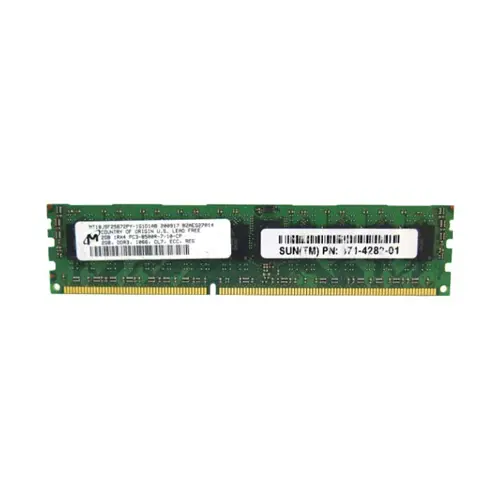
This DDR3-1066 Registered ECC RDIMM is purpose-built for entry-level servers and small-scale virtualization hosts, where its 2 GB single-rank x4 configuration and CL7 latency provide a predictable, low-latency memory subsystem for light memory databases and data integrity-sensitive applications. The registered signal architecture and hardware ECC actively mitigate signal loading and single-bit errors, ensuring stable operation in 24/7 environments that demand reliability over raw throughput.
1. ECC protection actively detects and corrects single-bit errors in flight, preserving financial transaction accuracy and preventing costly silent data corruption in always-on enterprise servers.
2. Registered buffering isolates the memory controller from heavy electrical loads, allowing compact data center motherboards to fully populate all slots without risking signal degradation or boot failures.
3. Single Rank x4 organization maximizes bandwidth per channel by enabling deeper interleaving, which directly boosts guest VM responsiveness in consolidation-heavy private cloud hosts.
4. CL7 low-latency timing shortens the gap between data request and delivery, giving latency-sensitive database engines faster page access and quicker query completion under sustained load.
5. The 2GB capacity increment fits lightweight appliance-oriented deployments, where a lean memory footprint keeps operating expenses and power draw tightly controlled at scale.
The Micron MT18JSF25672PY-1G1D1AB is a server-class DDR3 RDIMM engineered for data centers where uptime and accuracy are non-negotiable. Its four defining characteristics directly confront the real-world demands of IT infrastructure. First, ECC error correction actively detects and corrects single-bit memory errors caused by background radiation. In a dense virtualization cluster hosting dozens of VMs, one uncorrected bit flip can silently corrupt a guest operating system or database index; ECC ensures that your consolidated workloads keep running with full data integrity, eliminating mysterious crashes. Second, the registered signal buffer stabilizes the electrical load on the memory bus. When a bare-metal hypervisor like VMware ESXi is packing all 18 DIMM slots per server to maximize VM density, unbuffered modules would suffer signal degradation—registered logic keeps command and address signals clean, letting you scale to large capacities without sacrificing reliability.
The single-rank x4 configuration and CL7 latency translate directly into responsive performance under heavy concurrent access. Consider an in-memory database such as Redis or a memcached layer powering a high-traffic e-commerce site. The single-rank design reduces inter-rank turnaround penalties, delivering lower access latency for rapid key-value lookups when every microsecond of user-facing latency matters. Meanwhile, the 1.5V operating voltage and DDR3-1066 speed hit an optimal balance between thermal footprint and throughput, critical in rack-dense deployments where cooling limits are tight. In a virtual desktop infrastructure boot storm or a real-time analytics query, this memory module ensures that your services respond predictably, your data stays uncorrupted, and your hardware foundation remains rock-solid even under relentless loads.
General Virtualization
For lightweight hypervisors or small-scale virtualization on legacy servers, this 2 GB DDR3-1066 RDIMM can be deployed in large numbers to reach the minimum memory floor. Populate all channels symmetrically—typically six or eight identical DIMMs per socket—to sustain memory bandwidth for multiple idle VMs. Avoid mixing ranks or speeds; with single-rank x4 modules, full channel population keeps latency predictable and maximizes available throughput.
In-Memory Database
A single 2 GB DIMM is severely limiting for in-memory datasets. Clustering multiple modules can deliver 16–32 GB only on boards with many slots, which suits very small Redis or Memcached instances. This configuration is not recommended for production-grade in-memory DBs; instead, it may serve as a temporary testing node where native ECC protects against bit flips during development.
High-Performance Computing
HPC workloads that are compute-bound and not memory-capacity-bound can still leverage these modules for scaling out older cluster nodes. Install identical DIMMs across all memory channels (e.g., 12 x 2 GB for 24 GB on a dual-socket Westmere-era system) to sustain peak floating-point throughput. The registered ECC ensures result integrity over long-running simulations, though capacity-per-core is low, so carefully match problem size per node.
Rigorously tested server memory, compatible with Dell PowerEdge R710, HP ProLiant DL380 G7, and IBM System x3650 M3.
Q: Can I mix this MT18JSF25672PY-1G1D1AB with other memory modules of different brands or speeds?
A: Mixing Registered ECC memory with other brands or speeds risks instability. For servers, always use identical modules (same part number) to ensure data integrity and reliable operation.
Q: Is this memory compatible with my server using Intel Xeon or AMD Opteron platforms?
A: This DDR3-1066 Registered ECC RDIMM works with Intel Xeon 5500/5600 or AMD Opteron 4100/6100 servers supporting 1.5V and DDR3-1066. Confirm your board supports 240-pin RDIMMs.
Q: What is the recommended DIMM population order for optimal performance?
A: For this single-rank x4 RDIMM, populate channels per your server manual. Typically, install identical DIMMs in the first slot of each channel to enable balanced interleaving for optimal performance.
Q: Does this module support overclocking or XMP profiles?
A: No, this is a server-grade Registered ECC DIMM adhering to JEDEC standard DDR3-1066. It does not support overclocking or XMP profiles. It prioritizes data integrity and 24/7 reliability.
Q: What warranty and typical failure rate can I expect?
A: We offer a 1-year warranty covering manufacturing defects. When operated within specs, this enterprise DDR3 RDIMM exhibits a very low annualized failure rate, typically under 0.5%, ensuring long-term dependability.