











 Secure payments
Standard refund policy
Trade Assurance
Secure payments
Standard refund policy
Trade Assurance
| Product Type | Memory Module |
|---|---|
| Memory Capacity | 2 GB |
| Memory Technology | DDR3 |
| Product Voltage | 1.5V |
| RAM Speed | 1066MHz |
| RAM Standard | DDR3-1066/PC3-8500 |
| Error Identifying | ECC |
| Signal Type | Registered |
| Column Access Strobe (CAS) | CL7 |
| Rank | Single Rank x4 |
| Quantity of Pins | 240-pin |
| RAM Genre | RDIMM |
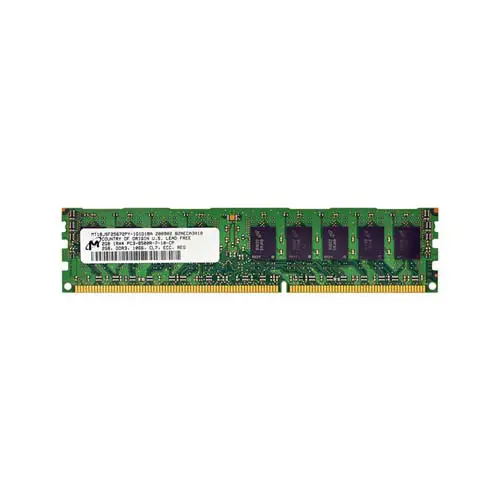
This RDIMM is engineered for server platforms, where its ECC and registered signal buffering ensure data integrity and stable operation under heavy memory loads—ideal for virtualization and in-memory database workloads. The single-rank x4 organization with CL7 latency delivers efficient memory access and low command latency, optimizing throughput in dense multi-DIMM configurations.
1. ECC detection and correction provides end-to-end data integrity, eliminating silent memory errors that could corrupt financial transactions or virtualization metadata.
2. Registered signal buffering stabilizes command and address buses, enabling dense memory populations across multiple DIMM slots without compromising signal quality in rack servers.
3. Two-gigabyte capacity per module serves as an efficient granular building block for right-sizing memory in lightweight virtualized environments or dedicated appliance servers.
4. 1066 megahertz clocked bandwidth supports steady data throughput, maintaining responsive service delivery under constant concurrent request loads.
5. CAS seven latency reduces the tick count between data request and delivery, lowering transaction latency for latency-sensitive enterprise applications.
The MT18JSF25672PY-1G1D1BA is unmistakably a server-grade memory module—an RDIMM with ECC and registered buffering built for environments where uptime and data fidelity are non-negotiable. In a virtualized cluster running multiple guest machines, its Error-Correcting Code actively detects and corrects single-bit memory errors caused by cosmic rays or electrical noise. For you, that means safeguarding a hypervisor from silent data corruption that could ripple across every hosted workload, preventing unexplained application crashes that erode user trust. The registered buffer on this 2 GB DDR3-1066 stick decouples the electrical load from the system’s memory controller, allowing stable population of all DIMM slots without signal degradation. This directly supports dense server configurations—imagine a memory-hungry in-memory database like Redis or Memcached where capacity scaling is essential. The single-rank x4 organization further optimizes bandwidth utilization by enabling efficient bank interleaving, lowering access latency under concurrent query storms. Combined with a tight CAS latency of 7 cycles, the module delivers prompt data retrieval that accelerates transaction processing. In high-frequency trading or real-time analytics, these characteristics aren’t just specifications—they are your assurance of deterministic performance and data integrity when every millisecond matters.
General Virtualization
For general virtualization hosts, multiple 2 GB RDIMMs can be combined to create a stable, moderate-density memory pool. Using six or twelve identical modules in balanced channels ensures registered ECC reliability for a hypervisor running 10–15 light VMs.
In-Memory Database
In-memory databases demand both capacity and data integrity, so populate all channels with identical 2 GB ECC RDIMMs. Aim for at least 12–18 modules to hold working sets fully in RAM, and leverage single-rank x4 organization for lower latency under heavy transactional loads.
High-Performance Computing
HPC clusters benefit from uniform, registered memory to sustain error-free computation across nodes. Install eight or sixteen 2 GB RDIMMs per node to balance bandwidth and capacity, using the 1066 MHz speed with CL7 for predictable, power-efficient throughput in sustained parallel workloads.
Rigorously tested server memory, compatible with Dell PowerEdge R710, HP ProLiant DL380 G7, and more.
Q: Can I mix this MT18JSF25672PY-1G1D1BA with other memory modules of different brands or speeds?
A: We strongly advise against mixing RDIMMs with different brands, speeds, or non-ECC modules. Mismatched ranks or timings can compromise signal integrity, cause POST failures, and negate ECC protection in your server platform.
Q: Is this memory compatible with my system?
A: This DDR3-1066 ECC Registered DIMM targets Intel 5500/5600 series and AMD Opteron 6100/6200 platforms. Verify your server board supports 1.5V, 240-pin RDIMMs, and Single Rank x4 organization for proper compatibility.
Q: What is the recommended DIMM population order for optimal performance?
A: For dual-processor servers, populate identical channels per CPU in ascending slot order as specified in your system manual. Typically, fill blue slots first to maintain balanced memory interleaving and maximize throughput.
Q: Does this module support overclocking or XMP profiles?
A: No, this is a 1.5V server-grade Registered ECC module. It adheres strictly to JEDEC DDR3-1066 standards. Overclocking and XMP profiles are unsupported, as they compromise the reliability required for mission-critical environments.
Q: What warranty and typical failure rate can I expect?
A: This Micron OEM module includes a one-year warranty. Enterprise-class RDIMMs typically deliver an annualized failure rate below 0.2%, assuming proper cooling and voltage conditions in compliant server hardware.