











 Secure payments
Standard refund policy
Trade Assurance
Secure payments
Standard refund policy
Trade Assurance
| Product Type | Memory Module |
|---|---|
| Thickness | 0.39 Inches |
| Length | 4.33 Inches |
| Compliance Standards | RoHS |
| Memory Capacity | 2 GB |
| Memory Technology | DDR3 |
| RAM Speed | 1066 |
| RAM Standard | DDR3-1066/PC3-8500 |
| Error Identifying | Non-ECC |
| Signal Type | Unbuffered |
| Column Access Strobe (CAS) | CL7 |
| Rank | Dual Rank x8 |
| Quantity of Pins | 204-pin |
| RAM Genre | SoDIMM |
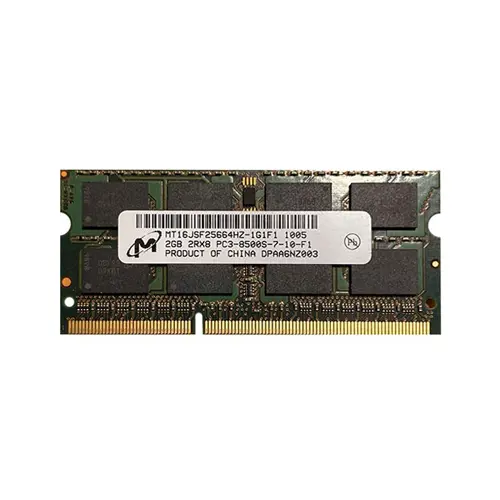
This DDR3-1066 SoDIMM is a non-ECC, unbuffered notebook memory module designed for upgrading legacy laptops and mobile workstations, offering hassle-free plug-and-play compatibility and a low-latency CL7 timing that improves system responsiveness. With its dual-rank x8 configuration, it maximizes memory bandwidth utilization on older Intel and AMD mobile platforms, making it a reliable choice for extending the life of portable systems running light productivity tasks or embedded applications.
1. The SoDIMM form factor ensures a straightforward, drop-in upgrade into virtually any ultrabook or laptop, eliminating compatibility concerns when refreshing older mobile systems.
2. DDR3 technology operates at an energy-efficient 1.5V, helping to reduce battery drain and heat generation during typical on-the-go office and browsing tasks.
3. A 2 GB capacity revives aging notebooks, allowing smooth web-based multitasking and lightweight productivity without relying on sluggish storage paging.
4. The 1066 MT/s data rate provides sufficient throughput for fluid HD streaming and responsive application switching in everyday portable use.
5. Low CL7 latency minimizes the idle wait states for data retrieval, which improves system zip and conserves battery power during brief burst workloads on notebooks.
Based on the SoDIMM form factor, 204-pin interface, and unbuffered design, this is a laptop memory module crafted for portable systems where space, power, and reliability converge. For users upgrading an aging ultrabook or a mobile workstation, four characteristics directly shape everyday experience. The compact 4.33-inch length and 0.39-inch thickness guarantee drop-in compatibility inside tightly packed laptop chassis, eliminating clearance struggles during installation. Unbuffered, Non-ECC architecture draws less power than server-grade alternatives, translating directly to extended battery life during long flights or back-to-back meetings when you cannot reach an outlet. The 2 GB capacity arranged as dual-rank x8 meets the demands of typical office multitasking and browser-based applications, delivering a cost-effective performance lift that keeps a secondary travel machine responsive without overspending. Finally, the DDR3-1066 speed at CL7 latency provides the ideal sweet spot for older platforms: it boots reliably every time, sidesteps the random lockups that plague mismatched high-speed modules, and sustains smooth operation in legacy point-of-sale terminals or field engineering laptops where stability matters more than raw throughput. This memory is not about flashy specs; it is about keeping your essential portable gear running reliably, efficiently, and effortlessly with a straightforward upgrade.
Laptop Upgrade
For older notebooks with a single 2GB DDR3 SO-DIMM, the cheapest capacity doubling comes from inserting a second identical 2GB module—enabling dual-channel and reaching 4GB total. A more future-proof approach swaps the original stick for a 2×4GB kit (8GB), dramatically improving multitasking and Windows 10/11 responsiveness on systems that support 8GB.
Mobile Workstation
Professional applications such as CAD, GIS, or heavy data analysis benefit from maximizing capacity. Populate both slots with 8GB DDR3-1066 SO-DIMMs to achieve 16GB—the practical ceiling for most DDR3-era mobile workstations. Dual-rank x8 modules like the 2GB unit here can serve as placeholders during hardware migration, but a 2×8GB configuration is strongly recommended for smooth operation of memory-hungry software.
Ultrabook Power Saving
In thin-and-light platforms where battery life is critical, prefer DDR3L (1.35V) 1066 SO-DIMMs over standard 1.5V parts. Even though the listed module is non‑low‑voltage, a retail upgrade should target a single 8GB DDR3L stick to minimize power draw and extend runtime. Pairing a low-voltage module with a Haswell or later ULV processor yields noticeable energy savings without sacrificing essential capacity.
Rigorously tested DDR3 laptop memory compatible with Dell Latitude E6420, Lenovo ThinkPad T420, HP EliteBook 8460p.
Q: Can I mix this MT16JSF25664HZ-1G1F1 with other memory modules of different brands or speeds?
A: Mixing modules with different brands or speeds is not recommended. Even if they physically fit, mismatched specs can cause system instability, boot failures, or the memory will downclock to the lowest common speed.
Q: Is this memory compatible with my laptop?
A: This is a DDR3-1066 SoDIMM module. It requires a notebook with a DDR3 SoDIMM slot. Please confirm your model supports 2GB unbuffered non-ECC modules and a maximum single-slot capacity if you are upgrading an older system.
Q: What is the recommended DIMM population order for optimal performance in a dual-channel laptop?
A: In most dual-slot laptops, populate the primary slot first, then add a matching capacity module in the secondary slot to enable symmetric dual-channel mode. Refer to your system's service manual for the exact slot layout.
Q: Does this module support overclocking or XMP profiles?
A: No, this standard JEDEC-compliant DDR3-1066 module does not support XMP profiles or overclocking. It is programmed with jedec standard timings at 1066MHz (CL7) to ensure reliable, plug-and-play operation in compatible notebooks.
Q: What warranty and typical failure rate can I expect?
A: This module comes with a one-year warranty covering manufacturing defects. The typical annualized failure rate (AFR) for quality DDR3 SoDIMMs is well below 0.5%, ensuring very reliable operation under normal conditions.