











 Secure payments
Standard refund policy
Trade Assurance
Secure payments
Standard refund policy
Trade Assurance
| Product Type | Memory Module |
|---|---|
| Compliance Standards | RoHS |
| Memory Capacity | 2 GB |
| Memory Technology | DDR3 |
| RAM Speed | 1066 |
| RAM Standard | DDR3-1066/PC3-8500 |
| Error Identifying | Non-ECC |
| Signal Type | Unbuffered |
| Column Access Strobe (CAS) | CL7 |
| Rank | Single Rank x8 |
| Quantity of Pins | 204-pin |
| RAM Genre | SoDIMM |
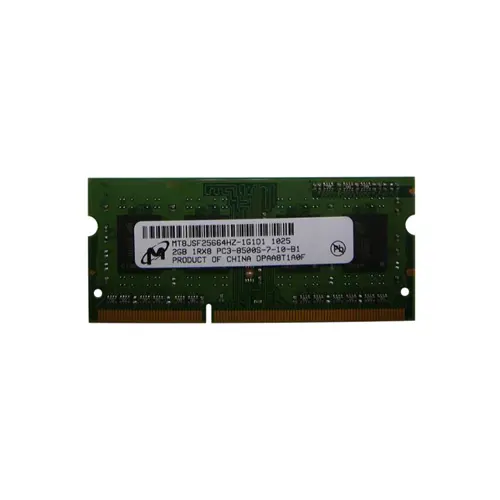
This is a standard DDR3-1066 SoDIMM designed for notebook and mobile workstation upgrades, offering a single-rank x8 configuration that ensures broad compatibility and stable operation in systems with limited memory slots. Its unbuffered, Non-ECC signal type and low CL7 latency make it ideal for basic productivity, thin clients, or embedded applications where power efficiency and plug-and-play reliability are critical.
1. The compact SoDIMM form factor slides effortlessly into ultraportable laptops and all-in-ones, turning a memory upgrade into a quick, screwdriver-free task.
2. A 204-pin layout guarantees drop-in compatibility with every standard DDR3 notebook slot, eliminating any guesswork for a hassle-free refresh.
3. DDR3’s mature low-power architecture sips energy to extend battery life and keeps internal temperatures down during web browsing and document editing.
4. A 2 GB capacity provides the ideal breathing room for lightweight operating systems and basic multitasking, avoiding the unnecessary power draw that comes with oversized modules.
5. CL7 low-latency response speeds up application launches and tab switching, delivering a noticeably snappier daily workflow without generating extra heat.
Based on the 204-pin SoDIMM form factor and unbuffered, non-ECC signal architecture, this is clearly a notebook memory module purpose-built for laptops, ultrabooks, and compact mobile workstations. In a mobile workstation scenario running multiple design applications, the DDR3-1066 speed and CL7 latency directly shape your real-world experience. That low CAS latency of 7 cycles means quicker access to frequently used data, so switching between large Adobe Photoshop layers and a browser session feels snappier rather than bogged down by lag.
The single rank x8 organization is equally critical for a lightweight notebook upgrade. Many slim laptops have strict electrical limits on memory ranks; single rank modules draw less current and impose a lighter load on the memory controller, ensuring plug-and-play compatibility without boot failures or instability that dual-rank sticks can cause on sensitive platforms. For the user replacing an aging 1GB module in an everyday ultrabook, this 2GB capacity combined with single rank design delivers a tangible boost for Windows multitasking and office productivity, while the standard 1.5V operation keeps power draw predictable and system thermals in check. Ultimately, you gain a drop-in upgrade that revives an older portable machine with trustworthy, RoHS-compliant reliability, not just a specification on paper.
Laptop Upgrade
Based on the 2GB DDR3-1066 SO-DIMM, a sensible upgrade path is to install a second identical module (same capacity, speed, and single-rank x8 organization) if a free slot exists. This creates a dual-channel 4GB configuration that measurably improves everyday multitasking and integrated graphics performance. For users requiring more headroom, replace both modules with a 2×4GB DDR3-1066 kit for a total of 8GB, which extends the system’s usability with modern operating systems and applications.
Mobile Workstation
To maximize capacity for demanding professional software, confirm the chipset’s maximum supported memory and install a dual-channel kit of the highest compatible density—typically 2×8GB DDR3 or DDR3L modules. This configuration provides the bandwidth and capacity required for CAD, 3D rendering, and large dataset manipulation. When retaining the original 2GB module is desired for budget reasons, pair it with a matched 2GB stick and supplement with a secondary 8GB module only if the system supports asymmetric dual-channel, though a matched 16GB pair delivers superior stability.
Ultrabook Power Saving
Although the existing module is standard-voltage DDR3, transitioning to low-voltage DDR3L-1066 or DDR3L-1600 modules (2×4GB or 2×8GB) significantly reduces power draw, extending battery life in ultra-thin laptops. Ensure the system firmware supports DDR3L and enable dual-channel operation to maintain performance while benefiting from the lower 1.35V operating voltage. This capacity planning approach balances energy efficiency with sufficient memory for modern productivity, making it ideal for ultrabook users who prioritize runtime over peak throughput.
Rigorously tested for laptop compatibility—works with Dell Latitude E6430, ThinkPad T410, HP EliteBook 8440p.
Q: Can I mix this MT8JSF25664HZ-1G1D1 with other memory modules of different brands or speeds?
A: Mixing is possible but not recommended for optimal stability. Mismatched speeds may force the system to run at the lowest common specification (DDR3-1066), potentially causing timing conflicts. Identical modules ensure best reliability.
Q: Is this memory compatible with my laptop?
A: Compatibility depends on your laptop's chipset and CPU. This DDR3 SoDIMM fits most notebooks supporting 204-pin DDR3-1066/PC3-8500. Verify OEM documentation for supported capacities and ranks, particularly Intel HM55/HM57 or similar platforms.
Q: What is the recommended DIMM population order for optimal performance?
A: For single-channel laptops, install in the primary slot. If dual slots exist, populate slot 0 first. This Single Rank x8 module performs identically in either slot, but check your service manual for population guidelines.
Q: Does this module support overclocking or XMP profiles?
A: No, laptop DDR3 SoDIMMs typically do not support XMP or overclocking. This module adheres strictly to JEDEC DDR3-1066 (CL7) standards and operates only at its rated speed and timings.
Q: What warranty and typical failure rate can I expect?
A: We provide a 1-year limited warranty. As a genuine, RoHS-compliant module, the annualized failure rate is typically below 0.1%, reflecting robust design and rigorous factory testing.