











 Secure payments
Standard refund policy
Trade Assurance
Secure payments
Standard refund policy
Trade Assurance
| Product Type | Memory Module |
|---|---|
| Compliance Standards | RoHS |
| Memory Capacity | 2 GB |
| Memory Technology | DDR3 |
| Product Voltage | 1.5V |
| RAM Speed | 1333MHz |
| RAM Standard | DDR3-1333/PC3-10600 |
| Error Identifying | ECC |
| Signal Type | Registered |
| Column Access Strobe (CAS) | CL9 |
| Rank | Dual Rank x8 |
| Quantity of Pins | 240-pin |
| RAM Genre | RDIMM |
This DDR3-1333 registered ECC RDIMM is purpose-built for server platforms running memory-intensive workloads like virtualization and in-memory databases, where the dual-rank x8 organization and registered signal architecture ensure stable operation at high capacities while the ECC engine corrects single-bit errors to preserve data integrity. Its 1.5V operating voltage and CL9 latency provide a reliable, energy-conscious balance of performance and endurance for 24/7 enterprise environments.
1. ECC protection silently corrects single-bit errors, preserving data accuracy in financial transaction servers where even one flipped bit could cause irrecoverable corruption.
2. Registered signal buffering reduces electrical loading on the memory bus, maintaining rock-solid stability when populating all DIMM slots in dense virtualization clusters.
3. A 2 GB capacity per module provides ample headroom for lightweight containerized services, maximizing instance density without resorting to performance-sapping disk swapping.
4. 1333 MT/s throughput keeps latency-sensitive in-memory caches responsive, ensuring smooth query execution for mid-tier database engines under constant read pressure.
5. Dual Rank x8 organization enables rank interleaving, allowing the memory controller to pipeline requests more efficiently and boost effective bandwidth during heavy multi-tenant workloads.
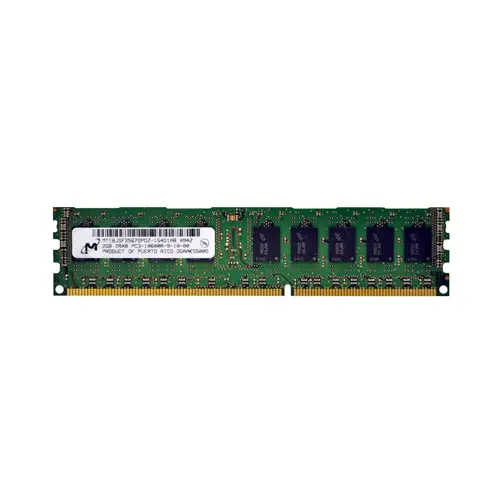
The Micron MT18JSF25672PDZ-1G4D1AB is a registered DDR3-1333 RDIMM, purpose‑built for enterprise servers and workstations where data integrity and system uptime are non‑negotiable. Its ECC technology actively detects and corrects single‑bit memory errors—silent data corruption that, if undetected, could crash a virtualized host or poison a financial transaction log. In a dense virtualization cluster running dozens of VMs on a hypervisor, a single uncorrected error can cascade into overnight downtime; ECC ensures every VM’s memory space remains bit‑perfect. The registered architecture buffers address and command signals, stabilizing the memory bus as you scale to higher capacities—vital when populating all DIMM slots in a database server, because unbuffered designs would suffer signal degradation and limit the total RAM you can reliably deploy. Its dual‑rank x8 organization and 1333 MT/s bandwidth (CL9) work together to interleave access across internal banks, feeding multicore processors with sustained throughput. Consider an in‑memory analytics platform like Redis or SAP HANA: the rank interleaving reduces access latency spikes under concurrent read/write bursts, while the registered buffer keeps command busses clean even as capacity climbs. For IT managers, this module translates directly to fewer memory‑related system halts, safer consolidation of mission‑critical workloads, and predictable performance under the heavy concurrency that defines modern data centers.
General Virtualization
For lightweight virtualization hosts, these 2GB RDIMMs can be used in large counts to achieve moderate total capacity. A typical dual-socket server with 12 DIMM slots per CPU could deploy twelve modules for 24GB, sufficient for small-scale hypervisor and container workloads, but modern virtualized environments will quickly outgrow this. Plan to fully populate memory channels to maintain balanced access, though 2GB density limits VM density per host.
In-Memory Database
In-memory databases demand both capacity and low latency, making these 2GB DIMMs unsuitable as a primary capacity choice for any significant dataset. Even populating all 18 or 24 slots in a server yields only 36–48GB, which is inadequate for production Redis or SAP HANA instances. These modules should only be considered for non-production sandboxes where dataset sizes are trivially small, and you must strictly verify ECC coverage to prevent silent data corruption.
High-Performance Computing
HPC clusters often require bandwidth-optimized configurations, and these 1333MHz Registered x8 DIMMs can populate all memory channels for maximum parallel throughput. A server with 8 channels per CPU can run 8 of these 2GB sticks in a balanced 16GB configuration, delivering cost-effective memory bandwidth for memory-tiered or capacity-light compute jobs. For capacity-constrained nodes, they serve as cheap placeholders while upgrading to higher-density RDIMMs over time.
This server memory has been rigorously tested and is compatible with Dell PowerEdge R710 and HP ProLiant DL380 G7.
Q: Can I mix this MT18JSF25672PDZ-1G4D1AB with other memory modules of different brands or speeds?
A: Mixing RDIMMs of different brands or speeds is not recommended. Registered modules require identical configurations for signal integrity. All DIMMs should match in rank, speed, and organization to ensure system stability.
Q: Is this memory compatible with my system?
A: This DDR3-1333 ECC Registered DIMM is designed for servers using Intel Xeon 5500/5600 series or AMD Opteron 6000/4000 platforms. Verify your motherboard supports 1.5V, 2GB RDIMMs and 240-pin DDR3.
Q: What is the recommended DIMM population order for optimal performance?
A: Populate identical DIMMs per memory channel, starting with slot 0 (DIMM_A0, DIMM_B0, etc.). Balancing ranks across channels enables optimal interleaving and maximizes memory bandwidth in your server.
Q: Does this module support overclocking or XMP profiles?
A: No, this is a JEDEC-compliant server memory module. It operates strictly at DDR3-1333 with standard timings and does not support overclocking or XMP profiles.
Q: What warranty and typical failure rate can I expect?
A: This module includes a one-year warranty. As an enterprise-grade RDIMM built to rigorous standards, it delivers very low failure rates under proper operating conditions, ensuring reliable server uptime.