











 Secure payments
Standard refund policy
Trade Assurance
Secure payments
Standard refund policy
Trade Assurance
| Product Type | Memory Module |
|---|---|
| Compliance Standards | RoHS |
| Memory Capacity | 2 GB |
| Memory Technology | DDR3 |
| Product Voltage | 1.35V |
| RAM Speed | 1333MHz |
| RAM Standard | DDR3-1333/PC3-10600 |
| Error Identifying | ECC |
| Signal Type | Registered |
| Column Access Strobe (CAS) | CL9 |
| Rank | Single Rank x8 |
| Quantity of Pins | 240-pin |
| RAM Genre | RDIMM |
This DDR3-1333 registered ECC RDIMM with a single-rank x8 configuration and low 1.35V operating voltage is purpose-built for entry-level servers and small-scale virtualization hosts, where its hardware error correction safeguards data integrity in always-on environments such as light database serving or domain controllers. The registered signal path ensures stable multi-DIMM population on compatible platforms, while the CL9 latency and 1333 MT/s bandwidth deliver sufficient responsiveness for memory-bound applications without exceeding power budgets.
1. ECC error correction transparently detects and fixes single-bit memory faults, preserving data accuracy in transactional systems and eliminating silent corruption that would otherwise bring down critical server workloads.
2. Registered buffer logic isolates the memory signal path from the controller, allowing fully loaded channels to run without signal degradation — essential for maintaining uptime in dense rack-scale virtualization.
3. Low-voltage DDR3L operation curtails per-DIMM energy consumption and thermal output, directly lowering datacenter cooling overhead and improving long-term power efficiency in always-on infrastructure.
4. Mainstream data-rate throughput supplies ample bandwidth for multi-tenant application hosting and in-memory caching, preventing memory saturation when numerous lightweight VMs run concurrently.
5. Single-rank x8 organization keeps per-channel electrical loading minimal, delivering cleaner signal integrity and more predictable latency in configurations where multiple modules populate each server channel.
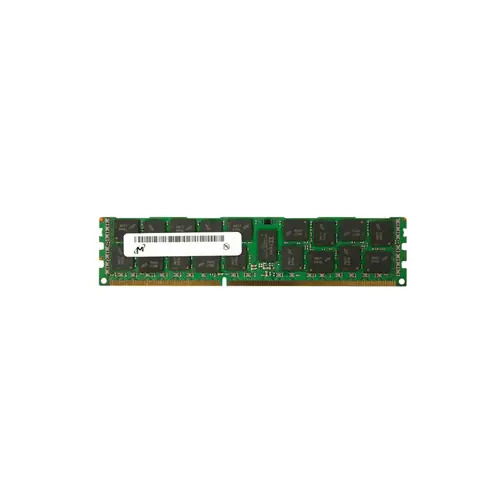
The Micron MT9KSF25672PZ-1G4D1EA is a Registered DDR3L-1333 RDIMM engineered for server platforms where uptime and data integrity are absolute. Its ECC technology actively detects and corrects single-bit memory errors, a critical safeguard against silent data corruption in virtualized clusters running multiple tenants—one flipped bit in a hypervisor’s memory space can crash dozens of workloads. The registered architecture buffers command and address signals, stabilizing the memory bus when populating all channels with high-density configurations, which is essential for memory-resident databases like Redis or SAP HANA that demand large, reliable footprints to accelerate real-time transactions. Operating at 1.35 volts, the module reduces thermal load and energy draw across rack-scale deployments, directly cutting cooling costs in always-on data centers. At 1333MHz with a CAS latency of 9, this single-rank x8 DIMM delivers consistent, predictable bandwidth for latency-sensitive applications such as financial trading engines or in-memory analytics. For IT managers scaling virtualization hosts or database servers, this module means fewer silent failures, higher consolidation ratios, and lower operational expense.
General Virtualization
Populate all memory channels symmetrically with this 2 GB DDR3L-1333 RDIMM to maximize bandwidth. A typical dual‑socket server with 12 DIMM slots yields only 24 GB, sufficient for a handful of light VMs in a lab. For any production rollout, this capacity is a bottleneck—fill every available slot and plan an immediate upgrade to higher‑density RDIMMs.
In‑Memory Database
Scale by installing these registered ECC modules in every slot across all memory controllers; a 24‑slot server reaches just 48 GB, which can host a tiny test dataset. Balance identical DIMMs per channel to preserve reliable, low‑latency access. Even with full population, a production in‑memory store demands far denser modules, making these 2 GB sticks a stopgap at best.
High‑Performance Computing
Exploit the 1.35 V low‑power registered design for stable, energy‑efficient clusters. Install at least one single‑rank x8 DIMM per channel to enable full interleaving at 1333 MT/s. A node with 16 slots provides 32 GB, adequate only for development or lightweight simulation. Aggregate multiple nodes to reach usable capacity, and consider replacing with 8 GB or 16 GB RDIMMs for meaningful per‑node memory.
Rigorously tested server memory for Dell PowerEdge R710, HP DL380 G7, Lenovo RD330, and Cisco UCS C200 M2.
Q: Can I mix this MT9KSF25672PZ-1G4D1EA with other memory modules of different brands or speeds?
A: Mixing RDIMMs of different brands or speeds is strongly discouraged. It may lead to signal integrity issues, system instability, or failure to POST on server platforms. Uniform modules ensure reliable ECC and registered operation.
Q: Is this memory compatible with my Intel Xeon or AMD EPYC server platform?
A: This 2GB DDR3-1333 Registered ECC module requires a motherboard with a 240-pin RDIMM slot and a chipset supporting 1.35V low-voltage DDR3. Verify your server’s qualified vendor list for compatibility with this specific part.
Q: What is the recommended DIMM population order for optimal performance?
A: Follow your server board's manual: typically populate identical RDIMMs per channel starting from the farthest slot from the CPU. Balanced channel loading maximizes memory bandwidth and maintains correct ECC multi-bit error protection.
Q: Does this module support overclocking or XMP profiles?
A: No. This is a JEDEC-compliant server RDIMM running at standard DDR3-1333 with CL9 timings. Server memory prioritizes data integrity over speed, so it does not support overclocking or Intel XMP profiles.
Q: What warranty and typical failure rate can I expect?
A: This module carries a 1-year warranty. Typical annualized failure rate (AFR) for Micron server RDIMMs is below 0.5% under specified operating conditions. Proper cooling and ESD-safe handling further ensure long-term reliability.