











 Secure payments
Standard refund policy
Trade Assurance
Secure payments
Standard refund policy
Trade Assurance
| Product Type | Memory Module |
|---|---|
| Compliance Standards | RoHS |
| Memory Capacity | 2 GB |
| Memory Technology | DDR3 |
| Product Voltage | 1.5V |
| RAM Speed | 1333MHz |
| RAM Standard | DDR3-1333/PC3-10600 |
| Error Identifying | ECC |
| Signal Type | Registered |
| Column Access Strobe (CAS) | CL9 |
| Rank | Single Rank x4 |
| Quantity of Pins | 240-pin |
| RAM Genre | RDIMM |
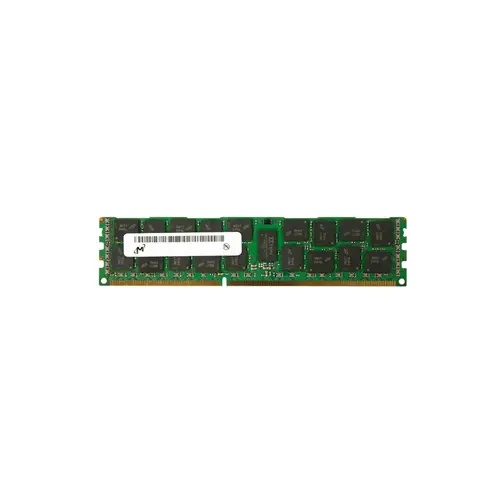
This DDR3-1333 Registered ECC RDIMM is engineered for legacy server platforms where data integrity and stability are critical, making it suitable for virtualization hosts and in-memory database workloads that demand reliable operation. Its registered signal type reduces electrical loading on the memory bus for enhanced stability in multi-DIMM configurations, while ECC provides single-bit error correction to prevent data corruption during continuous operation.
1. Error-correcting code protection silently catches and repairs single-bit corruption, preserving transactional data integrity across long-running enterprise workloads and financial databases.
2. Registered buffering isolates the memory controller from electrical load spikes, allowing large server fleets to scale to massive total RAM footprints without signal degradation or boot-time instability.
3. Single-rank layout reduces per-channel capacitance, helping sustain higher clock margins and predictable access latencies when multiple virtual machines contend for I/O under heavy consolidation.
4. Mainstream server-class frequency provides a balance of ample throughput and low power draw, keeping web front-ends and middleware tiers responsive under sustained concurrent request bursts.
5. Compact module capacity is purpose-fit for embedded service processors and lean virtualization hosts, minimizing idle energy consumption while still running critical lightweight management stacks.
When you are running a virtualized cluster or an in-memory database, every bit of data integrity and signal timing directly impacts your uptime and transaction consistency. The Micron MT18JSF25672PY-1G4D1 is an RDIMM engineered specifically for these mission-critical server workloads. Its ECC technology is not just a feature; it is your first line of defense against silent data corruption caused by single-bit errors, which can flip a financial calculation or a customer record without warning. Coupled with registered signal buffering, this module stabilizes the electrical load on the memory bus when you populate multiple channels, ensuring a 24/7 database server stays responsive even as you scale capacity. The DDR3-1333 speed and single-rank x4 organization deliver a predictable 10.6 GB/s bandwidth, which truly matters for a hypervisor juggling dozens of virtual machines. It eliminates the access conflicts that would otherwise stall your SQL queries under concurrent load. This is not generic desktop memory; it is a building block for resilient, latency-sensitive enterprise environments where a crash means lost revenue.
Server Memory Identification: This is a server-grade module, recognized by its ECC, Registered (RDIMM) type, 240-pin layout, and DDR3-1333 speed. Capacity planning must address the 2 GB density limitation by populating channels appropriately.
General Virtualization
Virtualization thrives on memory capacity for multiple guests. With only 2 GB per stick, you must occupy every available DIMM slot to achieve a usable footprint — a dual‑socket server with 12 slots yields just 24 GB. Reserve this configuration for light test labs or low‑density containers, and prioritize migrating to 8 GB or 16 GB RDIMMs for any production workload.
In-Memory Database
In‑memory platforms (Redis, Memcached, SAP HANA) demand entire datasets in RAM, making 2 GB modules extremely restrictive. Maximize module count across all memory channels to reach 32–48 GB only if the server is deeply populated. Acceptable solely for tiny development instances; any serious deployment requires replacing these with high‑capacity Registered DIMMs.
High‑Performance Computing
HPC workloads often prize bandwidth over raw capacity. Install six or twelve identical 2 GB modules to fully leverage triple‑channel or quad‑channel architectures, delivering peak memory throughput per core. This approach suits memory‑bandwidth‑bound simulations but caps total capacity, so balance against problem size. For larger datasets, blend channel population with higher‑density RDIMMs while preserving symmetry.
Server DDR3 RDIMM, rigorously tested. Fits Dell PowerEdge R710, R720, HP DL380 G7, and similar systems.
Q: Can I mix this MT18JSF25672PY-1G4D1 with other memory modules of different brands or speeds?
A: Mixing this RDIMM with different brands, speeds, or ranks is not recommended. Mismatched DRAM attributes often lead to signal integrity issues, system instability, or no POST in registered server environments.
Q: Is this memory compatible with my system?
A: This DDR3-1333 Registered ECC module is designed for Intel Xeon 5500/5600 series or AMD Opteron platforms with appropriate 240-pin RDIMM slots. Always confirm against your server board’s qualified vendor list.
Q: What is the recommended DIMM population order for optimal performance?
A: For optimal performance, populate identical DIMMs per channel starting with the slot farthest from the CPU. Follow your server manual’s population sequence, typically filling blue or white slots first across memory banks.
Q: Does this module support overclocking or XMP profiles?
A: No. As a JEDEC-compliant server memory, this registered DIMM does not support overclocking or XMP profiles. It operates at fixed timings to ensure 24/7 enterprise reliability and data integrity.
Q: What warranty and typical failure rate can I expect?
A: This module comes with a 1-year warranty. Thanks to rigorous screening and on-die ECC, annualized failure rates are typically under 0.5%, ensuring robust long-term operation in mission-critical server deployments.