











 Secure payments
Standard refund policy
Trade Assurance
Secure payments
Standard refund policy
Trade Assurance
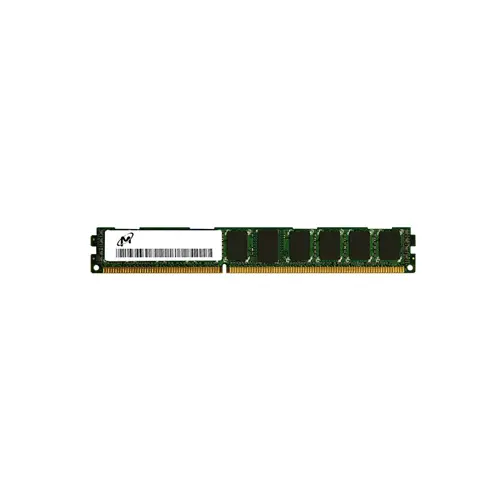
| Model | MT18JSF25672PDZ-1G4D1 |
|---|---|
| Product Type | Memory Module |
| Compliance Standards | RoHS |
| Memory Capacity | 2 GB |
| Memory Technology | DDR3 |
| Product Voltage | 1.5V |
| RAM Speed | 1333MHz |
| RAM Standard | DDR3-1333/PC3-10600 |
| Error Identifying | ECC |
| Signal Type | Registered |
| Column Access Strobe (CAS) | CL9 |
| Rank | Dual Rank x8 |
| Quantity of Pins | 240-pin |
| RAM Genre | RDIMM |
This 2GB DDR3-1333 RDIMM with ECC and Registered signaling is optimized for entry-level server platforms running virtualization, small-scale in-memory databases, or any workload demanding data integrity. Its dual-rank x8 configuration improves memory bandwidth over single-rank alternatives, while Registered logic and CL9 latency ensure stable signal integrity in multi-DIMM configurations.
1. Registered DIMM architecture stabilizes command and address signals across fully populated server channels, enabling larger memory footprints without sacrificing signal integrity or uptime.
2. ECC protection detects and corrects single-bit errors in real time, shielding virtualized databases and mission-critical applications from silent data corruption.
3. Dual Rank x8 organization leverages rank interleaving to keep memory banks active in parallel, improving throughput and reducing latency under heavy consolidation of mixed enterprise workloads.
4. The DDR3-1333 speed grade delivers steady, power-efficient bandwidth perfectly suited for legacy application servers and hypervisor management where balanced performance matters more than peak speed.
5. Entry-level capacity fits cost-optimized scenarios such as dedicated hypervisor boot modules or lightweight microservice nodes, simplifying sparing and minimizing overhead in dense rack deployments.
The Micron MT18JSF25672PDZ-1G4D1 is a server-grade Registered DDR3-1333 RDIMM, and its four defining characteristics directly address the realities of data center workloads. ECC error correction is the first line of defense against single-bit upsets caused by background radiation—a silent threat that, without ECC, could quietly corrupt financial transactions in an in-memory database or destabilize a long-running virtual machine. The registered signal buffer enables stable operation when you populate all memory channels, which is essential for dense virtualization clusters where you need maximum DIMMs per server to support dozens of VMs without intermittent crashes. Dual-rank x8 organization enables memory interleaving, increasing effective bandwidth so a heavily loaded hypervisor can service concurrent VM page requests with measurably lower latency. Finally, the DDR3-1333 speed and CL9 timing deliver 10.6 GB/s of consistent throughput, ensuring that latency-sensitive caching platforms like Redis or Memcached respond predictably under peak load. Together, these features mean fewer silent errors, higher density, and reliable performance—not just benchmarks—for virtualization and database-critical operations.
General Virtualization
With only 2 GB per RDIMM, this module is unsuitable for modern hypervisors. For lightweight lab environments, populate all channels with at least four identical modules to reach 8 GB, but expect severe performance constraints. In production, retire these low-capacity DIMMs and design for 64 GB+ using 8 GB or 16 GB RDIMMs across balanced memory channels.
In-Memory Database
In-memory databases demand both high capacity and reliability. A 2 GB ECC RDIMM is entirely inadequate for holding meaningful datasets in RAM. Deploying six or more of these modules per CPU only yields 12 GB, which is insufficient for most platforms. Plan for 32 GB or 64 GB RDIMMs to satisfy data locality and fault tolerance requirements without excessive slot consumption.
High-Performance Computing
HPC workloads require maximum bandwidth and low latency. Pairing these 1333 MHz dual-rank DIMMs in a fully balanced configuration across all memory channels (e.g., eight modules for a dual-socket system) provides a total of just 16 GB. This capacity bottleneck limits problem sizes. Migrate to higher-density, faster registered DIMMs to sustain compute throughput and avoid swapping penalties during large-scale simulations.
Validated server memory: rigorously tested for Dell PowerEdge R720, HP DL380p Gen8, and Lenovo RD430.
Q: Can I mix this MT18JSF25672PDZ-1G4D1 with other memory modules of different brands or speeds?
A: Mixing RDIMMs is not recommended. Mismatched brands, speeds, or ranks can cause signal integrity issues and system instability. For proper ECC and registered operation, all modules should be identical.
Q: Is this memory compatible with my system?
A: This is a 240-pin DDR3 Registered ECC RDIMM. It requires a server chipset supporting registered memory, such as Intel 5500/5600 series or AMD Opteron 6000/4000 platforms. Verify your board's qualified vendor list.
Q: What is the recommended DIMM population order for optimal performance?
A: Populate identical RDIMMs in matching channels, typically starting with the furthest slot per channel. Follow your server's manual for balanced memory configuration, often filling slots in pairs for dual-channel interleaving.
Q: Does this module support overclocking or XMP profiles?
A: No. This is a JEDEC-compliant DDR3-1333 CL9 server RDIMM. It does not support XMP or overclocking, as server platforms prioritize data integrity and stability over frequency manipulation.
Q: What warranty and typical failure rate can I expect?
A: This module includes a 1-year warranty. Server-grade RDIMMs have very low failure rates under normal operating conditions, typically measured in single-digit AFR (annualized failure rate) when properly cooled and powered.