











 Secure payments
Standard refund policy
Trade Assurance
Secure payments
Standard refund policy
Trade Assurance
| Product Type | Memory Module |
|---|---|
| Compliance Standards | RoHS |
| Memory Capacity | 2 GB |
| Memory Technology | DDR3 |
| Product Voltage | 1.5V |
| RAM Speed | 1333MHz |
| RAM Standard | DDR3-1333/PC3-10600 |
| Error Identifying | ECC |
| Signal Type | Registered |
| Column Access Strobe (CAS) | CL9 |
| Rank | Dual Rank x8 |
| Quantity of Pins | 240-pin |
| RAM Genre | RDIMM |
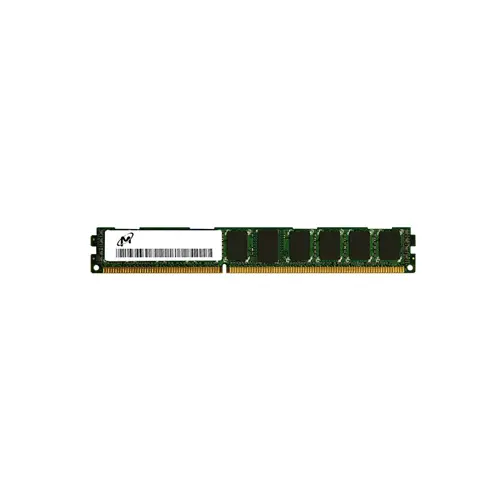
This Micron 2GB DDR3-1333 Registered ECC RDIMM (PC3-10600, CL9, dual-rank x8) is engineered for legacy server platforms where data integrity and system stability are critical, making it ideal for light virtualization, entry-level database servers, or embedded controllers that demand reliable memory operation. Its registered signal type reduces electrical loading on the memory controller and, combined with ECC, ensures single-bit error correction in always-on environments, while the dual-rank configuration optimizes interleaving for modest bandwidth gains under sustained access.
1. ECC memory protection detects and corrects data errors in real time, preserving the integrity of financial transactions and preventing costly downtime in mission-critical server environments.
2. Registered signal buffering stabilizes command and address lines under heavy DIMM populations, allowing dense memory configurations that maximize virtual machine density without compromising reliability.
3. Dual rank x8 organization leverages bank interleaving to reduce access conflicts, sustaining consistent throughput when multiple virtualized workloads contend for memory resources.
4. DDR3-1333 data rate delivers balanced bandwidth that keeps database queries and concurrent user requests flowing smoothly under typical enterprise workloads.
5. CL9 latency provides responsive data access that lowers transaction completion time, improving overall server efficiency for latency-sensitive applications.
In server environments, uptime and data accuracy are everything. The Micron 2GB DDR3-1333 RDIMM (MT18JSF25672PDZ-1G4F1) provides four essential capabilities. ECC instantly detects and corrects single-bit errors. For a virtualization cluster, a cosmic ray flipping a memory bit can crash a guest OS or silently corrupt a financial transaction; ECC neutralizes that risk, preserving transactional integrity. The registered interface buffers address and control signals, allowing you to fully populate all memory slots without electrical loading. This is crucial when scaling up an in-memory database like SAP HANA, where each module must operate reliably under constant heavy load. Dual-rank configuration enables rank interleaving, overlapping data transfers to improve effective bandwidth. When your database engine processes thousands of queries per second, this translates to lower latency and higher throughput. Finally, the 1333MHz speed with CL9 timing provides consistent platform performance. Together, these features minimize downtime and keep your business-critical applications running without compromise.
General Virtualization
For light to moderate virtualization hosts using DDR3-era platforms, populate at least six to eight of these 2 GB RDIMMs across three or four memory channels to reach 12–16 GB total. This satisfies hypervisor overhead plus a handful of low-resource VMs. Avoid mixing ranks asymmetrically—stick to identical dual-rank x8 modules to maintain balanced interleaving and reliable ECC performance.
In-Memory Database
An in-memory database demands capacity far beyond what single 2 GB modules can offer. A realistic deployment requires fully populating all DIMM slots—often 18 or 24 modules across multiple channels—to approach 36–48 GB, which is marginal for production datasets. Prioritize a configuration using the maximum supported RDIMM count per channel at 1333 MHz to minimize latency, acknowledging that an upgrade to higher-density modules is advisable for any growth.
High-Performance Computing
HPC workloads benefit from memory bandwidth rather than raw capacity per core. Install these 2 GB RDIMMs in a balanced multi-channel setup—one DIMM per channel across all available channels—to maximize aggregate bandwidth. For a dual-socket server with triple-channel architecture, that means six or twelve modules, yielding 12–24 GB. Operate at the native 1333 MT/s speed with CL9 to ensure deterministic latencies in tightly coupled parallel jobs.
Rigorously tested server DDR3 RDIMM, verified compatible with Dell PowerEdge R720, HP DL380p Gen8, Lenovo ThinkServer RD430.
Q: Can I mix this MT18JSF25672PDZ-1G4F1 with other memory modules of different brands or speeds?
A: Mixing is not recommended for registered ECC server memory. All modules should share identical speed, CAS latency, rank, and voltage to ensure signal integrity and prevent system instability.
Q: Is this memory compatible with my Intel Xeon or AMD Opteron server platform?
A: This DDR3-1333 Registered ECC RDIMM fits servers using Intel 5500/5600 series or AMD G34/C32 platforms. Verify that your board supports 2GB 240-pin 1.5V RDIMMs with dual rank x8 organization.
Q: What is the recommended DIMM population order for optimal performance on a dual-socket server?
A: Follow the motherboard manual strictly. Generally, populate identical DIMMs in the slots belonging to each memory channel first, slot 1 of channel A and B, to enable interleaving and balanced NUMA access.
Q: Does this module support overclocking or XMP profiles?
A: No, server-class Registered ECC memory adheres strictly to JEDEC DDR3-1333/PC3-10600 standards. Overclocking and XMP are not supported, as stability and data integrity take absolute precedence in enterprise environments.
Q: What warranty and typical failure rate can I expect?
A: This module is covered by a one-year warranty. As a rigorously tested, enterprise-grade RDIMM with ECC, it exhibits a very low annualized failure rate, typically below 0.5% under proper environmental and usage conditions.