











 Secure payments
Standard refund policy
Trade Assurance
Secure payments
Standard refund policy
Trade Assurance
| Model | MT9JSF25672PZ-1G4 |
|---|---|
| Product Type | Memory Module |
| Compliance Standards | RoHS |
| Memory Capacity | 2 GB |
| Memory Technology | DDR3 |
| Product Voltage | 1.5V |
| RAM Speed | 1333MHz |
| RAM Standard | DDR3-1333/PC3-10600 |
| Error Identifying | ECC |
| Signal Type | Registered |
| Column Access Strobe (CAS) | CL9 |
| Rank | Single Rank x8 |
| Quantity of Pins | 240-pin |
| RAM Genre | RDIMM |
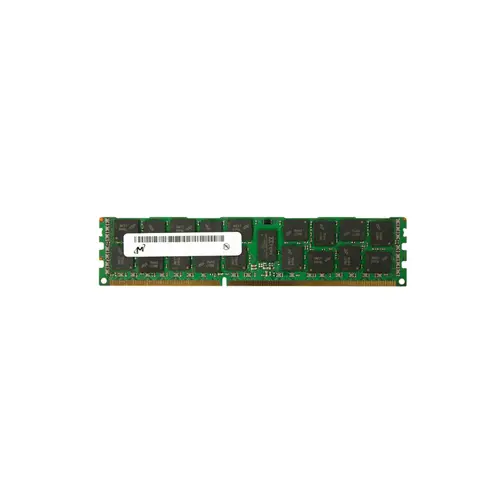
This Micron 2GB DDR3-1333 RDIMM is an entry-level server memory module built for small-scale virtualization, basic database hosting, and light multi-threaded workloads where data integrity is non-negotiable. Its registered signal distribution paired with single-rank x8 organization ensures stable command/address handling at 1.5V, while ECC support actively corrects single-bit errors to prevent silent data corruption in always-on environments.
1. ECC protection detects and corrects single-bit errors in real time, safeguarding transactional data integrity and preventing costly silent corruption in always-on enterprise servers.
2. Registered clock-driver buffering stabilizes command and address signals, enabling densely populated memory configurations essential for large-scale virtualization and multi-tenant cloud nodes.
3. 1333MHz bandwidth sustains steady throughput for mid-tier application servers, keeping response times consistent under heavy concurrent user access to business-critical services.
4. CL9 low-latency timing accelerates buffer flushes and memory fetches, directly improving query performance in database engines and reducing session wait times for ERP platforms.
5. Single Rank x8 organization minimizes electrical loading per channel, ensuring cleaner signal margins and reliable operation in dense rack-mount server farms where thermal and power headroom is constrained.
The Micron MT9JSF25672PZ-1G4 is a server-grade Registered DIMM engineered to eliminate the risks that keep IT managers awake at night. When you run a dense virtualization cluster, silent data corruption from random bit flips can cascade into guest operating system crashes or corrupt transactional records. The built-in ECC engine automatically detects and corrects single-bit errors on-the-fly, transforming a potential database outage into a non-event and preserving financial reporting accuracy without any performance penalty. Because virtualized environments often pack every DIMM slot to support more tenants, the Registered buffer dramatically improves signal integrity by re-driving address and command lines; this lets you fully populate your server without memory errors under heavy load, giving your hypervisor rock-solid stability across dozens of VMs. Inside those guests, in-memory analytics platforms like SAP HANA or high-velocity caching systems demand not just capacity but also predictable low-latency access. The single-rank x8 organization and DDR3-1333 speed with CL9 timing work together to reduce electrical loading and accelerate data delivery, directly boosting query throughput during peak trading hours. These characteristics collectively mean you get a memory foundation that protects data integrity, scales reliably in multi-slot configurations, and sustains responsive application performance where every millisecond counts.
This is a server-class 2GB DDR3-1333 Registered ECC DIMM (RDIMM) designed for platforms that require data integrity and stable multi-DIMM configurations. Capacity planning must account for its small density and reliance on registered signalling.
General Virtualization
Virtualized hosts demand generous memory to avoid contention among guests. With this 2GB module, target at least 64GB by installing thirty-two identical DIMMs evenly across all memory channels—typically two DIMMs per channel on a dual-socket system with four channels per CPU. Symmetrical population ensures consistent latency and bandwidth under mixed workloads.
In-Memory Database
In-memory databases thrive on large, contiguous address spaces and low latency. Use every available DIMM slot to maximize capacity; a 24-slot server filled with these modules yields 48GB. While 48GB may be modest for large datasets, balancing identical RDIMMs across all memory controllers enables channel interleaving, which significantly improves transactional throughput.
High-Performance Computing (HPC)
HPC codes often scale with memory bandwidth. Install one 2GB DIMM per channel initially to sustain the full 1333MT/s rank speed, minimizing access penalties. If capacity becomes a bottleneck, populate a second identical DIMM per channel—understanding that speed may drop to 1066MT/s or 800MT/s depending on the platform—and validate performance with application benchmarks.
Strictly tested, compatible with Dell PowerEdge R720, HP DL380p Gen8, and similar DDR3 ECC servers.
Q: Can I mix this MT9JSF25672PZ-1G4 with other memory modules of different brands or speeds?
A: Mixing RDIMMs of different brands or speeds is not recommended. The system will downclock all modules to the slowest speed, and mismatched timings or chip organizations may cause instability, especially in registered server platforms.
Q: Is this memory compatible with my Intel Xeon or AMD Opteron server platform?
A: This 2GB DDR3-1333 registered ECC module is compatible with platforms supporting 1.5V RDIMMs, such as Intel 5500/5600 series and AMD G34/C32 series. Verify your server’s qualified vendor list for this specific part number.
Q: What is the recommended DIMM population order for optimal performance?
A: Typically, populate identical DIMMs per memory channel starting from the farthest slot from the processor. For dual-processor systems, balance memory evenly across both CPUs. Always consult your server’s technical manual for the exact population sequence.
Q: Does this module support overclocking or XMP profiles?
A: No. As a server-grade registered DIMM, it adheres to JEDEC DDR3-1333 standard with fixed CL9 timings. It does not support overclocking, XMP, or enthusiast memory profiles; stability and data integrity are prioritized over speed flexibility.
Q: What warranty and typical failure rate can I expect?
A: This module carries a one-year warranty. For enterprise DDR3 RDIMMs, the annualized failure rate (AFR) is typically below 0.5% under normal operating conditions, ensuring high reliability for 24/7 server workloads.