











 Secure payments
Standard refund policy
Trade Assurance
Secure payments
Standard refund policy
Trade Assurance
| Product Type | Memory Module |
|---|---|
| Memory Capacity | 2 GB |
| Memory Technology | DDR3 |
| Product Voltage | 1.5V |
| RAM Speed | 1333MHz |
| RAM Standard | DDR3-1333/PC3-10600 |
| Error Identifying | ECC |
| Signal Type | Registered |
| Column Access Strobe (CAS) | CL9 |
| Rank | Dual Rank x8 |
| Quantity of Pins | 240-pin |
| RAM Genre | RDIMM |
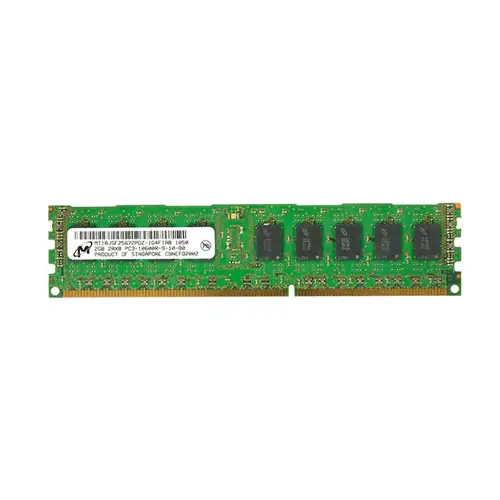
Designed for server platforms requiring unwavering data integrity, this 2GB DDR3-1333 Registered DIMM with ECC is ideally suited for virtualization hosts and memory-intensive databases where silent data corruption is unacceptable. Its registered signal type and dual-rank x8 configuration ensure stable electrical loading on dense memory buses, enabling reliable operation under sustained heavy workloads and minimizing the risk of command/address errors in multi-DIMM configurations.
1. Error-correcting code silently resolves single-bit memory faults, preserving the data integrity demanded by mission-critical enterprise applications and financial databases.
2. Registered logic stabilizes signal integrity across multiple DIMMs per channel, enabling dense server memory configurations without compromising system reliability.
3. Dual-rank interleaving maximizes bandwidth utilization by pipelining access across rank pairs, essential for sustaining throughput in virtualized server environments.
4. Balanced operating frequency provides ample transaction rates for moderate consolidation workloads, keeping multi-VM responsiveness smooth under typical enterprise loads.
5. Optimized capacity for auxiliary server roles such as baseboard management controllers ensures dedicated reliability without excess power or thermal overhead.
As a registered ECC module, the Micron MT18JSF25672PDZ-1G4F1AB directly tackles the critical pain points server operators face every day. ECC constantly defends against bit flips caused by background radiation, preventing the silent data corruption that could crash a hypervisor and bring down dozens of virtual machines overnight in a consolidated cluster. The registered buffer preserves signal integrity across fully loaded memory channels, meaning you can scale a VMware farm to hundreds of gigabytes with rock-solid stability instead of chasing mysterious lockups. Dual-rank organization enables rank interleaving, effectively doubling bandwidth. For an in-memory database like Redis or a transactional system, simultaneous access across ranks accelerates query processing and feeds data to the CPU without stalls. Complementing this, the tight CL9 latency minimizes wait states, keeping access cycles short and response times low in latency-sensitive workloads such as real-time analytics or high-frequency trading platforms. For IT architects, these specifications are not abstract numbers; they translate directly into fewer outages, smoother virtualization, and faster database operations, safeguarding business continuity and throughput.
General Virtualization
For lightweight virtualization hosts, 2 GB RDIMMs are only suitable in very small or legacy deployments. Use at least six modules (12 GB) for a basic hypervisor running a handful of low-memory VMs, but plan to move to higher-capacity DIMMs quickly. Triple-channel configurations (3 × 2 GB) on older Nehalem/Westmere platforms can work for lab environments, though production workloads demand 4 GB or 8 GB RDIMMs.
In-Memory Database
In-memory databases require capacity far beyond what 2 GB DIMMs can provide, making these modules a poor fit for primary data stores. A practical minimum for development or test instances would be 12 modules (24 GB) across triple channels, but this still limits dataset size severely. Production deployments should avoid 2 GB RDIMMs entirely, favoring 16 GB or 32 GB registered DIMMs to hold meaningful working sets in RAM.
High-Performance Computing (HPC)
Low-capacity 2 GB RDIMMs can still serve scale-out HPC clusters where memory per node is intentionally kept lean. Populate all six or eight DIMM slots per socket for maximum bandwidth, giving 12–16 GB per node, which suits throughput-oriented codes that stream data. For capacity-bound simulations, consolidate memory into 8 GB or larger modules to avoid swapping and I/O bottlenecks.
Rigorously tested and guaranteed compatible with servers like Dell PowerEdge R720, HP ProLiant DL380p Gen8, and IBM System x3650 M4.
Q: Can I mix this MT18JSF25672PDZ-1G4F1AB with other memory modules of different brands or speeds?
A: Mixing RDIMMs is not recommended. Mixing brands or speeds can cause instability, signal integrity degradation, and possible POST failures. For guaranteed compatibility and reliability, use identical modules across all channels.
Q: Is this memory compatible with my system?
A: This is a 2GB DDR3-1333 ECC Registered RDIMM (240-pin). It is compatible with servers using Intel Xeon 5500/5600 series or AMD Opteron 6100 series platforms. Verify your motherboard supports registered ECC DDR3 before ordering.
Q: What is the recommended DIMM population order for optimal performance?
A: Populate identical RDIMMs per channel, starting with the farthest slot from the CPU. For dual-rank x8 modules like this, follow the server manual's channel mirroring or independent channel guidelines to balance memory bandwidth.
Q: Does this module support overclocking or XMP profiles?
A: No, this enterprise-grade registered ECC module does not support overclocking or XMP. It runs strictly at JEDEC standard DDR3-1333 CL9 timings to ensure data integrity in mission-critical server environments.
Q: What warranty and typical failure rate can I expect?
A: This Micron module includes a 1-year warranty. With ECC and rigorous screening, the annualized failure rate is well under 0.5% in compatible server environments. Premature failures are typically covered by the warranty.