











 Secure payments
Standard refund policy
Trade Assurance
Secure payments
Standard refund policy
Trade Assurance
| Model | MT18JSF25672PDZ-1G4F |
|---|---|
| Product Type | Memory Module |
| Compliance Standards | RoHS |
| Memory Capacity | 2 GB |
| Memory Technology | DDR3 |
| Product Voltage | 1.5V |
| RAM Speed | 1333MHz |
| RAM Standard | DDR3-1333/PC3-10600 |
| Error Identifying | ECC |
| Signal Type | Registered |
| Column Access Strobe (CAS) | CL9 |
| Rank | Dual Rank x8 |
| Quantity of Pins | 240-pin |
| RAM Genre | RDIMM |
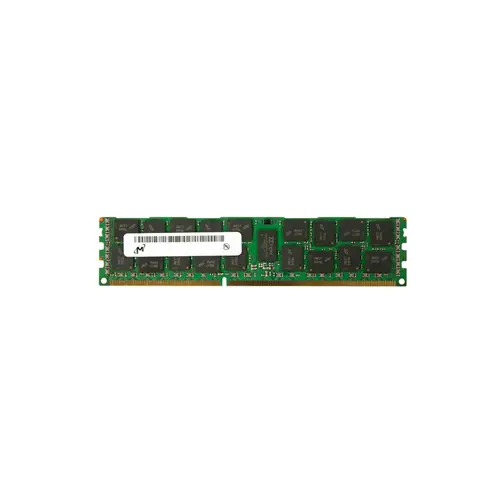
Designed for server-class platforms, this Micron 2GB DDR3-1333 Registered ECC RDIMM ensures data integrity in virtualized environments and memory-intensive workloads such as in-memory databases. Its dual-rank x8 configuration with CL9 latency enhances interleaving efficiency, while the registered signal type enables stable operation with higher-capacity memory configurations on compliant motherboards.
1. ECC protection silently corrects single-bit memory errors, preserving data integrity for mission-critical database transactions and financial computations.
2. Registered signal buffering stabilizes high-capacity memory arrays by reducing electrical load, enabling reliable operation across densely populated server racks.
3. Dual Rank x8 organization leverages rank interleaving to sustain streaming bandwidth, effectively smoothing I/O under heavy virtualization and multi-tenant workloads.
4. A mainstream transfer rate ensures balanced throughput for enterprise server tasks, efficiently servicing concurrent web requests and backend application logic without bottlenecks.
5. The tight column access latency sharpens logical command turnaround, lowering request-to-response gaps that benefit latency-sensitive OLTP and real-time analytics.
In enterprise servers powering virtual clusters and in-memory databases, memory selection directly dictates reliability and throughput. The MT18JSF25672PDZ-1G4F RDIMM offers four critical features that address real operational pain. Its ECC engine instantly rectifies single-bit errors caused by background radiation, preserving data fidelity in hypervisor-managed VMs and preventing in-memory database corruption that could trigger costly failovers. Registered logic buffers address and command signals, stabilizing fully populated memory channels so you can load a virtualization host with maximum DIMMs without boot failures or silent data drift. The Dual Rank layout interleaves memory banks to boost bandwidth for multi-threaded workloads; during a peak trading window, your Redis cluster returns results noticeably faster, directly enhancing user experience. Finally, operating at a standard 1.5V and 1333MHz with CL9 latency, this module delivers a thermal-friendly, responsive performance profile ideal for dense rack servers, avoiding throttling under sustained load. Each specification of this RDIMM is not just a parameter—it is a commitment to uninterrupted service.
This 2GB DDR3-1333 RDIMM is an ECC registered module built for legacy servers. Its small capacity requires careful population strategies to meet workload demands.
General Virtualization
Populate all memory channels identically to balance bandwidth and capacity. In a dual-socket system with three channels per CPU, twelve modules provide 24GB—enough for several light virtual machines. Always enable ECC to guard guest workloads against memory errors and improve uptime.
In-Memory Database
Maximize total capacity by filling every available DIMM slot; a typical dual-processor server can reach 36–48GB. Rely on registered ECC for data integrity, and consider memory mirroring if the platform supports it, accepting a 50% capacity trade-off for higher resilience. With 2GB sticks, this configuration suits modest in-memory caches or smaller dataset indexing layers.
High-Performance Computing
Install one dual-rank DIMM per memory channel to sustain the full 1333MT/s speed and avoid rank-downclock penalties. Dual-rank x8 construction improves command/address interleaving, delivering consistent bandwidth under heavy loads. Six to eight modules (12–16GB) work well for throughput-sensitive HPC jobs; scale to the board’s channel limit if additional memory headroom is needed.
Rigorously tested, compatible with Dell PowerEdge R720, HP ProLiant DL380p Gen8, and IBM x3650 M4.
Q: Can I mix this MT18JSF25672PDZ-1G4F with other memory modules of different brands or speeds?
A: Mixing RDIMMs is strongly discouraged. For server stability, only use identical modules—same model, speed, rank, and capacity. Mismatched specifications may cause POST failures or signal integrity issues.
Q: Is this memory compatible with my server platform?
A: This DDR3-1333 Registered ECC module is compatible with Intel Xeon E5-2600 v1/v2 and AMD Opteron 6300 series platforms that support 1.5V, 240-pin RDIMMs. Always verify your motherboard’s QVL list.
Q: What is the recommended DIMM population order for optimal performance?
A: Populate identical modules per channel, starting with the slot farthest from the CPU. Typically, fill blue slots first, then black. Follow your server board manual for balanced memory configuration and maximum throughput.
Q: Does this module support overclocking or XMP profiles?
A: No. This is a JEDEC-compliant server RDIMM designed for reliability, not overclocking. It runs at fixed 1333MHz with CL9 timing and does not support XMP profiles.
Q: What warranty and typical failure rate can I expect?
A: This module carries a 1-year limited warranty. Enterprise-grade DRAM typically exhibits an annualized failure rate (AFR) below 0.5% under normal operating conditions, ensuring high long-term reliability.