











 Secure payments
Standard refund policy
Trade Assurance
Secure payments
Standard refund policy
Trade Assurance
| Product Type | Memory Module |
|---|---|
| Compliance Standards | RoHS |
| Memory Capacity | 2 GB |
| Memory Technology | DDR3 |
| Product Voltage | 1.35V |
| RAM Speed | 1333MHz |
| RAM Standard | DDR3-1333/PC3-10600 |
| Error Identifying | ECC |
| Signal Type | Registered |
| Column Access Strobe (CAS) | CL9 |
| Rank | Single Rank x8 |
| Quantity of Pins | 240-pin |
| RAM Genre | RDIMM |
This 2GB DDR3-1333 registered ECC module operating at a low 1.35V is designed for entry-level servers and embedded systems, delivering critical data integrity for light virtualization, network appliance, or memory-resident caching workloads. Its registered signal type with single-rank x8 configuration ensures stable, low-load operation on server memory channels while ECC corrects single-bit errors in real time.
1. ECC error correction guards against single-bit memory faults in real time, ensuring data integrity for transaction-heavy databases and virtualization hosts where even fleeting corruption is unacceptable.
2. Registered signal buffering stabilizes command and address lines across high-density memory banks, enabling expansion to greater capacities without compromising reliability in multi-slot server platforms.
3. Low-voltage operation curbs power consumption and waste heat at the DIMM level, helping data centers lower cooling overheads and improve energy efficiency for dense compute clusters.
4. The balanced transfer rate sustains solid per-channel bandwidth, letting multiple concurrent virtual machines serve requests predictably under moderate consolidation loads.
5. Compact capacity acts as an economical building block for appliance-like servers or management controllers, allowing fine-grained memory provisioning without bloating idle resource spend.
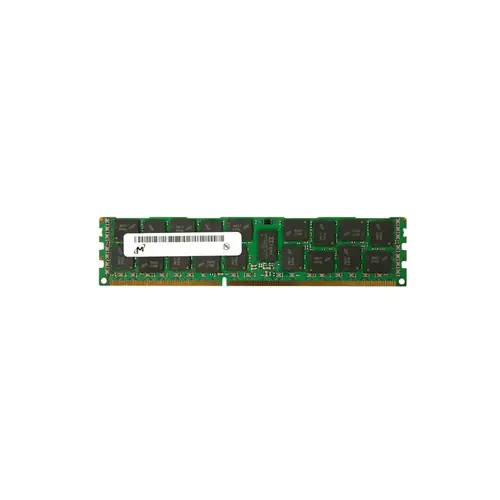
The Micron MT9KSF25672PZ-1G4D1 is a DDR3 Registered ECC RDIMM, purpose-built for server workloads where reliability defines the bottom line. Its four defining characteristics—error correction (ECC), registered buffering, 1.35V low-voltage operation, and a Single Rank x8 design—translate directly into business continuity. In a virtualized cluster consolidating dozens of VMs, ECC actively eliminates single-bit memory corruption caused by background radiation; without it, a silent bit flip could corrupt a hypervisor or guest operating system, causing unexplained application crashes and data rollbacks. Registered signal buffering preserves crisp command and address integrity even when all server DIMM slots are populated, preventing the electrical overshoot and signal degradation that destabilize unbuffered modules during heavy consolidation workloads. The Single Rank x8 architecture imposes a lighter load on the memory controller, delivering consistently tight CL9 latencies that are indispensable for in-memory databases like Redis or SAP HANA, where each microsecond of access delay directly limits transactional throughput. Meanwhile, the 1.35V operating voltage slashes power consumption by roughly 20 percent versus standard 1.5V DDR3, measurably reducing cooling overhead and extending service life in dense data centers. In both hypervisor farms and real-time analytics platforms, this module transforms a simple upgrade into a guarantee of pristine data accuracy and uninterrupted operation.
General Virtualization
This 2GB DDR3-1333 RDIMM operates at a low 1.35V with ECC and registered signaling, making it suitable for legacy hypervisor hosts running light virtual machines. For a basic ESXi or Hyper-V setup, populate at least three identical modules per channel (tri-channel configuration on older Xeon E5/E7 platforms) to maintain balanced memory interleaving and adequate capacity. Aim for a minimum of six modules (12GB total) per server to support a handful of low-resource VMs, but modern virtualization typically demands higher density; consider these modules only for supplementary slots or lab environments where power efficiency matters.
In-Memory Database
In-memory databases like Redis or SAP HANA require absolute data integrity, which the ECC feature of these RDIMMs ensures. With only 2GB per stick, capacity is extremely limited for production datasets, but you can deploy a high module count (e.g., 12 or 16 modules for 24–32GB total) in a single server to host a small, non-critical instance. Strictly observe rank and population rules: single-rank x8 DIMMs can be mixed if identical, but always populate channels symmetrically to avoid performance penalties on memory-intensive workloads.
High-Performance Computing
For HPC clusters built on repurposed DDR3-generation nodes, these low-voltage registered DIMMs help maintain node density within a constrained power envelope. Using 8 to 12 modules per dual-socket server (16–24GB per node) is adequate for lightweight parallel tasks or test development nodes. The CL9 latency and 1333MHz speed offer predictable, if modest, bandwidth; populate all memory channels uniformly with identical RDIMMs to sustain consistent throughput during MPI or OpenMP jobs, reserving any faster slots for future expansion if the board supports mixed speed with throttling.
Rigorously tested, compatible with Dell R720, R620, HP DL380p G8, IBM x3650 M4, Lenovo RD430.
Q: Can I mix this MT9KSF25672PZ-1G4D1 with other memory modules of different brands or speeds?
A: Mixing RDIMMs of different brands or speeds is not advised. It can cause instability, POST failures, or downclocking. For reliable server operation, use identical modules with matching rank, speed, and timings.
Q: Is this memory compatible with my system?
A: This DDR3-1333 ECC Registered DIMM is designed for compatible Intel Xeon E5-2400/E5-2600 v2 or AMD Opteron 6300 series platforms. Verify your server’s manual for ECC RDIMM support and 1.35V dual-voltage operation.
Q: What is the recommended DIMM population order for optimal performance?
A: For optimal performance, populate channels symmetrically per your server board’s guide. Typically, install identical DIMMs in slots of the same color starting from channel 0, balancing ranks across memory controllers.
Q: Does this module support overclocking or XMP profiles?
A: No. This is an enterprise-grade ECC Registered DIMM that strictly adheres to JEDEC DDR3-1333 specifications. Overclocking and XMP are not supported; reliability and data integrity are prioritized.
Q: What warranty and typical failure rate can I expect?
A: This module includes a one-year warranty. Typical annualized failure rates for Micron RDIMMs are below 0.5% under nominal operating conditions, ensuring high reliability for server deployments.