











 Secure payments
Standard refund policy
Trade Assurance
Secure payments
Standard refund policy
Trade Assurance
| Product Type | Memory Module |
|---|---|
| Compliance Standards | RoHS |
| Memory Capacity | 2 GB |
| Memory Technology | DDR3 |
| Product Voltage | 1.5V |
| RAM Speed | 1333MHz |
| RAM Standard | DDR3-1333/PC3-10600 |
| Error Identifying | ECC |
| Signal Type | Registered |
| Column Access Strobe (CAS) | CL9 |
| Rank | Single Rank x4 |
| Quantity of Pins | 240-pin |
| RAM Genre | RDIMM |
This RDIMM is a server-class DDR3-1333 module with ECC and registered signaling, making it ideally suited for virtualization hosts and in-memory database applications where data integrity and stability under heavy, multi-DIMM configurations are critical. Its single-rank x4 organization reduces electrical loading on the memory bus, enabling lower latency at CL9 and more reliable operation when populating all channels in dense server platforms.
1. ECC self-corrects single-bit errors in real time, safeguarding transactional accuracy in database servers that demand 24/7 data integrity.
2. Registered buffering isolates the memory bus from electrical loading, enabling fully populated DIMM slots without signal degradation in dense virtualization clusters.
3. Single Rank x4 keeps per-channel load light, maximizing DIMM-per-channel counts for expansive memory footprints under heavy hypervisor consolidation.
4. 1333MHz operation supplies a steady 10.6 GB/s throughput per channel, delivering predictable bandwidth for latency-sensitive enterprise applications.
5. 1.5V voltage aligns with standard server platforms, ensuring reliable power delivery and consistent thermal profiles in high-density rack deployments.
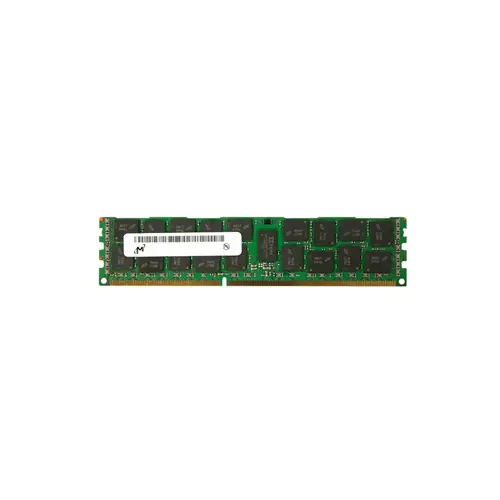
Designed specifically for server environments, the Micron MT18JSF25672PZ-1G4F1 RDIMM is not just another memory module—it is a critical safeguard for your infrastructure. In dense virtualization clusters running multiple virtual machines on a single host, the ECC technology is non-negotiable. It detects and corrects single-bit memory errors caused by background radiation, preventing silent data corruption that could crash multiple VMs and paralyze business operations. Paired with its Registered signal buffering, this RDIMM stabilizes command and address lines even when all 24 slots in a server board are fully populated, making large-scale memory expansion for in-memory databases like Redis or SAP HANA both predictable and reliable. The single-rank x4 organization further optimizes bandwidth efficiency, delivering lower latency under heavy simultaneous read/write loads. That means faster query responses during peak financial transactions and smoother live migrations. With a 1333MHz speed and CL9 latency, every cycle is used intelligently—this module turns raw capacity into truly resilient performance, ensuring your 24/7 services never compromise on data integrity or uptime.
General Virtualization
Populate at least one 2GB RDIMM per memory channel to sustain balanced bandwidth for hypervisor and guest workloads. For light consolidation, install eight identical modules (16GB) across channels; a dual-socket server with 18 slots reaches 36GB, sufficient for several low-resource VMs. Always use symmetric, single-rank x4 DIMM configurations to maintain consistent interleaving and ECC coverage.
In-Memory Database
Maximise capacity by filling every available DIMM slot—a typical dual-socket system with 18 slots yields 36GB using these 2GB RDIMMs. Enable memory mirroring or rank sparing to protect in-memory data structures, accepting reduced usable space for higher resilience. When total node memory is insufficient, cluster multiple hosts and distribute datasets across them.
High-Performance Computing (HPC)
Populate all memory channels uniformly, placing one 2GB RDIMM in each channel (or two per channel where supported) to saturate memory bandwidth per node. Avoid unbalanced configurations to prevent NUMA bottlenecks; identical single-rank modules guarantee predictable latency. Combine many nodes in a cluster to overcome the limited per-module capacity, leveraging aggregate throughput for parallel workloads.
Rigorously tested server memory, compatible with Dell PowerEdge R710/R720, HP ProLiant DL380 G7, and more.
Q: Can I mix this MT18JSF25672PZ-1G4F1 with other memory modules of different brands or speeds?
A: Mixing different brands or speeds is not recommended for registered server memory. It can cause POST failures or signal integrity issues. For guaranteed stability, populate identical Micron RDIMMs with the same part number and rank.
Q: Is this memory compatible with my system?
A: This 240-pin DDR3-1333 RDIMM is designed for dual-processor servers using Intel Xeon 5500/5600 series or AMD Opteron 6100 platforms. Verify your board supports 1.5V registered ECC memory and check the qualified vendor list for MT18JSF25672PZ-1G4F1.
Q: What is the recommended DIMM population order for optimal performance?
A: Populate identical DIMMs per channel in matching slots (typically blue or black connectors) as per your server board manual. Balance memory across all memory channels, using the same single-rank x4 configuration, for best memory bandwidth and interleaving.
Q: Does this module support overclocking or XMP profiles?
A: No. This is a JEDEC-compliant registered server DIMM clocked at 1333MHz with no XMP or overclocking support. It is engineered for 24/7 data integrity and stability in mission-critical environments, not performance tuning.
Q: What warranty and typical failure rate can I expect?
A: This Micron module includes a one-year warranty. In a properly cooled and managed server environment, the annualized failure rate (AFR) is typically well under 0.5%, reflecting stringent enterprise-grade screening and testing.